



Recent from talks
Knowledge base stats:
Talk channels stats:
Members stats:
Food insecurity and hunger in the United States
Food insecurity and hunger in the United States of America affects millions of Americans, including some who are middle class, or who are in households where all adults are in work. The United States produces far more food than it needs for domestic consumption—hunger within the U.S. is caused by some Americans having insufficient money to buy food for themselves or their families. Additional causes of hunger and food insecurity include neighborhood deprivation and agricultural policy. Hunger is addressed by a mix of public and private food aid provision. Public interventions include changes to agricultural policy, the construction of supermarkets in underserved neighborhoods, investment in transportation infrastructure, and the development of community gardens. Private aid is provided by food pantries, soup kitchens, food banks, and food rescue organizations.
Reliance on food banks has led to a rise in obesity and diabetes within the food insecure community. Many foods in food banks are highly processed and low in nutritional value leading to further health effects. One study showed 33% of American households visiting food pantries had diabetes. Food insecure individuals living in low-income communities experience higher rates of chronic disease, leading to healthcare costs and more financial hardships.
Historically, the U.S. was a world leader in reducing hunger both domestically and internationally. In the latter half of the twentieth century, other advanced economies in Europe and Asia began to overtake the U.S. in terms of reducing hunger among their own populations. In 2011, a report presented in the New York Times found that among 20 economies recognized as advanced by the International Monetary Fund and for which comparative rankings for food security were available, the U.S. was joint worst. Nonetheless, in March 2013, the Global Food Security Index ranked the U.S. number one for food affordability and overall food security. The Human Rights Measurement Initiative finds that the US is achieving 87.6% of what should be possible at their income level for fulfilling the right to food.
In 2023, about 13.5 percent of American households were food insecure. Surveys have consistently found much higher levels of food insecurity for students, with a 2019 study finding that over 40% of US undergraduate students experienced food insecurity. Indicators suggested the prevalence of food insecurity for US households approximately doubled during the COVID-19 pandemic, with an especially sharp rise for households with young children.
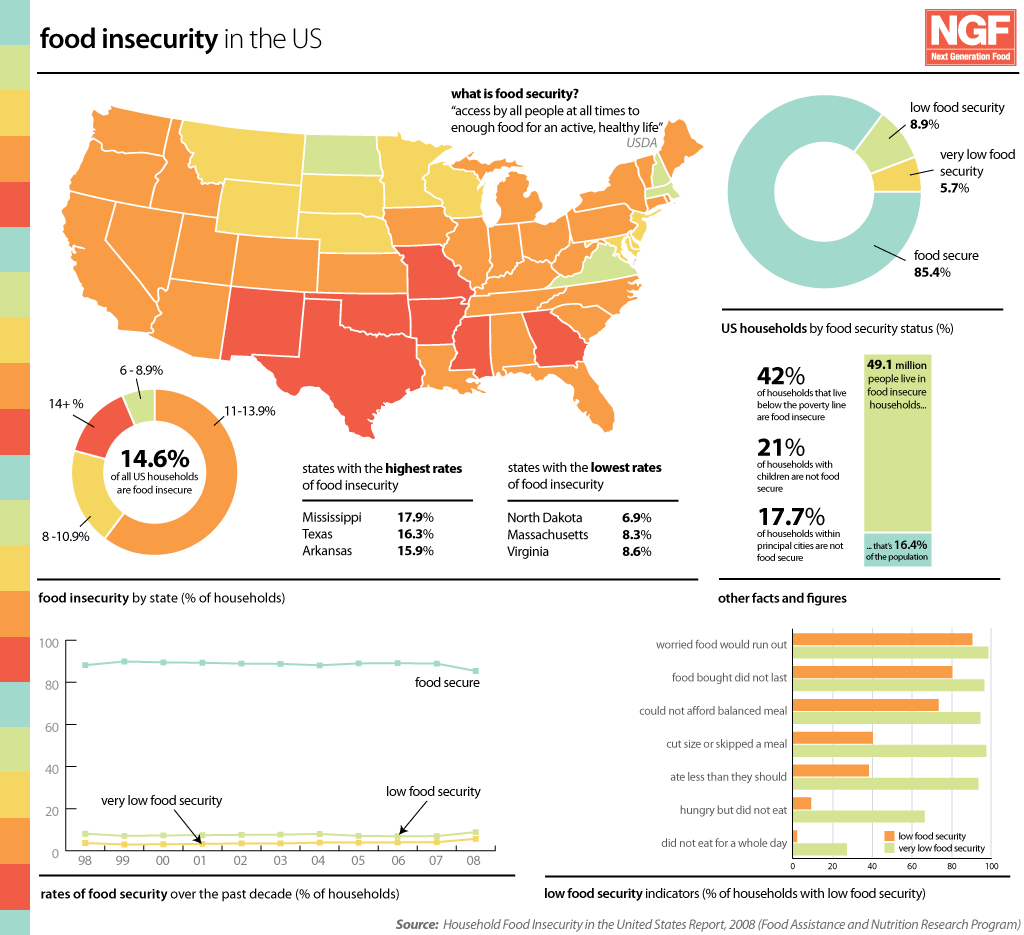
Food insecurity is defined at a household level, of not having adequate food for any household member due to finances. The step beyond this is very low food security, which is having six (for families without children) to eight (for families with children) or more food insecure conditions in the U.S. Department of Agriculture, Food Security Supplement Survey. To be very low food secure means members of the household disrupt their food intake due to financial reasons.
These conditions are many: worrying about running out of food, that food bought does not last, a lack of a balanced diet, adults cutting down portion sizes or out meals entirely, eating less than what they felt they should, being hungry and not eating, unintended weight loss, not eating for whole days (repeatedly), due to financial reasons.
Food insecurity is closely related to poverty but is not mutually exclusive. Food insecurity does not exist in isolation and is just one individual aspect in the multiple factors of social determinants regarding health
According to the United States Department of Agriculture (USDA), food insecurity is "a household-level economic and social condition of limited or uncertain access to adequate food." Hunger is defined as "an individual-level physiological condition that may result from food insecurity."
Hub AI
Food insecurity and hunger in the United States AI simulator
(@Food insecurity and hunger in the United States_simulator)
Food insecurity and hunger in the United States
Food insecurity and hunger in the United States of America affects millions of Americans, including some who are middle class, or who are in households where all adults are in work. The United States produces far more food than it needs for domestic consumption—hunger within the U.S. is caused by some Americans having insufficient money to buy food for themselves or their families. Additional causes of hunger and food insecurity include neighborhood deprivation and agricultural policy. Hunger is addressed by a mix of public and private food aid provision. Public interventions include changes to agricultural policy, the construction of supermarkets in underserved neighborhoods, investment in transportation infrastructure, and the development of community gardens. Private aid is provided by food pantries, soup kitchens, food banks, and food rescue organizations.
Reliance on food banks has led to a rise in obesity and diabetes within the food insecure community. Many foods in food banks are highly processed and low in nutritional value leading to further health effects. One study showed 33% of American households visiting food pantries had diabetes. Food insecure individuals living in low-income communities experience higher rates of chronic disease, leading to healthcare costs and more financial hardships.
Historically, the U.S. was a world leader in reducing hunger both domestically and internationally. In the latter half of the twentieth century, other advanced economies in Europe and Asia began to overtake the U.S. in terms of reducing hunger among their own populations. In 2011, a report presented in the New York Times found that among 20 economies recognized as advanced by the International Monetary Fund and for which comparative rankings for food security were available, the U.S. was joint worst. Nonetheless, in March 2013, the Global Food Security Index ranked the U.S. number one for food affordability and overall food security. The Human Rights Measurement Initiative finds that the US is achieving 87.6% of what should be possible at their income level for fulfilling the right to food.
In 2023, about 13.5 percent of American households were food insecure. Surveys have consistently found much higher levels of food insecurity for students, with a 2019 study finding that over 40% of US undergraduate students experienced food insecurity. Indicators suggested the prevalence of food insecurity for US households approximately doubled during the COVID-19 pandemic, with an especially sharp rise for households with young children.
Food insecurity is defined at a household level, of not having adequate food for any household member due to finances. The step beyond this is very low food security, which is having six (for families without children) to eight (for families with children) or more food insecure conditions in the U.S. Department of Agriculture, Food Security Supplement Survey. To be very low food secure means members of the household disrupt their food intake due to financial reasons.
These conditions are many: worrying about running out of food, that food bought does not last, a lack of a balanced diet, adults cutting down portion sizes or out meals entirely, eating less than what they felt they should, being hungry and not eating, unintended weight loss, not eating for whole days (repeatedly), due to financial reasons.
Food insecurity is closely related to poverty but is not mutually exclusive. Food insecurity does not exist in isolation and is just one individual aspect in the multiple factors of social determinants regarding health
According to the United States Department of Agriculture (USDA), food insecurity is "a household-level economic and social condition of limited or uncertain access to adequate food." Hunger is defined as "an individual-level physiological condition that may result from food insecurity."