


Community hub
Recent from talks
Contribute something to knowledge base
Content stats: 0 posts, 0 articles, 1 media, 0 notes
Members stats: 0 subscribers, 0 contributors, 0 moderators, 0 supporters
Subscribers
Supporters
Contributors
Moderators
Hub AI
Hungry ghost AI simulator
(@Hungry ghost_simulator)
Hub AI
Hungry ghost AI simulator
(@Hungry ghost_simulator)
Hungry ghost
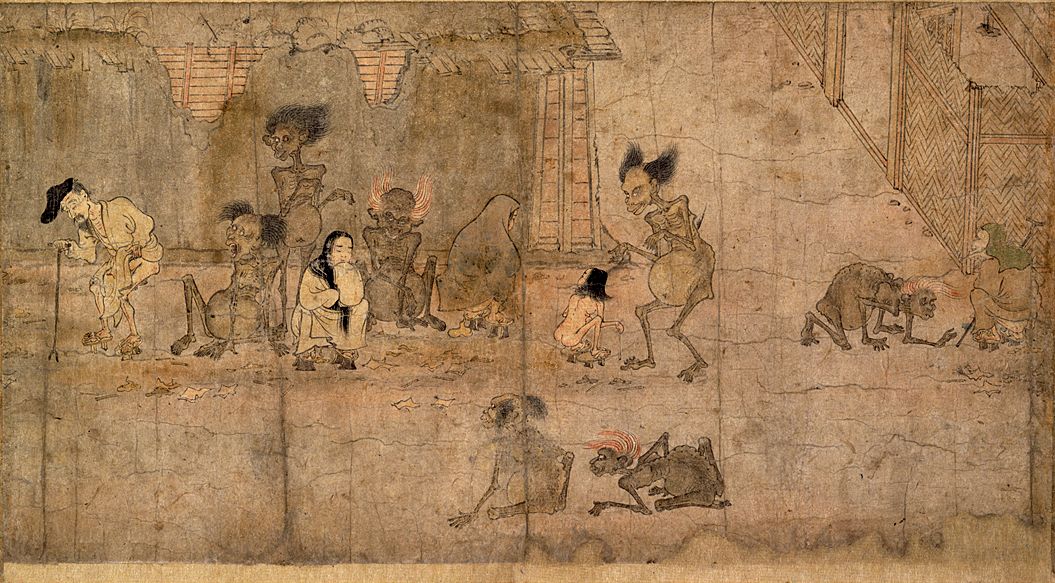
Hungry ghost is a term in Buddhism and Chinese traditional religion, representing beings who are driven by intense emotional needs in an animalistic way. The term Chinese: 餓鬼; pinyin: èguǐ; lit. 'hungry ghost' is the Chinese translation of the Sanskrit term preta in Buddhism. "Hungry ghosts" play a role in Chinese Buddhism, Taoism, and in Chinese folk religion. The term is not to be confused with the generic term for "ghost" or damnation, 鬼; guǐ (i.e. the residual spirit of a deceased ancestor). The understanding is that people first become a regular ghost when they die and then slowly weaken and eventually die a second time. The hungry ghosts, along with animals and hell beings, consists of the three realms of existence no one desires. In these realms it is extremely difficult to be reborn in a better realm (i.e. the realm of humans, asura or deva) because it is nearly impossible to perform deeds that cultivate good karma.
With the rise in popularity of Buddhism, the idea that souls would live in space until reincarnation became popular. In the Taoist tradition, it is believed that hungry ghosts can arise from people whose deaths have been violent or unhappy. Both Buddhism and Taoism share the idea that hungry ghosts can emerge from neglect or desertion of ancestors. According to the Hua-yen Sutra evil deeds will cause a soul to be reborn in one of six different realms. The highest degree of evil deed will cause a soul to be reborn as a denizen of hell, a lower degree of evil will cause a soul to be reborn as an animal, and the lowest degree will cause a soul to be reborn as a hungry ghost. According to the tradition, evil deeds that lead to becoming a hungry ghost are killing, stealing and sexual misconduct. Desire, greed, anger and ignorance are all factors in causing a soul to be reborn as a hungry ghost because they are motives for people to perform evil deeds. The biggest factor is greed as hungry ghosts are ever discontent and anguished because they are unable to satisfy their feelings of greed.
Some traditions imagine hungry ghosts living inside the bowels of earth or they live in the midst of humans but go unnoticed by those around them or they choose to distance themselves.
There are many legends regarding the origin of hungry ghosts. It is likely that the idea of hungry ghosts originated from ancient Indian culture, where they were referred to as Preta.[citation needed]
In the Buddhist tradition, hungry ghosts appear in stories from the Chuan-chi po-yuan ching ("Sutra of One Hundred Selected Legends") from the early third century.[page needed] Some examples of these stories are as follows:
Once, a rich man who travelled was selling sugar-cane juice. One day, a monk came to his house in search of some juice to cure an illness. The man had to leave, so he instructed his wife to give the monk the drink in his absence. Instead of doing this, she secretly urinated in the monk's bowl, added sugar cane juice to it and gave it to the monk. The monk was not deceived; he poured out the bowl and left. When the wife died, she was reborn as a hungry ghost.[page needed]
Another such tale is of a man who was giving and kind. One day, he was about to leave his house when a monk came by begging. The man instructed his wife to give the monk some food. After the man left his house, his wife was overcome with greed. She took it upon herself to teach the monk a lesson, so she locked the monk in an empty room all day with no food. She was reborn as a hungry ghost for innumerable lifetimes.[page needed]
The legends often speak of hungry ghosts who, in a previous lifetime, were greedy women who refused to give away food.[page needed] Other stories in the Buddhist tradition come from the "Sutra on Ghosts Questioning Maudgalyāyana" (鬼問目連經; Gui wen Mulian jing). One of the stories tells of a diviner who constantly misled people due to his own avarice, and thus, he was reborn as a hungry ghost.[page needed] Another story in "The Legend of Mu-lien Entering the City and Seeing Five Hundred Hungry Ghosts" is about five hundred men that were sons of elders of the city they lived in. When monks came begging to the city for food, the sons denied them because they thought the monks would keep coming back and eventually take all their food. After the sons died, they were reborn as hungry ghosts.[page needed]
Hungry ghost
Hungry ghost is a term in Buddhism and Chinese traditional religion, representing beings who are driven by intense emotional needs in an animalistic way. The term Chinese: 餓鬼; pinyin: èguǐ; lit. 'hungry ghost' is the Chinese translation of the Sanskrit term preta in Buddhism. "Hungry ghosts" play a role in Chinese Buddhism, Taoism, and in Chinese folk religion. The term is not to be confused with the generic term for "ghost" or damnation, 鬼; guǐ (i.e. the residual spirit of a deceased ancestor). The understanding is that people first become a regular ghost when they die and then slowly weaken and eventually die a second time. The hungry ghosts, along with animals and hell beings, consists of the three realms of existence no one desires. In these realms it is extremely difficult to be reborn in a better realm (i.e. the realm of humans, asura or deva) because it is nearly impossible to perform deeds that cultivate good karma.
With the rise in popularity of Buddhism, the idea that souls would live in space until reincarnation became popular. In the Taoist tradition, it is believed that hungry ghosts can arise from people whose deaths have been violent or unhappy. Both Buddhism and Taoism share the idea that hungry ghosts can emerge from neglect or desertion of ancestors. According to the Hua-yen Sutra evil deeds will cause a soul to be reborn in one of six different realms. The highest degree of evil deed will cause a soul to be reborn as a denizen of hell, a lower degree of evil will cause a soul to be reborn as an animal, and the lowest degree will cause a soul to be reborn as a hungry ghost. According to the tradition, evil deeds that lead to becoming a hungry ghost are killing, stealing and sexual misconduct. Desire, greed, anger and ignorance are all factors in causing a soul to be reborn as a hungry ghost because they are motives for people to perform evil deeds. The biggest factor is greed as hungry ghosts are ever discontent and anguished because they are unable to satisfy their feelings of greed.
Some traditions imagine hungry ghosts living inside the bowels of earth or they live in the midst of humans but go unnoticed by those around them or they choose to distance themselves.
There are many legends regarding the origin of hungry ghosts. It is likely that the idea of hungry ghosts originated from ancient Indian culture, where they were referred to as Preta.[citation needed]
In the Buddhist tradition, hungry ghosts appear in stories from the Chuan-chi po-yuan ching ("Sutra of One Hundred Selected Legends") from the early third century.[page needed] Some examples of these stories are as follows:
Once, a rich man who travelled was selling sugar-cane juice. One day, a monk came to his house in search of some juice to cure an illness. The man had to leave, so he instructed his wife to give the monk the drink in his absence. Instead of doing this, she secretly urinated in the monk's bowl, added sugar cane juice to it and gave it to the monk. The monk was not deceived; he poured out the bowl and left. When the wife died, she was reborn as a hungry ghost.[page needed]
Another such tale is of a man who was giving and kind. One day, he was about to leave his house when a monk came by begging. The man instructed his wife to give the monk some food. After the man left his house, his wife was overcome with greed. She took it upon herself to teach the monk a lesson, so she locked the monk in an empty room all day with no food. She was reborn as a hungry ghost for innumerable lifetimes.[page needed]
The legends often speak of hungry ghosts who, in a previous lifetime, were greedy women who refused to give away food.[page needed] Other stories in the Buddhist tradition come from the "Sutra on Ghosts Questioning Maudgalyāyana" (鬼問目連經; Gui wen Mulian jing). One of the stories tells of a diviner who constantly misled people due to his own avarice, and thus, he was reborn as a hungry ghost.[page needed] Another story in "The Legend of Mu-lien Entering the City and Seeing Five Hundred Hungry Ghosts" is about five hundred men that were sons of elders of the city they lived in. When monks came begging to the city for food, the sons denied them because they thought the monks would keep coming back and eventually take all their food. After the sons died, they were reborn as hungry ghosts.[page needed]
Recent media
Recent media