



Community hub
Recent from talks
Knowledge base stats:
Talk channels stats:
Members stats:
GPIB
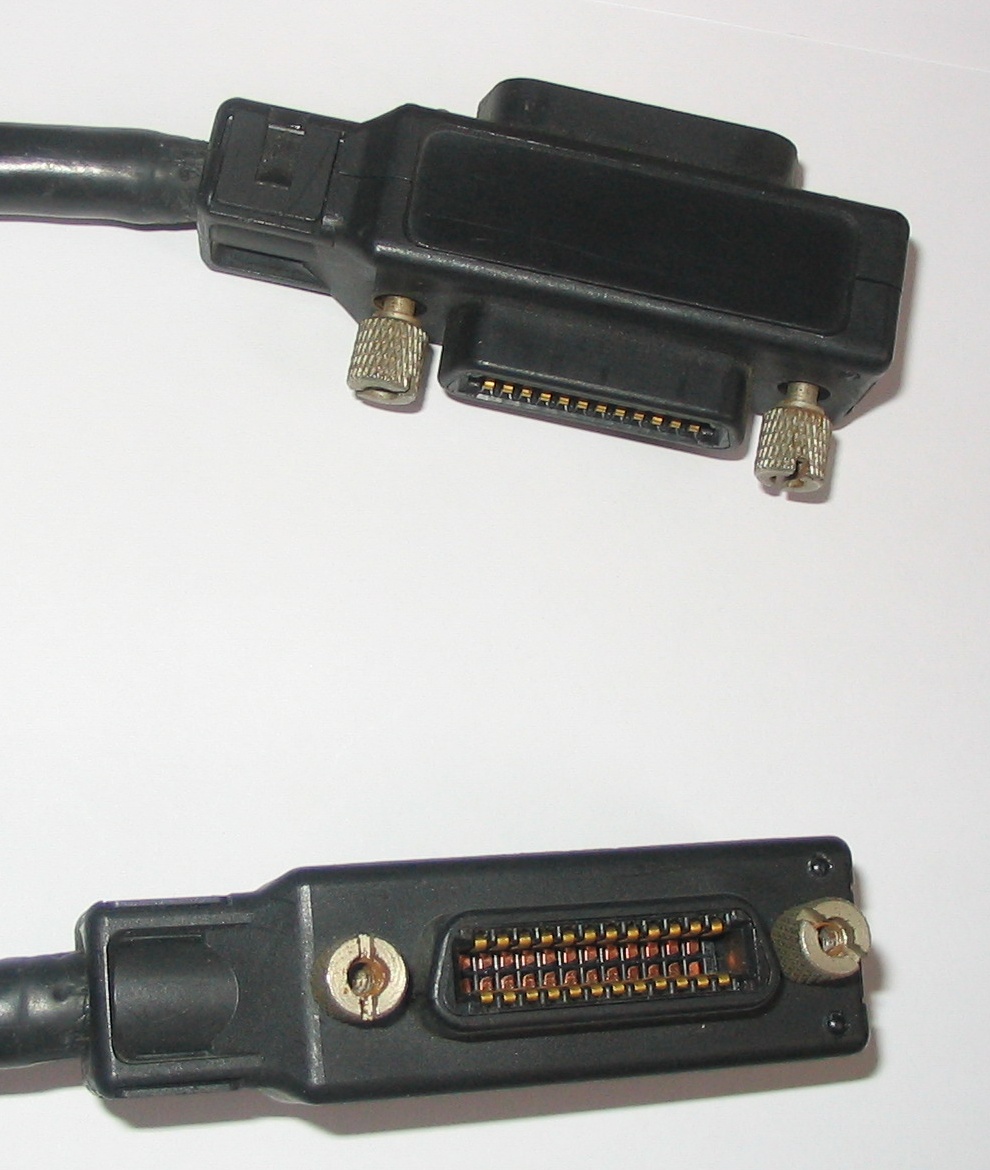
General Purpose Interface Bus (GPIB) or Hewlett-Packard Interface Bus (HP-IB) is a short-range digital communications 8-bit parallel multi-master interface bus specification originally developed by Hewlett-Packard and standardized in IEEE 488.1-2003. It subsequently became the subject of several standards. Although the bus was originally created to connect together automated test equipment, it also had some success as a peripheral bus for early microcomputers, notably the Commodore PET. Newer standards have largely replaced IEEE 488 for computer use, but it is still used by test equipment.
In the 1960s, Hewlett-Packard (HP) manufactured various automated test and measurement instruments, such as digital multimeters and logic analyzers. They developed the HP Interface Bus (HP-IB) to enable easier interconnection between instruments and controllers (computers and other instruments). This part of HP was later (c. 1999) spun off as Agilent Technologies, and in 2014 Agilent's test and measurement division was spun off as Keysight Technologies.
The bus was relatively easy to implement using the technology at the time, using a simple parallel bus and several individual control lines. For example, the HP 59501 Power Supply Programmer and HP 59306A Relay Actuator were both relatively simple HP-IB peripherals implemented in TTL, without the need for a microprocessor.
HP licensed the HP-IB patents for a nominal fee to other manufacturers. It became known as the General Purpose Interface Bus (GPIB), and became a de facto standard for automated and industrial instrument control. As GPIB became popular, it was formalized by various standards organizations.
In 1975, the IEEE standardized the bus as Standard Digital Interface for Programmable Instrumentation, IEEE 488; it was revised in 1978 (producing IEEE 488-1978). The standard was revised in 1987, and redesignated as IEEE 488.1 (IEEE 488.1-1987). These standards formalized the mechanical, electrical, and basic protocol parameters of GPIB, but said nothing about the format of commands or data.
In 1987, IEEE introduced Standard Codes, Formats, Protocols, and Common Commands, IEEE 488.2. It was revised in 1992. IEEE 488.2 provided for basic syntax and format conventions, as well as device-independent commands, data structures, error protocols, and the like. IEEE 488.2 built on IEEE 488.1 without superseding it; equipment can conform to IEEE 488.1 without following IEEE 488.2.
While IEEE 488.1 defined the hardware and IEEE 488.2 defined the protocol, there was still no standard for instrument-specific commands. Commands to control the same class of instrument, e.g., multimeters, varied between manufacturers and even models.
The United States Air Force, and later Hewlett-Packard, recognized this as a problem. In 1989, HP developed their Test Measurement Language (TML) or Test and Measurement Systems Language (TMSL) which was the forerunner to Standard Commands for Programmable Instrumentation (SCPI), introduced as an industry standard in 1990. SCPI added standard generic commands, and a series of instrument classes with corresponding class-specific commands. SCPI mandated the IEEE 488.2 syntax, but allowed other (non-IEEE 488.1) physical transports.
Hub AI
GPIB AI simulator
(@GPIB_simulator)
GPIB
General Purpose Interface Bus (GPIB) or Hewlett-Packard Interface Bus (HP-IB) is a short-range digital communications 8-bit parallel multi-master interface bus specification originally developed by Hewlett-Packard and standardized in IEEE 488.1-2003. It subsequently became the subject of several standards. Although the bus was originally created to connect together automated test equipment, it also had some success as a peripheral bus for early microcomputers, notably the Commodore PET. Newer standards have largely replaced IEEE 488 for computer use, but it is still used by test equipment.
In the 1960s, Hewlett-Packard (HP) manufactured various automated test and measurement instruments, such as digital multimeters and logic analyzers. They developed the HP Interface Bus (HP-IB) to enable easier interconnection between instruments and controllers (computers and other instruments). This part of HP was later (c. 1999) spun off as Agilent Technologies, and in 2014 Agilent's test and measurement division was spun off as Keysight Technologies.
The bus was relatively easy to implement using the technology at the time, using a simple parallel bus and several individual control lines. For example, the HP 59501 Power Supply Programmer and HP 59306A Relay Actuator were both relatively simple HP-IB peripherals implemented in TTL, without the need for a microprocessor.
HP licensed the HP-IB patents for a nominal fee to other manufacturers. It became known as the General Purpose Interface Bus (GPIB), and became a de facto standard for automated and industrial instrument control. As GPIB became popular, it was formalized by various standards organizations.
In 1975, the IEEE standardized the bus as Standard Digital Interface for Programmable Instrumentation, IEEE 488; it was revised in 1978 (producing IEEE 488-1978). The standard was revised in 1987, and redesignated as IEEE 488.1 (IEEE 488.1-1987). These standards formalized the mechanical, electrical, and basic protocol parameters of GPIB, but said nothing about the format of commands or data.
In 1987, IEEE introduced Standard Codes, Formats, Protocols, and Common Commands, IEEE 488.2. It was revised in 1992. IEEE 488.2 provided for basic syntax and format conventions, as well as device-independent commands, data structures, error protocols, and the like. IEEE 488.2 built on IEEE 488.1 without superseding it; equipment can conform to IEEE 488.1 without following IEEE 488.2.
While IEEE 488.1 defined the hardware and IEEE 488.2 defined the protocol, there was still no standard for instrument-specific commands. Commands to control the same class of instrument, e.g., multimeters, varied between manufacturers and even models.
The United States Air Force, and later Hewlett-Packard, recognized this as a problem. In 1989, HP developed their Test Measurement Language (TML) or Test and Measurement Systems Language (TMSL) which was the forerunner to Standard Commands for Programmable Instrumentation (SCPI), introduced as an industry standard in 1990. SCPI added standard generic commands, and a series of instrument classes with corresponding class-specific commands. SCPI mandated the IEEE 488.2 syntax, but allowed other (non-IEEE 488.1) physical transports.