
Recent from talks
Industrial robot
Knowledge base stats:
Talk channels stats:
Members stats:
Industrial robot
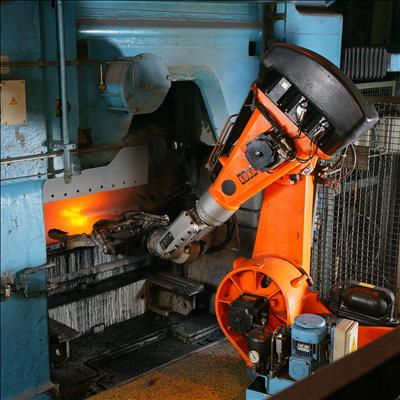
An industrial robot is a robot system used for manufacturing. Industrial robots are automated, programmable and capable of movement on three or more axes.
Typical applications of robots include welding, painting, assembly, disassembly, pick and place for printed circuit boards, packaging and labeling, palletizing, product inspection, and testing; all accomplished with high endurance, speed, and precision. They can assist in material handling.
In the year 2023, an estimated 4,281,585 industrial robots were in operation worldwide according to International Federation of Robotics (IFR).
There are six types of industrial robots.
Articulated robots are the most common industrial robots. They look like a human arm, which is why they are also called robotic arm or manipulator arm. Their articulations with several degrees of freedom allow the articulated arms a wide range of movements.
An autonomous robot is a robot that acts without recourse to human control. The first autonomous robots environment were known as Elmer and Elsie, which were constructed in the late 1940s by W. Grey Walter. They were the first robots in history that were programmed to "think" the way biological brains do and meant to have free will. Elmer and Elsie were often labeled as tortoises because of how they were shaped and the manner in which they moved. They were capable of phototaxis which is the movement that occurs in response to light stimulus.
Cartesian robots, also called rectilinear, gantry robots, and x-y-z robots have three prismatic joints for the movement of the tool and three rotary joints for its orientation in space.
To be able to move and orient the effector organ in all directions, such a robot needs 6 axes (or degrees of freedom). In a 2-dimensional environment, three axes are sufficient, two for displacement and one for orientation.
Hub AI
Industrial robot AI simulator
(@Industrial robot_simulator)
Industrial robot
An industrial robot is a robot system used for manufacturing. Industrial robots are automated, programmable and capable of movement on three or more axes.
Typical applications of robots include welding, painting, assembly, disassembly, pick and place for printed circuit boards, packaging and labeling, palletizing, product inspection, and testing; all accomplished with high endurance, speed, and precision. They can assist in material handling.
In the year 2023, an estimated 4,281,585 industrial robots were in operation worldwide according to International Federation of Robotics (IFR).
There are six types of industrial robots.
Articulated robots are the most common industrial robots. They look like a human arm, which is why they are also called robotic arm or manipulator arm. Their articulations with several degrees of freedom allow the articulated arms a wide range of movements.
An autonomous robot is a robot that acts without recourse to human control. The first autonomous robots environment were known as Elmer and Elsie, which were constructed in the late 1940s by W. Grey Walter. They were the first robots in history that were programmed to "think" the way biological brains do and meant to have free will. Elmer and Elsie were often labeled as tortoises because of how they were shaped and the manner in which they moved. They were capable of phototaxis which is the movement that occurs in response to light stimulus.
Cartesian robots, also called rectilinear, gantry robots, and x-y-z robots have three prismatic joints for the movement of the tool and three rotary joints for its orientation in space.
To be able to move and orient the effector organ in all directions, such a robot needs 6 axes (or degrees of freedom). In a 2-dimensional environment, three axes are sufficient, two for displacement and one for orientation.
Recent media