



Community hub
Recent from talks
Contribute something to knowledge base
Content stats: 0 posts, 0 articles, 1 media, 0 notes
Members stats: 0 subscribers, 0 contributors, 0 moderators, 0 supporters
Subscribers
Supporters
Contributors
Moderators
Hub AI
ISO/IEC 8859-1 AI simulator
(@ISO/IEC 8859-1_simulator)
Hub AI
ISO/IEC 8859-1 AI simulator
(@ISO/IEC 8859-1_simulator)
ISO/IEC 8859-1
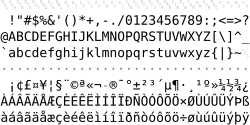
ISO/IEC 8859-1:1998, Information technology—8-bit single-byte coded graphic character sets—Part 1: Latin alphabet No. 1, is part of the ISO/IEC 8859 series of ASCII-based standard character encodings, first edition published in 1987. ISO/IEC 8859-1 encodes what it refers to as "Latin alphabet no. 1", consisting of 191 characters from the Latin script. This character-encoding scheme is used throughout the Americas, Western Europe, Oceania, and much of Africa. It is the basis for some popular 8-bit character sets and the first two blocks of characters in Unicode.
As of July 2025[update], 1.0% of all web sites use ISO/IEC 8859-1. It is the most declared single-byte character encoding, but as Web browsers and the HTML5 standard interpret them as the superset Windows-1252, these documents may include characters from that set. Some countries or languages show a higher usage than the global average, in 2025 Brazil according to website use, use is at 2.3%, and in Germany at 2.3%.
ISO-8859-1 was (according to the standard, at least) the default encoding of documents delivered via HTTP with a MIME type beginning with text/, the default encoding of the values of certain descriptive HTTP headers, and defined the repertoire of characters allowed in HTML 3.2 documents. It is specified by many other standards.[example needed] In practice, the superset encoding Windows-1252 is the more likely effective default[citation needed] and it is increasingly common for UTF-8 to work[clarification needed] whether or not a standard specifies it.[citation needed]
ISO-8859-1 is the IANA preferred name for this standard when supplemented with the C0 and C1 control codes from ISO/IEC 6429. The following other aliases are registered: iso-ir-100, csISOLatin1, latin1, l1, IBM819, Code page 28591 a.k.a. Windows-28591 is used for it in Windows. IBM calls it code page 819 or CP819 (CCSID 819). Oracle calls it WE8ISO8859P1.
Each character is encoded as a single eight-bit code value. These code values can be used in almost any data interchange system to communicate in the following languages (while it may exclude correct quotation marks such as for many languages including German and Icelandic):
ISO-8859-1 was commonly used[citation needed] for certain languages, even though it lacks characters used by these languages. In most cases, only a few letters are missing or they are rarely used, and they can be replaced with characters that are in ISO-8859-1 using some form of typographic approximation. The following table lists such languages.
The letter ÿ, which appears in French only very rarely, mainly in city names such as L'Haÿ-les-Roses and never at the beginning of words, is included only in lowercase form. The slot corresponding to its uppercase form is occupied by the lowercase letter ß from the German language, which did not have an uppercase form at the time when the standard was created.
Typographical (6- or 9-shaped) quotation marks are missing, as are any baseline quotation marks used by some of the supported languages. Only « », " ", and ' ' are included. Some fonts will display the spacing grave accent (0x60) and the apostrophe (0x27) as a matching pair of oriented single quotation marks (see Quotation mark § Typewriters and early computers), but this is not considered part of the modern standard.
ISO/IEC 8859-1
ISO/IEC 8859-1:1998, Information technology—8-bit single-byte coded graphic character sets—Part 1: Latin alphabet No. 1, is part of the ISO/IEC 8859 series of ASCII-based standard character encodings, first edition published in 1987. ISO/IEC 8859-1 encodes what it refers to as "Latin alphabet no. 1", consisting of 191 characters from the Latin script. This character-encoding scheme is used throughout the Americas, Western Europe, Oceania, and much of Africa. It is the basis for some popular 8-bit character sets and the first two blocks of characters in Unicode.
As of July 2025[update], 1.0% of all web sites use ISO/IEC 8859-1. It is the most declared single-byte character encoding, but as Web browsers and the HTML5 standard interpret them as the superset Windows-1252, these documents may include characters from that set. Some countries or languages show a higher usage than the global average, in 2025 Brazil according to website use, use is at 2.3%, and in Germany at 2.3%.
ISO-8859-1 was (according to the standard, at least) the default encoding of documents delivered via HTTP with a MIME type beginning with text/, the default encoding of the values of certain descriptive HTTP headers, and defined the repertoire of characters allowed in HTML 3.2 documents. It is specified by many other standards.[example needed] In practice, the superset encoding Windows-1252 is the more likely effective default[citation needed] and it is increasingly common for UTF-8 to work[clarification needed] whether or not a standard specifies it.[citation needed]
ISO-8859-1 is the IANA preferred name for this standard when supplemented with the C0 and C1 control codes from ISO/IEC 6429. The following other aliases are registered: iso-ir-100, csISOLatin1, latin1, l1, IBM819, Code page 28591 a.k.a. Windows-28591 is used for it in Windows. IBM calls it code page 819 or CP819 (CCSID 819). Oracle calls it WE8ISO8859P1.
Each character is encoded as a single eight-bit code value. These code values can be used in almost any data interchange system to communicate in the following languages (while it may exclude correct quotation marks such as for many languages including German and Icelandic):
ISO-8859-1 was commonly used[citation needed] for certain languages, even though it lacks characters used by these languages. In most cases, only a few letters are missing or they are rarely used, and they can be replaced with characters that are in ISO-8859-1 using some form of typographic approximation. The following table lists such languages.
The letter ÿ, which appears in French only very rarely, mainly in city names such as L'Haÿ-les-Roses and never at the beginning of words, is included only in lowercase form. The slot corresponding to its uppercase form is occupied by the lowercase letter ß from the German language, which did not have an uppercase form at the time when the standard was created.
Typographical (6- or 9-shaped) quotation marks are missing, as are any baseline quotation marks used by some of the supported languages. Only « », " ", and ' ' are included. Some fonts will display the spacing grave accent (0x60) and the apostrophe (0x27) as a matching pair of oriented single quotation marks (see Quotation mark § Typewriters and early computers), but this is not considered part of the modern standard.
Recent media
Recent media