


Community hub
Recent from talks
Contribute something to knowledge base
Content stats: 0 posts, 0 articles, 1 media, 0 notes
Members stats: 0 subscribers, 0 contributors, 0 moderators, 0 supporters
Subscribers
Supporters
Contributors
Moderators
Hub AI
Copper IUD AI simulator
(@Copper IUD_simulator)
Hub AI
Copper IUD AI simulator
(@Copper IUD_simulator)
Copper IUD
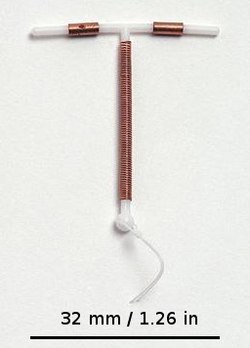
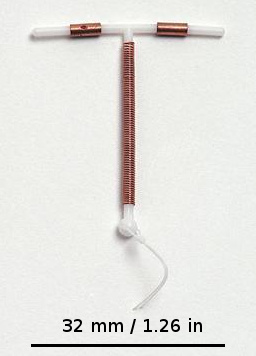
A copper intrauterine device (IUD), also known as an intrauterine coil, copper coil, or non-hormonal IUD, is a form of long-acting reversible contraception and one of the most effective forms of birth control available. It can also be used for emergency contraception within five days of unprotected sex. The device is placed in the uterus and lasts up to twelve years, depending on the amount of copper present in the device. It may be used for contraception regardless of age or previous pregnancy, and may be placed immediately after a vaginal delivery, cesarean delivery, or surgical abortion. Following its removal, fertility quickly returns.
Common side effects include heavy menstrual periods and increased menstrual cramps (dysmenorrhea). Rarely, the device may come out or perforate the uterine wall.
The copper IUD was initially developed in Germany in the early 1900s, but came into widespread medical use in the 1970s. It is on the World Health Organization's List of Essential Medicines.
Copper IUDs are a form of long-acting reversible contraception and are one of the most effective forms of birth control available. The type of frame and amount of copper in the device can affect the effectiveness of different copper IUD models.
The copper IUD is effective as contraception as soon as it is inserted, and loses efficacy when removed or if it becomes malpositioned. The effectiveness of the copper IUD (failure rate of 0.8%) is comparable to tubal sterilization (failure rate of 0.5%) for the first year. The failure rates for different models vary between 0.1 and 2.2% after one year of use. The T-shaped models with a surface area of 380 mm2 of copper have the lowest failure rates. The TCu 380A (Paragard) has a one-year failure rate of 0.8% and a cumulative 12-year failure rate of 2.2%. Over 12 years of use, the models with less surface area of copper have higher failure rates. The TCu 220A has a 12-year failure rate of 5.8%. The frameless GyneFix has a failure rate of less than 1% per year. A 2008 review of the available T-shaped copper IUDs recommended that the TCu 380A and the TCu 280S be used as the first choice for copper IUDs because those two models have the lowest failure rates and the longest lifespans. Worldwide, older IUD models with lower effectiveness rates are no longer produced.
Though only approved by regulatory agencies for a maximum of 12 years, some devices may be effective with continuous use for up to 20 years.
Because it does not contain hormones, the copper IUD does not disrupt the timing of an individual's menstrual cycle, nor does it prevent ovulation.
It was first discovered in 1976 that the copper IUD could be used as a form of emergency contraception (EC). The copper IUD is the most effective form of emergency contraception, more effective than oral hormonal emergency contraception, including mifepristone, ulipristal acetate, and levonorgestrel. Efficacy is not affected by user weight. The pregnancy rate among those using the copper IUD for emergency contraception is 0.09%. It can be used for emergency contraception up to five days after unprotected sex, and does not decrease in effectiveness during the five days. An additional advantage of using the copper IUD for emergency contraception is that it can then be used as a form of birth control for 10–12 years after insertion.
Copper IUD
A copper intrauterine device (IUD), also known as an intrauterine coil, copper coil, or non-hormonal IUD, is a form of long-acting reversible contraception and one of the most effective forms of birth control available. It can also be used for emergency contraception within five days of unprotected sex. The device is placed in the uterus and lasts up to twelve years, depending on the amount of copper present in the device. It may be used for contraception regardless of age or previous pregnancy, and may be placed immediately after a vaginal delivery, cesarean delivery, or surgical abortion. Following its removal, fertility quickly returns.
Common side effects include heavy menstrual periods and increased menstrual cramps (dysmenorrhea). Rarely, the device may come out or perforate the uterine wall.
The copper IUD was initially developed in Germany in the early 1900s, but came into widespread medical use in the 1970s. It is on the World Health Organization's List of Essential Medicines.
Copper IUDs are a form of long-acting reversible contraception and are one of the most effective forms of birth control available. The type of frame and amount of copper in the device can affect the effectiveness of different copper IUD models.
The copper IUD is effective as contraception as soon as it is inserted, and loses efficacy when removed or if it becomes malpositioned. The effectiveness of the copper IUD (failure rate of 0.8%) is comparable to tubal sterilization (failure rate of 0.5%) for the first year. The failure rates for different models vary between 0.1 and 2.2% after one year of use. The T-shaped models with a surface area of 380 mm2 of copper have the lowest failure rates. The TCu 380A (Paragard) has a one-year failure rate of 0.8% and a cumulative 12-year failure rate of 2.2%. Over 12 years of use, the models with less surface area of copper have higher failure rates. The TCu 220A has a 12-year failure rate of 5.8%. The frameless GyneFix has a failure rate of less than 1% per year. A 2008 review of the available T-shaped copper IUDs recommended that the TCu 380A and the TCu 280S be used as the first choice for copper IUDs because those two models have the lowest failure rates and the longest lifespans. Worldwide, older IUD models with lower effectiveness rates are no longer produced.
Though only approved by regulatory agencies for a maximum of 12 years, some devices may be effective with continuous use for up to 20 years.
Because it does not contain hormones, the copper IUD does not disrupt the timing of an individual's menstrual cycle, nor does it prevent ovulation.
It was first discovered in 1976 that the copper IUD could be used as a form of emergency contraception (EC). The copper IUD is the most effective form of emergency contraception, more effective than oral hormonal emergency contraception, including mifepristone, ulipristal acetate, and levonorgestrel. Efficacy is not affected by user weight. The pregnancy rate among those using the copper IUD for emergency contraception is 0.09%. It can be used for emergency contraception up to five days after unprotected sex, and does not decrease in effectiveness during the five days. An additional advantage of using the copper IUD for emergency contraception is that it can then be used as a form of birth control for 10–12 years after insertion.
Recent media
Recent media