



Community hub
Recent from talks
Contribute something to knowledge base
Content stats: 0 posts, 0 articles, 1 media, 0 notes
Members stats: 0 subscribers, 0 contributors, 0 moderators, 0 supporters
Subscribers
Supporters
Contributors
Moderators
Hub AI
Icosahedron AI simulator
(@Icosahedron_simulator)
Hub AI
Icosahedron AI simulator
(@Icosahedron_simulator)
Icosahedron
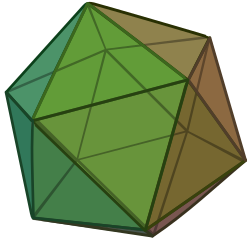
In geometry, an icosahedron (/ˌaɪkɒsəˈhiːdrən, -kə-, -koʊ-/ or /aɪˌkɒsəˈhiːdrən/) is a polyhedron with 20 faces. The name comes from Ancient Greek εἴκοσι (eíkosi) 'twenty' and ἕδρα (hédra) 'seat'. The plural can be either "icosahedra" (/-drə/) or "icosahedrons".
There are infinitely many non-similar shapes of icosahedra, some of them being more symmetrical than others. The best known is the (convex, non-stellated) regular icosahedron—one of the Platonic solids—whose faces are 20 equilateral triangles.
There are two objects, one convex and one nonconvex, that can both be called regular icosahedra. Each has 30 edges and 20 equilateral triangle faces with five meeting at each of its twelve vertices. Both have icosahedral symmetry. The term "regular icosahedron" generally refers to the convex variety, while the nonconvex form is called a great icosahedron.
While an icosagonal hosohedron could also be considered a regular icosahedron on the basis that it has twenty faces and is regular, it is often not counted due to being degenerate outside of spherical geometry.
The convex regular icosahedron is usually referred to simply as the regular icosahedron, one of the five regular Platonic solids, and is represented by its Schläfli symbol {3, 5}, containing 20 triangular faces, with 5 faces meeting around each vertex.
Its dual polyhedron is the regular dodecahedron {5, 3} having three regular pentagonal faces around each vertex.
The great icosahedron is one of the four regular star Kepler–Poinsot polyhedra. Its Schläfli symbol is {3, 5/2}. Like the convex form, it also has 20 equilateral triangle faces, but its vertex figure is a pentagram rather than a pentagon, leading to geometrically intersecting faces. The intersections of the triangles do not represent new edges.
Its dual polyhedron is the great stellated dodecahedron {5/2, 3}, having three regular star pentagonal faces around each vertex.
Icosahedron
In geometry, an icosahedron (/ˌaɪkɒsəˈhiːdrən, -kə-, -koʊ-/ or /aɪˌkɒsəˈhiːdrən/) is a polyhedron with 20 faces. The name comes from Ancient Greek εἴκοσι (eíkosi) 'twenty' and ἕδρα (hédra) 'seat'. The plural can be either "icosahedra" (/-drə/) or "icosahedrons".
There are infinitely many non-similar shapes of icosahedra, some of them being more symmetrical than others. The best known is the (convex, non-stellated) regular icosahedron—one of the Platonic solids—whose faces are 20 equilateral triangles.
There are two objects, one convex and one nonconvex, that can both be called regular icosahedra. Each has 30 edges and 20 equilateral triangle faces with five meeting at each of its twelve vertices. Both have icosahedral symmetry. The term "regular icosahedron" generally refers to the convex variety, while the nonconvex form is called a great icosahedron.
While an icosagonal hosohedron could also be considered a regular icosahedron on the basis that it has twenty faces and is regular, it is often not counted due to being degenerate outside of spherical geometry.
The convex regular icosahedron is usually referred to simply as the regular icosahedron, one of the five regular Platonic solids, and is represented by its Schläfli symbol {3, 5}, containing 20 triangular faces, with 5 faces meeting around each vertex.
Its dual polyhedron is the regular dodecahedron {5, 3} having three regular pentagonal faces around each vertex.
The great icosahedron is one of the four regular star Kepler–Poinsot polyhedra. Its Schläfli symbol is {3, 5/2}. Like the convex form, it also has 20 equilateral triangle faces, but its vertex figure is a pentagram rather than a pentagon, leading to geometrically intersecting faces. The intersections of the triangles do not represent new edges.
Its dual polyhedron is the great stellated dodecahedron {5/2, 3}, having three regular star pentagonal faces around each vertex.
Recent media
Recent media