



Community hub
Recent from talks
Knowledge base stats:
Talk channels stats:
Members stats:
Idli
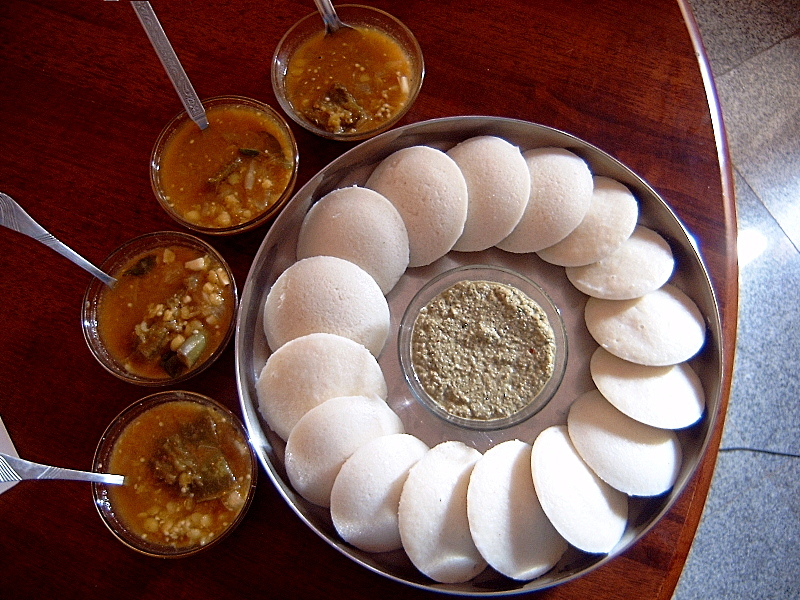
Idli or idly (/ˈɪdliː/; plural: idlis) is a type of savoury rice cake, originating from South India, popular as a breakfast food in India and in Sri Lanka. The cakes are made by steaming a batter consisting of fermented de-husked black lentils and rice. The fermentation process breaks down the starches so that they are more readily metabolised by the body.
Idli has several variations, including rava idli, which is made from semolina. Regional variants include sanna of Konkan.
A precursor of the modern idli is mentioned in several ancient Indian works. Vaddaradhane, a 920 CE Kannada language work by Shivakotiacharya, mentions "iddalige", prepared only from a black gram batter. Chavundaraya II, the author of the earliest available Kannada encyclopedia, Lokopakara (c.1025 CE), describes the preparation of this food by soaking black gram in buttermilk, ground to a fine paste, and mixed with the clear water of curd and spices. The Western Chalukya king and scholar Someshwara III, reigning in the area now called Karnataka, included an idli recipe in his encyclopedia, Manasollasa (1130 CE). This Sanskrit-language work describes the food as iḍḍarikā. In Karnataka, the Idli in 1235 CE is described as being "light, like coins of high value", which is not suggestive of a rice base. The food prepared using this recipe is now called uddina idli in Karnataka.
The recipe mentioned in these ancient Indian works leaves out three key aspects of the modern idli recipe: the use of rice (not just black gram), the long fermentation of the mix, and the steaming for fluffiness. The references to the modern recipe appear in the Indian works only after 1250 CE. Food historian K. T. Achaya speculates that the modern idli recipe might have originated in present-day Indonesia, which has a long tradition of fermented food. According to him, the cooks employed by the Hindu kings of the Indianised kingdoms might have invented the steamed idli there, and brought the recipe back to India during 800–1200 CE. Achaya mentioned an Indonesian dish called "kedli", which according to him, was like an idli. However, Janaki Lenin was unable to find any recipe for an Indonesian dish by this name. According to food historian Colleen Taylor Sen the fermentation process of idli batter is a natural process that was discovered independently in India, since nearly all cultures use fermentation in some form. According to Dorian Fuller, the steaming technique was already in use in Neolithic South India around 2000 BCE.
The Gujarati work Varṇaka Samuccaya (1520 CE) mentions idli as idari, and also mentions its local adaptation, idada (a non-fermented version of dhokla).
The earliest extant Tamil work to mention idli (as itali) is Maccapuranam, dated to the 17th century. In 2015, Chennai-based idli caterer Eniyavan started celebrating March 30 as "World Idli Day".
To make Idli, four parts uncooked rice (idli rice or parboiled rice) to one part whole white lentil (black gram, Vigna mungo) are soaked separately for at least four hours to six hours or overnight. Optionally spices such as fenugreek seeds can be added at the time of soaking for additional flavour. Once done soaking, the lentils are ground to a fine paste and the rice is separately coarsely ground, then they are combined. Next, the mixture is left to ferment overnight during which its volume will more than double. After fermentation, some of the batter may be kept as a starter culture for the next batch. The finished idli batter is put into greased moulds of an idli tray or "tree" for steaming. The perforated molds allow the idlis to be cooked evenly. The tree holds the trays above the level of boiling water in a pot, and the pot is covered until the idlis are done (about 10–25 minutes, depending on size). A more traditional method is to use leaves instead of moulds.
Since plain idlis are mild in taste, a condiment is considered essential. Idlis are often served with chutneys (coconut-based), sambar and Medu vada. However, this varies greatly by region and personal taste, it is also often served with kaara chutney (onion-based) or spicy fish curries. The dry spice mixture podi is convenient while travelling.
Hub AI
Idli AI simulator
(@Idli_simulator)
Idli
Idli or idly (/ˈɪdliː/; plural: idlis) is a type of savoury rice cake, originating from South India, popular as a breakfast food in India and in Sri Lanka. The cakes are made by steaming a batter consisting of fermented de-husked black lentils and rice. The fermentation process breaks down the starches so that they are more readily metabolised by the body.
Idli has several variations, including rava idli, which is made from semolina. Regional variants include sanna of Konkan.
A precursor of the modern idli is mentioned in several ancient Indian works. Vaddaradhane, a 920 CE Kannada language work by Shivakotiacharya, mentions "iddalige", prepared only from a black gram batter. Chavundaraya II, the author of the earliest available Kannada encyclopedia, Lokopakara (c.1025 CE), describes the preparation of this food by soaking black gram in buttermilk, ground to a fine paste, and mixed with the clear water of curd and spices. The Western Chalukya king and scholar Someshwara III, reigning in the area now called Karnataka, included an idli recipe in his encyclopedia, Manasollasa (1130 CE). This Sanskrit-language work describes the food as iḍḍarikā. In Karnataka, the Idli in 1235 CE is described as being "light, like coins of high value", which is not suggestive of a rice base. The food prepared using this recipe is now called uddina idli in Karnataka.
The recipe mentioned in these ancient Indian works leaves out three key aspects of the modern idli recipe: the use of rice (not just black gram), the long fermentation of the mix, and the steaming for fluffiness. The references to the modern recipe appear in the Indian works only after 1250 CE. Food historian K. T. Achaya speculates that the modern idli recipe might have originated in present-day Indonesia, which has a long tradition of fermented food. According to him, the cooks employed by the Hindu kings of the Indianised kingdoms might have invented the steamed idli there, and brought the recipe back to India during 800–1200 CE. Achaya mentioned an Indonesian dish called "kedli", which according to him, was like an idli. However, Janaki Lenin was unable to find any recipe for an Indonesian dish by this name. According to food historian Colleen Taylor Sen the fermentation process of idli batter is a natural process that was discovered independently in India, since nearly all cultures use fermentation in some form. According to Dorian Fuller, the steaming technique was already in use in Neolithic South India around 2000 BCE.
The Gujarati work Varṇaka Samuccaya (1520 CE) mentions idli as idari, and also mentions its local adaptation, idada (a non-fermented version of dhokla).
The earliest extant Tamil work to mention idli (as itali) is Maccapuranam, dated to the 17th century. In 2015, Chennai-based idli caterer Eniyavan started celebrating March 30 as "World Idli Day".
To make Idli, four parts uncooked rice (idli rice or parboiled rice) to one part whole white lentil (black gram, Vigna mungo) are soaked separately for at least four hours to six hours or overnight. Optionally spices such as fenugreek seeds can be added at the time of soaking for additional flavour. Once done soaking, the lentils are ground to a fine paste and the rice is separately coarsely ground, then they are combined. Next, the mixture is left to ferment overnight during which its volume will more than double. After fermentation, some of the batter may be kept as a starter culture for the next batch. The finished idli batter is put into greased moulds of an idli tray or "tree" for steaming. The perforated molds allow the idlis to be cooked evenly. The tree holds the trays above the level of boiling water in a pot, and the pot is covered until the idlis are done (about 10–25 minutes, depending on size). A more traditional method is to use leaves instead of moulds.
Since plain idlis are mild in taste, a condiment is considered essential. Idlis are often served with chutneys (coconut-based), sambar and Medu vada. However, this varies greatly by region and personal taste, it is also often served with kaara chutney (onion-based) or spicy fish curries. The dry spice mixture podi is convenient while travelling.