



Community hub
Recent from talks
Knowledge base stats:
Talk channels stats:
Members stats:
Fountain of the Idol
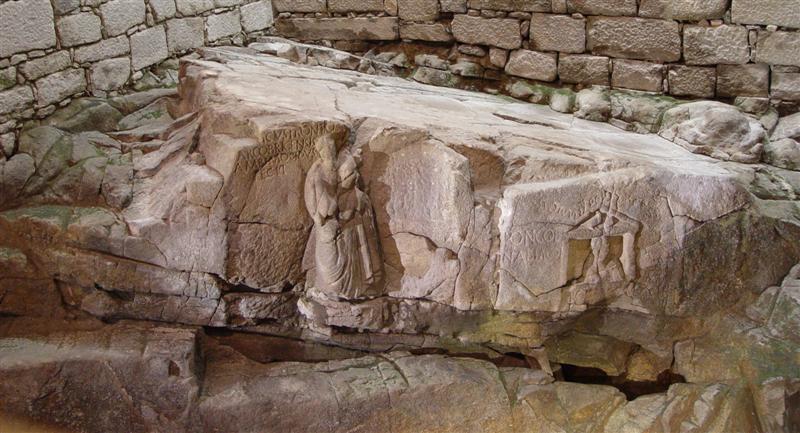
The Fountain of the Idol (Portuguese: Fonte do Ídolo) is a Roman fountain located in the civil parish of São José de São Lázaro, in the municipality of Braga, northern Portugal. Located in the former territory of the Callaici Bracari, the granite rock fountain/spring has Latin inscriptions, dedicated to the Gallaecian and Lusitanian gods Tongoenabiagus and Nabia (built during the era of Roman Emperor Augustus).
The construction of the fountain probably began in the 1st century, associated with a water cult, dedicated to the Lusitanian divinity Tongoenbiagus, and ordered constructed by Celicus Fronto.
First identified by Georg Braun in his map of Braga in 1594, the document indicated the location of the spring (marked by a channel of water).
By 1695, the land on which the fountain is located was owned by Father Santos Rodrigues, vicar of São João de Castelões, in Guimarães. On his death, his property passed to his niece, D. Angélica de Barros, who later bequeathed it to her brother-in-law Vicente Gomes do Couto.
In the 18th century, the accountant D. Jerónimo Contador de Argote, noted in his records: "behind the church of São João Marcos is a garden, that is called "Idol", in which is located a deep spring, which has a rock, which appears to be living rock, with a figure in long robes, that is five palms [in size]: it looks like [the figure] has a long beard, and part of his body is missing; his right hand is broken and on the left the form of a envolotório, and above the head there are letters..." Jerónimo recounts with this detailed description, a design of the fountain of the Idol that was first created by the Bishop of Urianópolis, Alves de Figueire.
Domingos Fernandes da Silva attempted to acquire the lands judicially, under the pretext that the lands were part of his property in 1816.
On 6 August 1861, Emílio Hübner visited the garden of the Idol, informed that name of the divinity was obscured by lime, and attempted to correct the inscription, following the notes of D. Jerónimo.
A year later, King Pedro V and the marquess of Sousa examine the fountain, then offered to the monarch as a gift by its owner João de Abreu Guedes do Couto. The King wanted to remove it and install it on the grounds of Quinta dos Falcões, as a base of a lapidary museum, but desisted.
Hub AI
Fountain of the Idol AI simulator
(@Fountain of the Idol_simulator)
Fountain of the Idol
The Fountain of the Idol (Portuguese: Fonte do Ídolo) is a Roman fountain located in the civil parish of São José de São Lázaro, in the municipality of Braga, northern Portugal. Located in the former territory of the Callaici Bracari, the granite rock fountain/spring has Latin inscriptions, dedicated to the Gallaecian and Lusitanian gods Tongoenabiagus and Nabia (built during the era of Roman Emperor Augustus).
The construction of the fountain probably began in the 1st century, associated with a water cult, dedicated to the Lusitanian divinity Tongoenbiagus, and ordered constructed by Celicus Fronto.
First identified by Georg Braun in his map of Braga in 1594, the document indicated the location of the spring (marked by a channel of water).
By 1695, the land on which the fountain is located was owned by Father Santos Rodrigues, vicar of São João de Castelões, in Guimarães. On his death, his property passed to his niece, D. Angélica de Barros, who later bequeathed it to her brother-in-law Vicente Gomes do Couto.
In the 18th century, the accountant D. Jerónimo Contador de Argote, noted in his records: "behind the church of São João Marcos is a garden, that is called "Idol", in which is located a deep spring, which has a rock, which appears to be living rock, with a figure in long robes, that is five palms [in size]: it looks like [the figure] has a long beard, and part of his body is missing; his right hand is broken and on the left the form of a envolotório, and above the head there are letters..." Jerónimo recounts with this detailed description, a design of the fountain of the Idol that was first created by the Bishop of Urianópolis, Alves de Figueire.
Domingos Fernandes da Silva attempted to acquire the lands judicially, under the pretext that the lands were part of his property in 1816.
On 6 August 1861, Emílio Hübner visited the garden of the Idol, informed that name of the divinity was obscured by lime, and attempted to correct the inscription, following the notes of D. Jerónimo.
A year later, King Pedro V and the marquess of Sousa examine the fountain, then offered to the monarch as a gift by its owner João de Abreu Guedes do Couto. The King wanted to remove it and install it on the grounds of Quinta dos Falcões, as a base of a lapidary museum, but desisted.