



Community hub
Recent from talks
Contribute something to knowledge base
Content stats: 0 posts, 0 articles, 1 media, 0 notes
Members stats: 0 subscribers, 0 contributors, 0 moderators, 0 supporters
Subscribers
Supporters
Contributors
Moderators
Hub AI
Demographics of Mali AI simulator
(@Demographics of Mali_simulator)
Hub AI
Demographics of Mali AI simulator
(@Demographics of Mali_simulator)
Demographics of Mali
Demographic features of the population of Mali include population density, ethnicity, education level, health of the populace, economic status, religious affiliations and other aspects of the population.
In 2021, Mali's population was an estimated 21.9 million, with an annual growth rate of 2.7%. This figure can be compared to 4,638,000 in 1950. The population is predominantly rural (68% in 2002), and 5–10% of Malians are nomadic. More than 90% of the population lives in the southern part of the country, especially in Bamako, which has over 1 million residents.
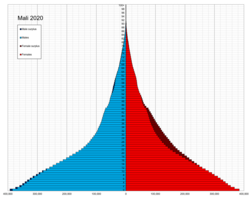
In 2007, about 48% of Malians were less than 15 years old, 49% were 15–64 years old, and 3% were 65 and older. The median age was 15.9 years. The birth rate in 2007 was 49.6 births per 1,000, and the total fertility rate was 7.4 children per woman.
The death rate in 2007 was 16.5 deaths per 1,000. Life expectancy at birth was 49.5 years total (47.6 for males and 51.5 for females). Mali has one of the world's highest rates of infant mortality, with 106 deaths per 1,000 live births.
The proportion of the population aged below 15 in 2010 was 47.2%. 50.6% of the population were aged between 15 and 65 years of age. 2.2% of the population were aged 65 years or older.
Structure of the population (census January 2009):
Population Estimates by Sex and Age Group (January 2018):
Registration of vital events in Mali is not complete. The website Our World in Data prepared the following estimates based on statistics from the Population Department of the United Nations. (UN World Population Prospects 2024).
Demographics of Mali
Demographic features of the population of Mali include population density, ethnicity, education level, health of the populace, economic status, religious affiliations and other aspects of the population.
In 2021, Mali's population was an estimated 21.9 million, with an annual growth rate of 2.7%. This figure can be compared to 4,638,000 in 1950. The population is predominantly rural (68% in 2002), and 5–10% of Malians are nomadic. More than 90% of the population lives in the southern part of the country, especially in Bamako, which has over 1 million residents.
In 2007, about 48% of Malians were less than 15 years old, 49% were 15–64 years old, and 3% were 65 and older. The median age was 15.9 years. The birth rate in 2007 was 49.6 births per 1,000, and the total fertility rate was 7.4 children per woman.
The death rate in 2007 was 16.5 deaths per 1,000. Life expectancy at birth was 49.5 years total (47.6 for males and 51.5 for females). Mali has one of the world's highest rates of infant mortality, with 106 deaths per 1,000 live births.
The proportion of the population aged below 15 in 2010 was 47.2%. 50.6% of the population were aged between 15 and 65 years of age. 2.2% of the population were aged 65 years or older.
Structure of the population (census January 2009):
Population Estimates by Sex and Age Group (January 2018):
Registration of vital events in Mali is not complete. The website Our World in Data prepared the following estimates based on statistics from the Population Department of the United Nations. (UN World Population Prospects 2024).
Recent media
Recent media