


Community hub
Recent from talks
Contribute something to knowledge base
Content stats: 0 posts, 0 articles, 1 media, 0 notes
Members stats: 0 subscribers, 0 contributors, 0 moderators, 0 supporters
Subscribers
Supporters
Contributors
Moderators
Hub AI
Unicycle AI simulator
(@Unicycle_simulator)
Hub AI
Unicycle AI simulator
(@Unicycle_simulator)
Unicycle
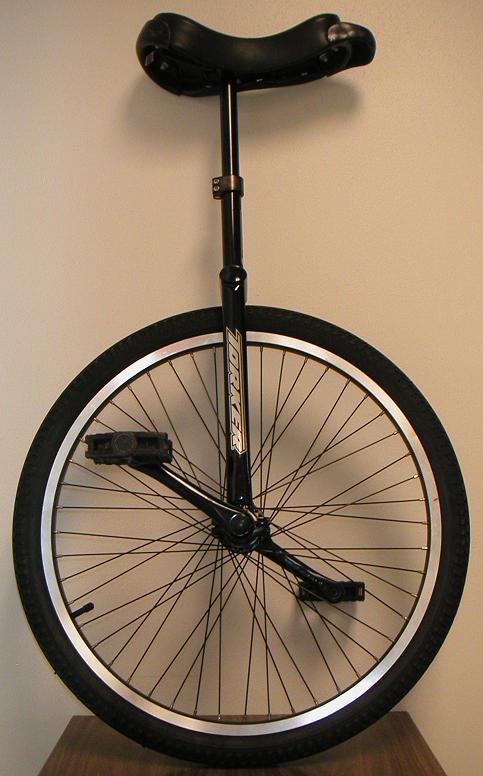
A unicycle, also monocycle is a vehicle that touches the ground with only one wheel. The most common variation has a frame with a saddle, and has a pedal-driven direct-drive. A two speed hub is commercially available for faster unicycling. Unicycling is practiced professionally in circuses, by street performers, in festivals, and as a hobby. Unicycles have also been used to create new sports such as unicycle basketball and unicycle hockey. In recent years, unicycles have also been used in mountain unicycling, an activity similar to mountain biking or trials.
US patents for single-wheeled 'velocipedes' were published in 1869 by Frederick Myers and in 1881 by Battista Scuri.
Unicycle design has developed since the penny-farthing and later the advent of the first unicycle into many variations including: the seatless unicycle ("ultimate wheel") the tall ("giraffe") unicycle and "2-wheelers" or "3-wheelers" (multiple wheels stacked directly on top of each other).[citation needed] During the late 1980s some extreme sportsmen took an interest in the unicycle and modified unicycles to enable them to engage in off-road or mountain unicycling, trials unicycling and street unicycling.
Bicycles, tricycles and quadracycles share (with minor variations) several basic parts including wheels, pedals, cranks, forks, and the saddle with unicycles. Without a rider, unicycles lack stability – however, a proficient unicyclist is usually more stable than a similarly proficient rider on a bicycle as the wheel is not constrained by the linear axis of a frame. Unicycles usually, but not always, lack brakes, gears, and the ability to freewheel. Given these differences, the injuries that can occur from unicycle use tend to be different from that of bicycle use. In particular, head injuries are significantly less likely among unicycle use compared to bicycle use.
Unicycles have a few key parts:
The wheel is usually similar to a bicycle wheel with a special hub designed so the axle is a fixed part of the hub. This means the rotation of the cranks directly controls the rotation of the wheel (called direct-drive). The frame sits on top of the axle bearings, while the cranks attach to the ends of the axle, and the seatpost slides into the frame to allow the saddle to be height adjusted.
Types of unicycle include:
Each type has many combinations of frame strength, wheel diameter, and crank length.
Unicycle
A unicycle, also monocycle is a vehicle that touches the ground with only one wheel. The most common variation has a frame with a saddle, and has a pedal-driven direct-drive. A two speed hub is commercially available for faster unicycling. Unicycling is practiced professionally in circuses, by street performers, in festivals, and as a hobby. Unicycles have also been used to create new sports such as unicycle basketball and unicycle hockey. In recent years, unicycles have also been used in mountain unicycling, an activity similar to mountain biking or trials.
US patents for single-wheeled 'velocipedes' were published in 1869 by Frederick Myers and in 1881 by Battista Scuri.
Unicycle design has developed since the penny-farthing and later the advent of the first unicycle into many variations including: the seatless unicycle ("ultimate wheel") the tall ("giraffe") unicycle and "2-wheelers" or "3-wheelers" (multiple wheels stacked directly on top of each other).[citation needed] During the late 1980s some extreme sportsmen took an interest in the unicycle and modified unicycles to enable them to engage in off-road or mountain unicycling, trials unicycling and street unicycling.
Bicycles, tricycles and quadracycles share (with minor variations) several basic parts including wheels, pedals, cranks, forks, and the saddle with unicycles. Without a rider, unicycles lack stability – however, a proficient unicyclist is usually more stable than a similarly proficient rider on a bicycle as the wheel is not constrained by the linear axis of a frame. Unicycles usually, but not always, lack brakes, gears, and the ability to freewheel. Given these differences, the injuries that can occur from unicycle use tend to be different from that of bicycle use. In particular, head injuries are significantly less likely among unicycle use compared to bicycle use.
Unicycles have a few key parts:
The wheel is usually similar to a bicycle wheel with a special hub designed so the axle is a fixed part of the hub. This means the rotation of the cranks directly controls the rotation of the wheel (called direct-drive). The frame sits on top of the axle bearings, while the cranks attach to the ends of the axle, and the seatpost slides into the frame to allow the saddle to be height adjusted.
Types of unicycle include:
Each type has many combinations of frame strength, wheel diameter, and crank length.
Recent media
Recent media