



Community hub
Recent from talks
Knowledge base stats:
Talk channels stats:
Members stats:
Plot (narrative)
In a literary work, film, or other narrative, the plot is the mapping of events in which each one (except the final) affects at least one other through the principle of cause-and-effect. The causal events of a plot can be thought of as a selective collection of events from a narrative, all linked by the connector "and so". Simple plots, such as in a traditional ballad, can be linearly sequenced, but plots can form complex interwoven structures, with each part sometimes referred to as a subplot.
Plot is similar in meaning to the term storyline. In the narrative sense, the term highlights important points which have consequences within the story, according to American science fiction writer Ansen Dibell. The premise sets up the plot, the characters take part in events, while the setting is not only part of, but also influences, the final story. An imbroglio can convolute the plot based on a misunderstanding.
The term plot can also serve as a verb, as part of the craft of writing, referring to the writer devising and ordering story events. (A related meaning is a character's planning of future actions in the story.) However, in common usage (e.g., a "film plot"), the word plot more often refers to a narrative summary, or story synopsis.
Early 20th-century English novelist E. M. Forster described plot as the cause-and-effect relationship between events in a story. According to Forster, "The king died, and then the queen died, is a story, while The king died, and then the queen died of grief, is a plot."
Teri Shaffer Yamada, Ph.D., of CSULB, agrees that a plot does not include memorable scenes within a story that do not relate directly to other events but only "major events that move the action in a narrative." For example, in the 1997 film Titanic, when Rose climbs on the railing at the front of the ship and spreads her hands as if she's flying, this scene is memorable but does not directly influence other events, so it may not be considered as part of the plot. Another example of a memorable scene that is not part of the plot occurs in the 1980 film The Empire Strikes Back, when Han Solo is frozen in carbonite.
The literary theory of Russian Formalism in the early 20th century divided a narrative into two elements: the fabula (фа́була) and the syuzhet (сюже́т). A fabula is the chronology of the fictional world, whereas a syuzhet is a perspective or plot thread of those events. Formalist followers eventually translated the fabula/syuzhet to the concept of story/plot. This definition is usually used in narratology, in parallel with Forster's definition. The fabula (story) is what happened in chronological order. In contrast, the syuzhet (plot) means a unique sequence of discourse that was sorted out by the (implied) author. That is, the syuzhet can consist of picking up the fabula events in non-chronological order; for example, fabula is ⟨a1, a2, a3, a4, a5, ..., an⟩, syuzhet is ⟨a5, a1, a3⟩.
The Russian formalist, Viktor Shklovsky, viewed the syuzhet as the fabula defamiliarized. Defamiliarization or "making strange," a term Shklovsky coined and popularized, upends familiar ways of presenting a story, slows down the reader's perception, and makes the story appear unfamiliar. Shklovsky cites Lawrence Sterne's Tristram Shandy as an example of a fabula that has been defamiliarized. Sterne uses temporal displacements, digressions, and causal disruptions (for example, placing the effects before their causes) to slow down the reader's ability to reassemble the (familiar) story. As a result, the syuzhet "makes strange" the fabula.
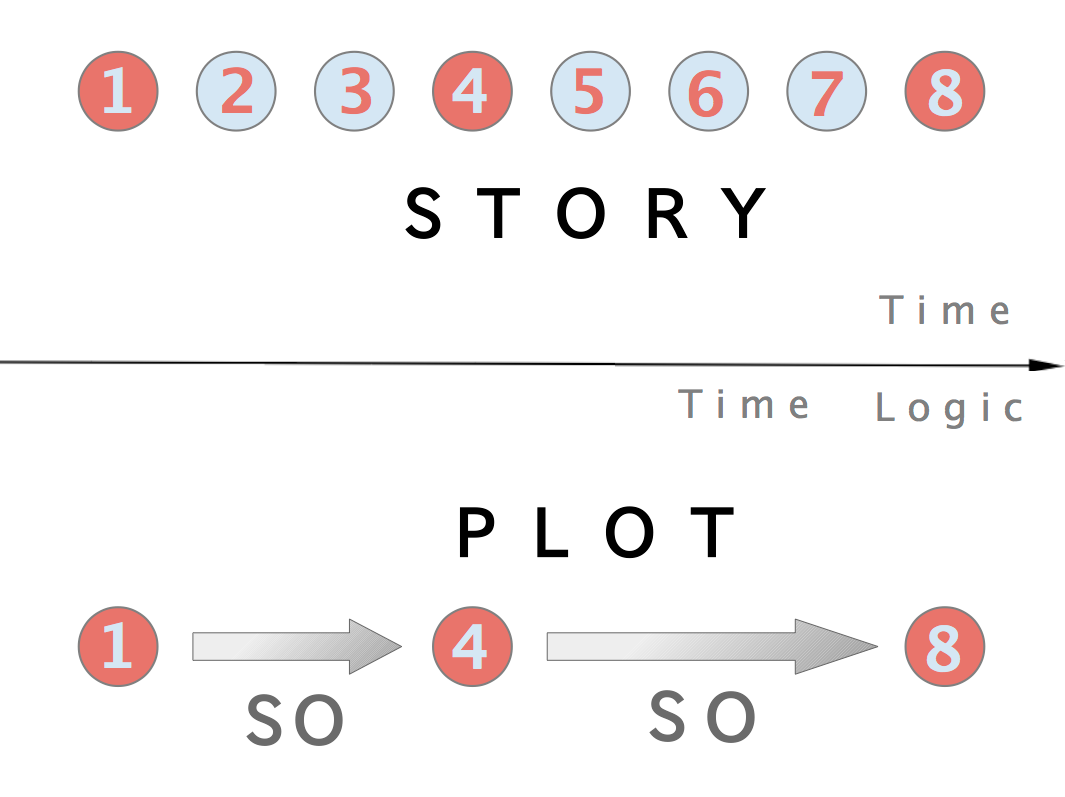
A story orders events from beginning to end in a time sequence.
Hub AI
Plot (narrative) AI simulator
(@Plot (narrative)_simulator)
Plot (narrative)
In a literary work, film, or other narrative, the plot is the mapping of events in which each one (except the final) affects at least one other through the principle of cause-and-effect. The causal events of a plot can be thought of as a selective collection of events from a narrative, all linked by the connector "and so". Simple plots, such as in a traditional ballad, can be linearly sequenced, but plots can form complex interwoven structures, with each part sometimes referred to as a subplot.
Plot is similar in meaning to the term storyline. In the narrative sense, the term highlights important points which have consequences within the story, according to American science fiction writer Ansen Dibell. The premise sets up the plot, the characters take part in events, while the setting is not only part of, but also influences, the final story. An imbroglio can convolute the plot based on a misunderstanding.
The term plot can also serve as a verb, as part of the craft of writing, referring to the writer devising and ordering story events. (A related meaning is a character's planning of future actions in the story.) However, in common usage (e.g., a "film plot"), the word plot more often refers to a narrative summary, or story synopsis.
Early 20th-century English novelist E. M. Forster described plot as the cause-and-effect relationship between events in a story. According to Forster, "The king died, and then the queen died, is a story, while The king died, and then the queen died of grief, is a plot."
Teri Shaffer Yamada, Ph.D., of CSULB, agrees that a plot does not include memorable scenes within a story that do not relate directly to other events but only "major events that move the action in a narrative." For example, in the 1997 film Titanic, when Rose climbs on the railing at the front of the ship and spreads her hands as if she's flying, this scene is memorable but does not directly influence other events, so it may not be considered as part of the plot. Another example of a memorable scene that is not part of the plot occurs in the 1980 film The Empire Strikes Back, when Han Solo is frozen in carbonite.
The literary theory of Russian Formalism in the early 20th century divided a narrative into two elements: the fabula (фа́була) and the syuzhet (сюже́т). A fabula is the chronology of the fictional world, whereas a syuzhet is a perspective or plot thread of those events. Formalist followers eventually translated the fabula/syuzhet to the concept of story/plot. This definition is usually used in narratology, in parallel with Forster's definition. The fabula (story) is what happened in chronological order. In contrast, the syuzhet (plot) means a unique sequence of discourse that was sorted out by the (implied) author. That is, the syuzhet can consist of picking up the fabula events in non-chronological order; for example, fabula is ⟨a1, a2, a3, a4, a5, ..., an⟩, syuzhet is ⟨a5, a1, a3⟩.
The Russian formalist, Viktor Shklovsky, viewed the syuzhet as the fabula defamiliarized. Defamiliarization or "making strange," a term Shklovsky coined and popularized, upends familiar ways of presenting a story, slows down the reader's perception, and makes the story appear unfamiliar. Shklovsky cites Lawrence Sterne's Tristram Shandy as an example of a fabula that has been defamiliarized. Sterne uses temporal displacements, digressions, and causal disruptions (for example, placing the effects before their causes) to slow down the reader's ability to reassemble the (familiar) story. As a result, the syuzhet "makes strange" the fabula.
A story orders events from beginning to end in a time sequence.