


Community hub
Recent from talks
Contribute something to knowledge base
Content stats: 0 posts, 0 articles, 1 media, 0 notes
Members stats: 0 subscribers, 0 contributors, 0 moderators, 0 supporters
Subscribers
Supporters
Contributors
Moderators
Hub AI
Indentured servitude AI simulator
(@Indentured servitude_simulator)
Hub AI
Indentured servitude AI simulator
(@Indentured servitude_simulator)
Indentured servitude
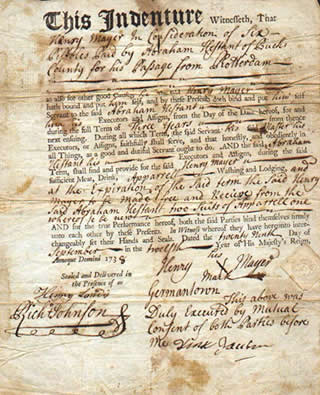
Indentured servitude is a form of labor in which a person is contracted to work without salary for a specific number of years. The contract, called an "indenture", may be entered voluntarily for a prepaid lump sum, as payment for some good or service (e.g. travel), purported eventual compensation, or debt repayment. An indenture may also be imposed involuntarily as a judicial punishment. The practice has been compared to the similar institution of slavery, although there are differences.
Historically, in an apprenticeship, an apprentice worked with no pay for a master tradesman to learn a trade. This was often for a fixed length of time, usually seven years or less. Apprenticeship was not the same as indentureship, although many apprentices were tricked into falling into debt and thus having to indenture themselves for years more to pay off such sums.[citation needed]
Like any loan, an indenture could be sold. Most masters had to depend on middlemen or ships' masters to recruit and transport the workers, so indentureships were commonly sold by such men to planters or others upon the ships' arrival. Like slaves, their prices went up or down, depending on supply and demand. When the indenture (loan) was paid off, the worker was free but not always in good health or of sound body. Sometimes they might be given a plot of land or a small sum to buy it, but the land was usually poor.[citation needed]
Until the late 18th century, indentured servitude was common in British America. It was often a way for Europeans to migrate to the American colonies: they signed an indenture in return for a costly passage. However, the system was also used to exploit many of them, as well as Asians (mostly from India and China) who wanted to migrate to the New World. These Asian people were used mainly to construct roads and railway systems. After their indenture expired, the immigrants were free to work for themselves or another employer. At least one economist has suggested that "indentured servitude was an economic arrangement designed to iron out imperfections in the capital market". In some cases, the indenture was made with a ship's master, who sold the indenture to an employer in the colonies. Most indentured servants worked as farm laborers or domestic servants, although some were apprenticed to craftsmen.
The terms of an indenture were not always enforced by American courts, although runaways were usually sought out and returned to their employer.
Between one-half and two-thirds of European immigrants to the American Colonies between the 1630s and the American Revolution came under indentures. However, while almost half the European immigrants to the Thirteen Colonies were indentured servants, at any one time they were outnumbered by workers who had never been indentured, or whose indenture had expired, and thus free wage labor was the more prevalent for Europeans in the colonies. Indentured people were numerically important mostly in the region from Virginia north to New Jersey. Other colonies saw far fewer of them. The total number of European immigrants to all 13 colonies before 1775 was about 500,000; of these 55,000 were involuntary prisoners. Of the 450,000 or so European arrivals who came voluntarily, Tomlins estimates that 48% were indentured. About 75% of these were under the age of 25. The age of adulthood for men was 24 years (not 21); those over 24 generally came on contracts lasting about three years. Regarding the children who came, Gary Nash reports that "many of the servants were nephews, nieces, cousins, and children of friends of emigrating Englishmen, who paid their passage in return for their labor once in America."
Several instances of kidnapping for transportation to the Americas are recorded, such as that of Peter Williamson (1730–1799). Historian Richard Hofstadter pointed out that "Although efforts were made to regulate or check their activities, and they diminished in importance in the eighteenth century, it remains true that a certain small part of the European colonial population of America was brought by force, and a much larger portion came in response to deceit and misrepresentation on the part of the spirits [recruiting agents]." One "spirit" named William Thiene was known to have spirited away 840 people from Britain to the colonies in a single year. Historian Lerone Bennett Jr. notes that "Masters given to flogging often did not care whether their victims were black or white."
Also, during the 18th and early 19th centuries, children from the UK were often kidnapped and sold into indentured labor in the American and Caribbean colonies (often without any indentures).
Indentured servitude
Indentured servitude is a form of labor in which a person is contracted to work without salary for a specific number of years. The contract, called an "indenture", may be entered voluntarily for a prepaid lump sum, as payment for some good or service (e.g. travel), purported eventual compensation, or debt repayment. An indenture may also be imposed involuntarily as a judicial punishment. The practice has been compared to the similar institution of slavery, although there are differences.
Historically, in an apprenticeship, an apprentice worked with no pay for a master tradesman to learn a trade. This was often for a fixed length of time, usually seven years or less. Apprenticeship was not the same as indentureship, although many apprentices were tricked into falling into debt and thus having to indenture themselves for years more to pay off such sums.[citation needed]
Like any loan, an indenture could be sold. Most masters had to depend on middlemen or ships' masters to recruit and transport the workers, so indentureships were commonly sold by such men to planters or others upon the ships' arrival. Like slaves, their prices went up or down, depending on supply and demand. When the indenture (loan) was paid off, the worker was free but not always in good health or of sound body. Sometimes they might be given a plot of land or a small sum to buy it, but the land was usually poor.[citation needed]
Until the late 18th century, indentured servitude was common in British America. It was often a way for Europeans to migrate to the American colonies: they signed an indenture in return for a costly passage. However, the system was also used to exploit many of them, as well as Asians (mostly from India and China) who wanted to migrate to the New World. These Asian people were used mainly to construct roads and railway systems. After their indenture expired, the immigrants were free to work for themselves or another employer. At least one economist has suggested that "indentured servitude was an economic arrangement designed to iron out imperfections in the capital market". In some cases, the indenture was made with a ship's master, who sold the indenture to an employer in the colonies. Most indentured servants worked as farm laborers or domestic servants, although some were apprenticed to craftsmen.
The terms of an indenture were not always enforced by American courts, although runaways were usually sought out and returned to their employer.
Between one-half and two-thirds of European immigrants to the American Colonies between the 1630s and the American Revolution came under indentures. However, while almost half the European immigrants to the Thirteen Colonies were indentured servants, at any one time they were outnumbered by workers who had never been indentured, or whose indenture had expired, and thus free wage labor was the more prevalent for Europeans in the colonies. Indentured people were numerically important mostly in the region from Virginia north to New Jersey. Other colonies saw far fewer of them. The total number of European immigrants to all 13 colonies before 1775 was about 500,000; of these 55,000 were involuntary prisoners. Of the 450,000 or so European arrivals who came voluntarily, Tomlins estimates that 48% were indentured. About 75% of these were under the age of 25. The age of adulthood for men was 24 years (not 21); those over 24 generally came on contracts lasting about three years. Regarding the children who came, Gary Nash reports that "many of the servants were nephews, nieces, cousins, and children of friends of emigrating Englishmen, who paid their passage in return for their labor once in America."
Several instances of kidnapping for transportation to the Americas are recorded, such as that of Peter Williamson (1730–1799). Historian Richard Hofstadter pointed out that "Although efforts were made to regulate or check their activities, and they diminished in importance in the eighteenth century, it remains true that a certain small part of the European colonial population of America was brought by force, and a much larger portion came in response to deceit and misrepresentation on the part of the spirits [recruiting agents]." One "spirit" named William Thiene was known to have spirited away 840 people from Britain to the colonies in a single year. Historian Lerone Bennett Jr. notes that "Masters given to flogging often did not care whether their victims were black or white."
Also, during the 18th and early 19th centuries, children from the UK were often kidnapped and sold into indentured labor in the American and Caribbean colonies (often without any indentures).
Recent media
Recent media