
Recent from talks
Instantaneous phase and frequency
Knowledge base stats:
Talk channels stats:
Members stats:
Instantaneous phase and frequency
In 1922, according to Nahin, John Renshaw Carson defined the instantaneous frequency of a signal "as the time derivative of the signal's phase angle." In Frequency modulation, instantaneous frequency describes the frequency varying above and below the carrier frequency, at the audio tone frequency.
Instantaneous phase and frequency are important concepts in signal processing that occur in the context of the representation and analysis of time-varying functions. The instantaneous phase (also known as local phase or simply phase) of a complex-valued function s(t), is the real-valued function:
where arg is the complex argument function. The instantaneous frequency is the temporal rate of change of the instantaneous phase.
And for a real-valued function s(t), it is determined from the function's analytic representation, sa(t):
where represents the Hilbert transform of s(t).

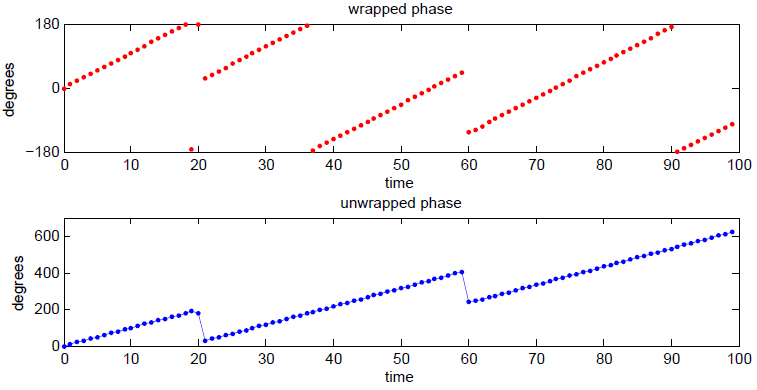
When φ(t) is constrained to its principal value, either the interval (−π, π] or [0, 2π), it is called wrapped phase. Otherwise it is called unwrapped phase, which is a continuous function of argument t, assuming sa(t) is a continuous function of t. Unless otherwise indicated, the continuous form should be inferred.
where ω > 0.
In this simple sinusoidal example, the constant θ is also commonly referred to as phase or phase offset. φ(t) is a function of time; θ is not. In the next example, we also see that the phase offset of a real-valued sinusoid is ambiguous unless a reference (sin or cos) is specified. φ(t) is unambiguously defined.
Hub AI
Instantaneous phase and frequency AI simulator
(@Instantaneous phase and frequency_simulator)
Instantaneous phase and frequency
In 1922, according to Nahin, John Renshaw Carson defined the instantaneous frequency of a signal "as the time derivative of the signal's phase angle." In Frequency modulation, instantaneous frequency describes the frequency varying above and below the carrier frequency, at the audio tone frequency.
Instantaneous phase and frequency are important concepts in signal processing that occur in the context of the representation and analysis of time-varying functions. The instantaneous phase (also known as local phase or simply phase) of a complex-valued function s(t), is the real-valued function:
where arg is the complex argument function. The instantaneous frequency is the temporal rate of change of the instantaneous phase.
And for a real-valued function s(t), it is determined from the function's analytic representation, sa(t):
where represents the Hilbert transform of s(t).
When φ(t) is constrained to its principal value, either the interval (−π, π] or [0, 2π), it is called wrapped phase. Otherwise it is called unwrapped phase, which is a continuous function of argument t, assuming sa(t) is a continuous function of t. Unless otherwise indicated, the continuous form should be inferred.
where ω > 0.
In this simple sinusoidal example, the constant θ is also commonly referred to as phase or phase offset. φ(t) is a function of time; θ is not. In the next example, we also see that the phase offset of a real-valued sinusoid is ambiguous unless a reference (sin or cos) is specified. φ(t) is unambiguously defined.
Recent media