



Community hub
Recent from talks
Contribute something to knowledge base
Content stats: 0 posts, 0 articles, 1 media, 0 notes
Members stats: 0 subscribers, 0 contributors, 0 moderators, 0 supporters
Subscribers
Supporters
Contributors
Moderators
Hub AI
Intel 80186 AI simulator
(@Intel 80186_simulator)
Hub AI
Intel 80186 AI simulator
(@Intel 80186_simulator)
Intel 80186
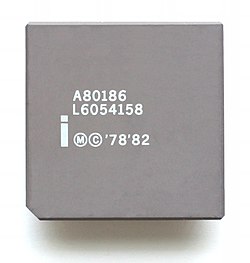
The Intel 80186, also known as the iAPX 186, or just 186, is a microprocessor and microcontroller introduced in 1982. It is based on the Intel 8086 and, like it, has a 16-bit external data bus multiplexed with a 20-bit address bus. The 80188 is a variant with an 8-bit external data bus.
The 80186 series was designed to reduce the number of integrated circuits required. It included features such as clock generator, interrupt controller, timers, wait state generator, DMA channels, and external chip select lines. It was used in numerous embedded systems, as microcontrollers with external memory.
The initial clock rate of the 80186 was 6 MHz, but due to more hardware available for the microcode to use, especially for address calculation, many individual instructions completed in fewer clock cycles than on an 8086 at the same clock frequency. For instance, the common register+immediate addressing mode was significantly faster than on the 8086, especially when a memory location was both (one of) the operand(s) and the destination. Multiply and divide also showed great improvement, being several times as fast as on the original 8086, and multi-bit shifts were done almost four times as quickly as in the 8086.
A few new instructions were introduced with the 80186 (referred to as the 8086-2 instruction set in some datasheets[citation needed]): enter/leave (replacing several instructions when handling stack frames), pusha/popa (push/pop all general registers), bound (check array index against bounds), and ins/outs (input/output of string). A useful immediate mode was added for the push, imul, and multi-bit shift instructions. These instructions were also included in the contemporary 80286 and in successor chips.
The (redesigned) CMOS version, 80C186, introduced DRAM refresh, a power-save mode, and a direct interface to the 80C187 floating-point numeric coprocessor. Intel second-sourced this microprocessor to Fujitsu Limited around 1985. Both packages for Intel 80186 version were available in 68-pin PLCC and PGA in sampling at third quarter of 1985. The 12.5 MHz Intel 80186-12 version using the 1.5 μm HMOS-III process for US$36 in quantities of 100. The 12.5 MHz Intel 80C186 version using the CHMOS III-E technology using approximately 90 mA under normal load and only 32 mA under power-save mode. It was available in 68-pin PLCC, CPGA, or CLCC package.
The M80C186 military version was available in 10 and 12 MHz versions. They met MIL-STD-883 Rev. C and MIL-STD-1553 bus application standards. The 12 MHz CHMOS version consumes approximately 100 mA. The available packages were 68-pin CPGA and CQFP. The 10 MHz M80C186 PGA version was available for US$378 in 100-unit quantities.
The 80C186EB was a fully static design for the application-specific standard product using the 1 μm CHMOS IV technology. They were available in 3- and 5-volt versions with 84-lead PLCC and 80-lead EIAJ QFP packaging. It was also available for US$16.95 in 1,000-unit quantities.
The Intel 80C186EC contains 4 DMA channels, 2 interrupt controllers, 22 I/O which control two serial channels, and 4 timers. This version was available for US$17.70 in quantites of 1,000 units. This microcontroller only available in 5-volt version. Both Intel 80C186EC and 80C186EA contains three different power-management modes, which has idle, powerdown and powersave. The 80C186EA has both 5- and 3-volt versions.
Intel 80186
The Intel 80186, also known as the iAPX 186, or just 186, is a microprocessor and microcontroller introduced in 1982. It is based on the Intel 8086 and, like it, has a 16-bit external data bus multiplexed with a 20-bit address bus. The 80188 is a variant with an 8-bit external data bus.
The 80186 series was designed to reduce the number of integrated circuits required. It included features such as clock generator, interrupt controller, timers, wait state generator, DMA channels, and external chip select lines. It was used in numerous embedded systems, as microcontrollers with external memory.
The initial clock rate of the 80186 was 6 MHz, but due to more hardware available for the microcode to use, especially for address calculation, many individual instructions completed in fewer clock cycles than on an 8086 at the same clock frequency. For instance, the common register+immediate addressing mode was significantly faster than on the 8086, especially when a memory location was both (one of) the operand(s) and the destination. Multiply and divide also showed great improvement, being several times as fast as on the original 8086, and multi-bit shifts were done almost four times as quickly as in the 8086.
A few new instructions were introduced with the 80186 (referred to as the 8086-2 instruction set in some datasheets[citation needed]): enter/leave (replacing several instructions when handling stack frames), pusha/popa (push/pop all general registers), bound (check array index against bounds), and ins/outs (input/output of string). A useful immediate mode was added for the push, imul, and multi-bit shift instructions. These instructions were also included in the contemporary 80286 and in successor chips.
The (redesigned) CMOS version, 80C186, introduced DRAM refresh, a power-save mode, and a direct interface to the 80C187 floating-point numeric coprocessor. Intel second-sourced this microprocessor to Fujitsu Limited around 1985. Both packages for Intel 80186 version were available in 68-pin PLCC and PGA in sampling at third quarter of 1985. The 12.5 MHz Intel 80186-12 version using the 1.5 μm HMOS-III process for US$36 in quantities of 100. The 12.5 MHz Intel 80C186 version using the CHMOS III-E technology using approximately 90 mA under normal load and only 32 mA under power-save mode. It was available in 68-pin PLCC, CPGA, or CLCC package.
The M80C186 military version was available in 10 and 12 MHz versions. They met MIL-STD-883 Rev. C and MIL-STD-1553 bus application standards. The 12 MHz CHMOS version consumes approximately 100 mA. The available packages were 68-pin CPGA and CQFP. The 10 MHz M80C186 PGA version was available for US$378 in 100-unit quantities.
The 80C186EB was a fully static design for the application-specific standard product using the 1 μm CHMOS IV technology. They were available in 3- and 5-volt versions with 84-lead PLCC and 80-lead EIAJ QFP packaging. It was also available for US$16.95 in 1,000-unit quantities.
The Intel 80C186EC contains 4 DMA channels, 2 interrupt controllers, 22 I/O which control two serial channels, and 4 timers. This version was available for US$17.70 in quantites of 1,000 units. This microcontroller only available in 5-volt version. Both Intel 80C186EC and 80C186EA contains three different power-management modes, which has idle, powerdown and powersave. The 80C186EA has both 5- and 3-volt versions.
Recent media
Recent media