


Community hub
Recent from talks
Contribute something to knowledge base
Content stats: 0 posts, 0 articles, 1 media, 0 notes
Members stats: 0 subscribers, 0 contributors, 0 moderators, 0 supporters
Subscribers
Supporters
Contributors
Moderators
Hub AI
Interception AI simulator
(@Interception_simulator)
Hub AI
Interception AI simulator
(@Interception_simulator)
Interception
In ball-playing competitive team sports, an interception or pick is a move by a player involving a pass of the ball—whether by foot or hand, depending on the rules of the sport—in which the ball is intended for a player of the same team but caught or otherwise brought under control by a player of the opposing team, who thereby usually gains possession of the ball for their team. It is commonly seen in football, including American and Canadian football, as well as association football, rugby league, rugby union, Australian rules football and Gaelic football, as well as any sport by which a loose object is passed between players toward a goal. In basketball, this is called a steal.
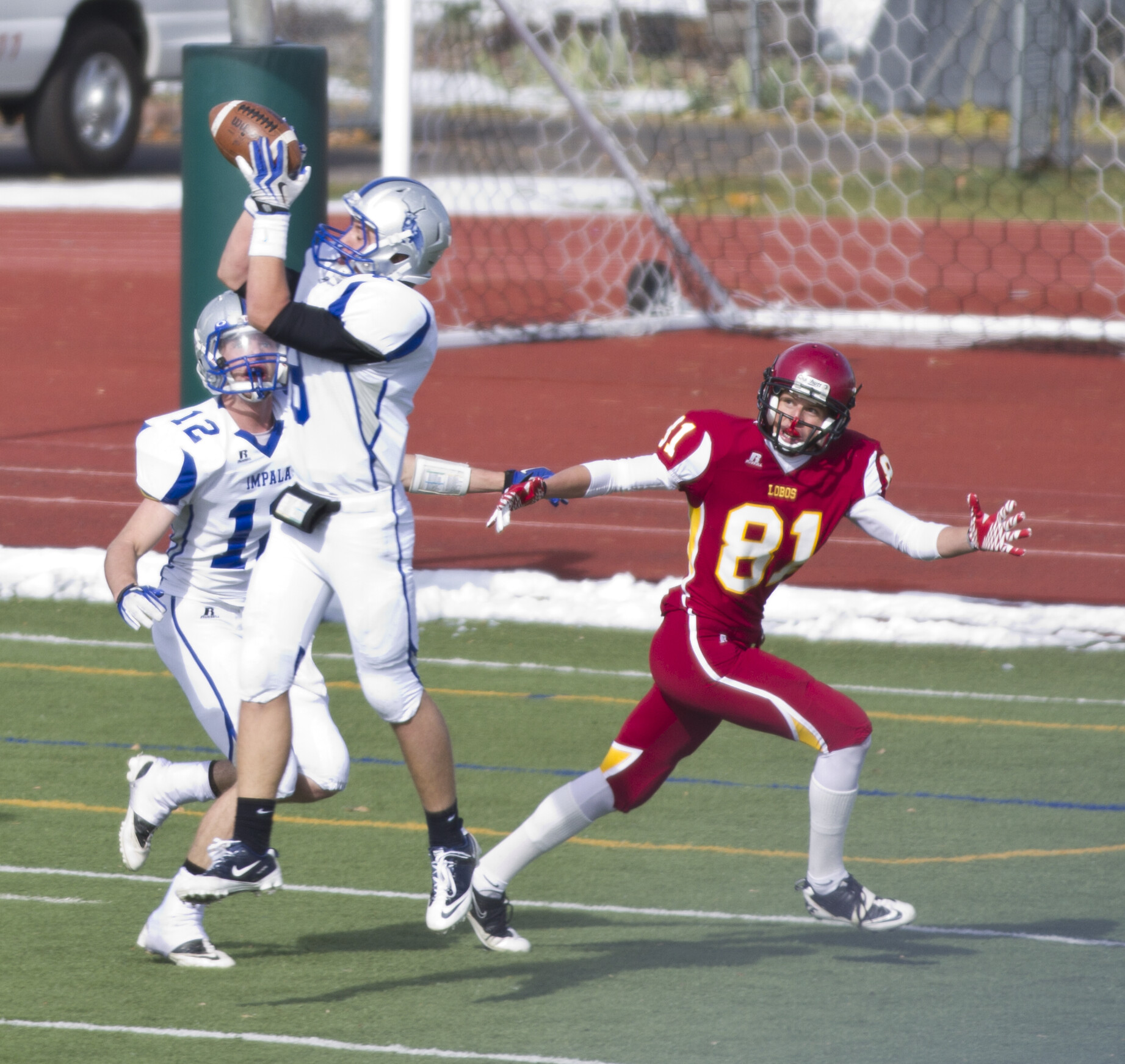
In American football and Canadian football, an interception occurs when a forward pass that has not yet touched the ground is caught by a player of the defensive team. This leads to an immediate change of possession during the play, and the defender who caught the ball can immediately attempt to move the ball as far towards the opposing end zone as possible, up to a touchdown. Following the stoppage of play, if the interceptor retained possession of the ball, his team takes over possession at the spot where he was downed. Because possession is a critical component in these sports, a successful interception can be a dramatic reversal of the teams' fortunes.
Interceptions are predominantly made by the secondary or (on some occasions) the linebackers, who are usually closest to the quarterback's intended targets: the wide receivers, running backs, and tight ends. Less frequently, a defensive lineman may get an interception from a tipped ball, a near sack, a shovel pass, or a screen pass, but are more likely to force a fumble than get an interception. As soon as a pass is intercepted, everyone on the defense changes their play to become a blocker, keeping opposing players away while helping the person with the interception get as much yardage as possible and perhaps a touchdown (commonly called a "pick-six", since a touchdown is worth six points); at the same time, everyone on the offense becomes the defense and attempts to tackle the ball-carrier. If the interception occurs on an extra-point attempt, rather than an ordinary play from scrimmage, a return of the interception to the other end zone is sometimes called a "pick-two", as it is a defensive two-point conversion rather than a touchdown. For example, on December 4, 2016, the Kansas City Chiefs strong safety Eric Berry scored the game-winning points via a pick-two in a 29–28 victory over the Atlanta Falcons. Berry also achieved an ordinary pick-six earlier in the same game.
If the intercepting team has the lead, and there is little time left in the game, the intercepting player may down the ball immediately and not attempt to gain any yardage; the team then runs out the clock using scrimmage plays. This eliminates the chance of a fumble that could be recovered by the other team. There are also player safety implications: when the ball is turned over, the play is now suddenly and unexpectedly moving in the opposite direction. All of the players on offense are instantly susceptible to unexpected blocks, even if not attempting to stop the ball carrier; a hard and unseen block can result in severe injuries. Additionally, offensive players, particularly the quarterback, are often inexperienced tacklers and are at risk of injuring themselves while tackling the ball carrier.
Only the interception of a forward pass is recorded statistically as an interception, for both the passer and the intercepting player. If a receiver fails to catch the ball and bobbles or tips it before it is intercepted, even if his action was entirely responsible for the interception, it is always recorded as an interception thrown by the passer. The interception of a lateral pass is recorded as a fumble by the passer.
In 1938 (20 years before the CFL was established) Joe Zelikovitz of the Ottawa Rough Riders caught seven interceptions in one game.
In an 11-year CFL career, Less Browne recorded 87 interceptions during the 1980s and 90s, which is both a CFL and all-pro record. He was inducted into the Canadian Football Hall of Fame (CFHF) in 2002.
Barron Miles, a defensive back in the early 2000s for the BC Lions and Montreal Alouettes, recorded 66 interceptions, tied for second all-time, in a 12-year CFL career. He is also the all-time leader in blocked kicks with 13. He was inducted into the CFHF in 2018.
Interception
In ball-playing competitive team sports, an interception or pick is a move by a player involving a pass of the ball—whether by foot or hand, depending on the rules of the sport—in which the ball is intended for a player of the same team but caught or otherwise brought under control by a player of the opposing team, who thereby usually gains possession of the ball for their team. It is commonly seen in football, including American and Canadian football, as well as association football, rugby league, rugby union, Australian rules football and Gaelic football, as well as any sport by which a loose object is passed between players toward a goal. In basketball, this is called a steal.
In American football and Canadian football, an interception occurs when a forward pass that has not yet touched the ground is caught by a player of the defensive team. This leads to an immediate change of possession during the play, and the defender who caught the ball can immediately attempt to move the ball as far towards the opposing end zone as possible, up to a touchdown. Following the stoppage of play, if the interceptor retained possession of the ball, his team takes over possession at the spot where he was downed. Because possession is a critical component in these sports, a successful interception can be a dramatic reversal of the teams' fortunes.
Interceptions are predominantly made by the secondary or (on some occasions) the linebackers, who are usually closest to the quarterback's intended targets: the wide receivers, running backs, and tight ends. Less frequently, a defensive lineman may get an interception from a tipped ball, a near sack, a shovel pass, or a screen pass, but are more likely to force a fumble than get an interception. As soon as a pass is intercepted, everyone on the defense changes their play to become a blocker, keeping opposing players away while helping the person with the interception get as much yardage as possible and perhaps a touchdown (commonly called a "pick-six", since a touchdown is worth six points); at the same time, everyone on the offense becomes the defense and attempts to tackle the ball-carrier. If the interception occurs on an extra-point attempt, rather than an ordinary play from scrimmage, a return of the interception to the other end zone is sometimes called a "pick-two", as it is a defensive two-point conversion rather than a touchdown. For example, on December 4, 2016, the Kansas City Chiefs strong safety Eric Berry scored the game-winning points via a pick-two in a 29–28 victory over the Atlanta Falcons. Berry also achieved an ordinary pick-six earlier in the same game.
If the intercepting team has the lead, and there is little time left in the game, the intercepting player may down the ball immediately and not attempt to gain any yardage; the team then runs out the clock using scrimmage plays. This eliminates the chance of a fumble that could be recovered by the other team. There are also player safety implications: when the ball is turned over, the play is now suddenly and unexpectedly moving in the opposite direction. All of the players on offense are instantly susceptible to unexpected blocks, even if not attempting to stop the ball carrier; a hard and unseen block can result in severe injuries. Additionally, offensive players, particularly the quarterback, are often inexperienced tacklers and are at risk of injuring themselves while tackling the ball carrier.
Only the interception of a forward pass is recorded statistically as an interception, for both the passer and the intercepting player. If a receiver fails to catch the ball and bobbles or tips it before it is intercepted, even if his action was entirely responsible for the interception, it is always recorded as an interception thrown by the passer. The interception of a lateral pass is recorded as a fumble by the passer.
In 1938 (20 years before the CFL was established) Joe Zelikovitz of the Ottawa Rough Riders caught seven interceptions in one game.
In an 11-year CFL career, Less Browne recorded 87 interceptions during the 1980s and 90s, which is both a CFL and all-pro record. He was inducted into the Canadian Football Hall of Fame (CFHF) in 2002.
Barron Miles, a defensive back in the early 2000s for the BC Lions and Montreal Alouettes, recorded 66 interceptions, tied for second all-time, in a 12-year CFL career. He is also the all-time leader in blocked kicks with 13. He was inducted into the CFHF in 2018.
Recent media
Recent media