



Community hub
Recent from talks
Knowledge base stats:
Talk channels stats:
Members stats:
Iñupiaq language
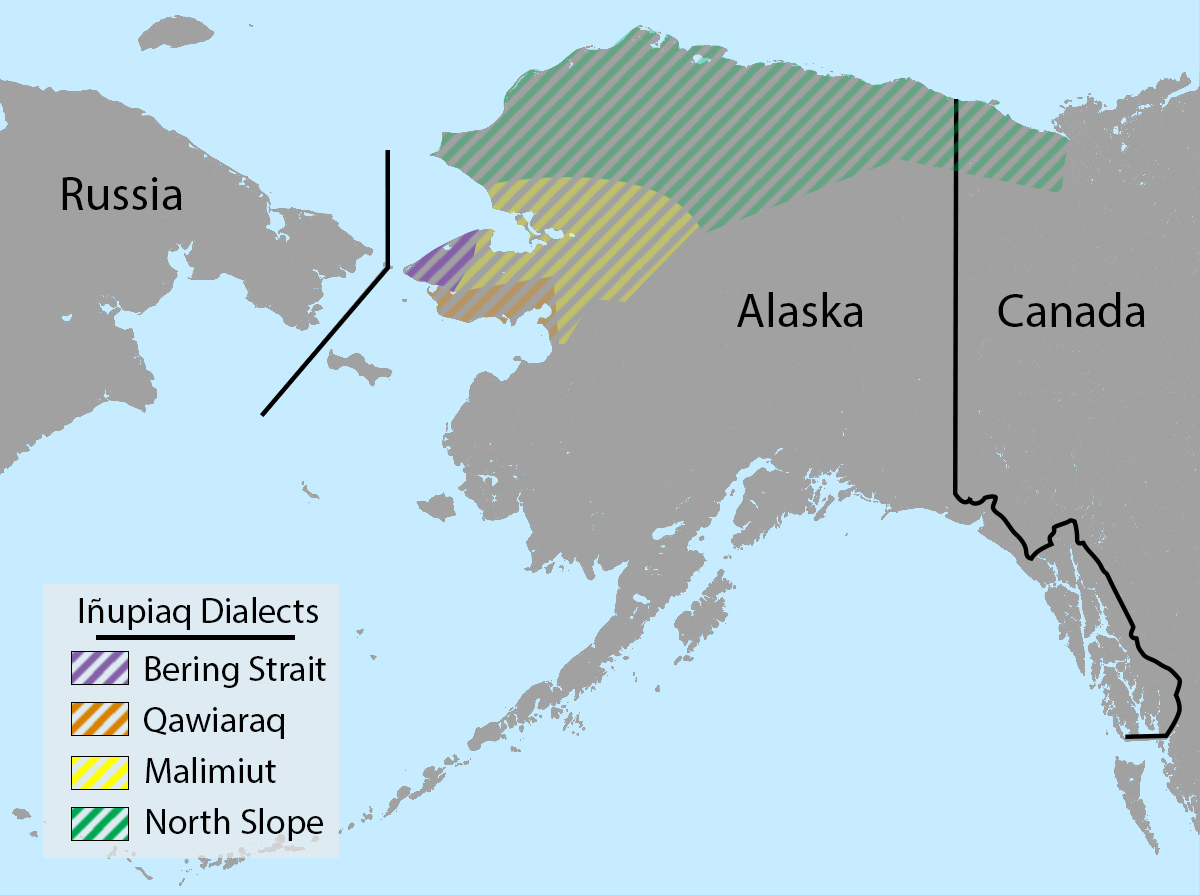
Iñupiaq or Inupiaq (/ɪ.ˈnuː.pi.æk/ ih-NOO-pee-ak, Inupiaq: [iɲupiaq]), also known as Iñupiat, Inupiat (/ɪ.ˈnuː.pi.æt/ ih-NOO-pee-at), Iñupiatun or Alaskan Inuit, is an Inuit language, or perhaps group of languages, spoken by the Iñupiat people in northern and northwestern Alaska, as well as a small adjacent part of the Northwest Territories of Canada. The Iñupiat language is a member of the Inuit–Yupik–Unangan language family, and is closely related and, to varying degrees, mutually intelligible with other Inuit languages of Canada and Greenland. There are roughly 2,000 speakers. Iñupiaq is considered to be a threatened language, with most speakers at or above the age of 40. Iñupiaq is an official language of the State of Alaska, along with several other indigenous languages.
The major varieties of the Iñupiaq language are the North Slope Iñupiaq and Seward Peninsula Iñupiaq dialects.
The Iñupiaq language has been in decline since contact with English in the late 19th century. American territorial acquisition and the legacy of boarding schools have created a situation today where a small minority of Iñupiat speak the Iñupiaq language. There is, however, revitalization work underway today in several communities.
The Iñupiaq language is an Inuit language, the ancestors of which may have been spoken in the northern regions of Alaska for as long as 5,000 years. Between 1,000 and 800 years ago, Inuit migrated east from Alaska to Canada and Greenland, eventually occupying the entire Arctic coast and much of the surrounding inland areas. The Iñupiaq dialects are the most conservative forms of the Inuit language, with less linguistic change than the other Inuit languages.[citation needed]
In the mid to late 19th century, Russian, British, and American colonists made contact with Iñupiat people. In 1885, the American territorial government appointed Rev. Sheldon Jackson as General Agent of Education. Under his administration, Iñupiat people (and all Alaska Natives) were educated in English-only environments, forbidding the use of Iñupiaq and other indigenous languages of Alaska. After decades of English-only education, with strict punishment if heard speaking Iñupiaq, after the 1970s, most Iñupiat did not pass the Iñupiaq language on to their children, for fear of them being punished for speaking their language.
In 1972, the Alaska Legislature passed legislation mandating that if "a [school is attended] by at least 15 pupils whose primary language is other than English, [then the school] shall have at least one teacher who is fluent in the native language".
Today, the University of Alaska Fairbanks offers bachelor's degrees in Iñupiaq language and culture, while a preschool/kindergarten-level Iñupiaq immersion school named Nikaitchuat Iḷisaġviat teaches grades PreK–1st grade in Kotzebue.
In 2014, Iñupiaq became an official language of the State of Alaska, alongside English and nineteen other indigenous languages. In the same year, Iñupiat linguist and educator Edna Ahgeak MacLean published an Iñupiaq - English grammar and dictionary with over 19,000 entries. An online version was later released by her.
Hub AI
Iñupiaq language AI simulator
(@Iñupiaq language_simulator)
Iñupiaq language
Iñupiaq or Inupiaq (/ɪ.ˈnuː.pi.æk/ ih-NOO-pee-ak, Inupiaq: [iɲupiaq]), also known as Iñupiat, Inupiat (/ɪ.ˈnuː.pi.æt/ ih-NOO-pee-at), Iñupiatun or Alaskan Inuit, is an Inuit language, or perhaps group of languages, spoken by the Iñupiat people in northern and northwestern Alaska, as well as a small adjacent part of the Northwest Territories of Canada. The Iñupiat language is a member of the Inuit–Yupik–Unangan language family, and is closely related and, to varying degrees, mutually intelligible with other Inuit languages of Canada and Greenland. There are roughly 2,000 speakers. Iñupiaq is considered to be a threatened language, with most speakers at or above the age of 40. Iñupiaq is an official language of the State of Alaska, along with several other indigenous languages.
The major varieties of the Iñupiaq language are the North Slope Iñupiaq and Seward Peninsula Iñupiaq dialects.
The Iñupiaq language has been in decline since contact with English in the late 19th century. American territorial acquisition and the legacy of boarding schools have created a situation today where a small minority of Iñupiat speak the Iñupiaq language. There is, however, revitalization work underway today in several communities.
The Iñupiaq language is an Inuit language, the ancestors of which may have been spoken in the northern regions of Alaska for as long as 5,000 years. Between 1,000 and 800 years ago, Inuit migrated east from Alaska to Canada and Greenland, eventually occupying the entire Arctic coast and much of the surrounding inland areas. The Iñupiaq dialects are the most conservative forms of the Inuit language, with less linguistic change than the other Inuit languages.[citation needed]
In the mid to late 19th century, Russian, British, and American colonists made contact with Iñupiat people. In 1885, the American territorial government appointed Rev. Sheldon Jackson as General Agent of Education. Under his administration, Iñupiat people (and all Alaska Natives) were educated in English-only environments, forbidding the use of Iñupiaq and other indigenous languages of Alaska. After decades of English-only education, with strict punishment if heard speaking Iñupiaq, after the 1970s, most Iñupiat did not pass the Iñupiaq language on to their children, for fear of them being punished for speaking their language.
In 1972, the Alaska Legislature passed legislation mandating that if "a [school is attended] by at least 15 pupils whose primary language is other than English, [then the school] shall have at least one teacher who is fluent in the native language".
Today, the University of Alaska Fairbanks offers bachelor's degrees in Iñupiaq language and culture, while a preschool/kindergarten-level Iñupiaq immersion school named Nikaitchuat Iḷisaġviat teaches grades PreK–1st grade in Kotzebue.
In 2014, Iñupiaq became an official language of the State of Alaska, alongside English and nineteen other indigenous languages. In the same year, Iñupiat linguist and educator Edna Ahgeak MacLean published an Iñupiaq - English grammar and dictionary with over 19,000 entries. An online version was later released by her.