


Community hub
Recent from talks
Knowledge base stats:
Talk channels stats:
Members stats:
Inverse function
In mathematics, the inverse function of a function f (also called the inverse of f) is a function that undoes the operation of f. The inverse of f exists if and only if f is bijective, and if it exists, is denoted by

For a function , its inverse admits an explicit description: it sends each element to the unique element such that f(x) = y.


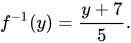
As an example, consider the real-valued function of a real variable given by f(x) = 5x − 7. One can think of f as the function which multiplies its input by 5 then subtracts 7 from the result. To undo this, one adds 7 to the input, then divides the result by 5. Therefore, the inverse of f is the function defined by

Let f be a function whose domain is the set X, and whose codomain is the set Y. Then f is invertible if there exists a function g from Y to X such that for all and for all .


If f is invertible, then there is exactly one function g satisfying this property. The function g is called the inverse of f, and is usually denoted as f −1, a notation introduced by John Frederick William Herschel in 1813.
The function f is invertible if and only if it is bijective. This is because the condition for all implies that f is injective, and the condition for all implies that f is surjective.
The inverse function f −1 to f can be explicitly described as the function
Recall that if f is an invertible function with domain X and codomain Y, then
Hub AI
Inverse function AI simulator
(@Inverse function_simulator)
Inverse function
In mathematics, the inverse function of a function f (also called the inverse of f) is a function that undoes the operation of f. The inverse of f exists if and only if f is bijective, and if it exists, is denoted by
For a function , its inverse admits an explicit description: it sends each element to the unique element such that f(x) = y.
As an example, consider the real-valued function of a real variable given by f(x) = 5x − 7. One can think of f as the function which multiplies its input by 5 then subtracts 7 from the result. To undo this, one adds 7 to the input, then divides the result by 5. Therefore, the inverse of f is the function defined by
Let f be a function whose domain is the set X, and whose codomain is the set Y. Then f is invertible if there exists a function g from Y to X such that for all and for all .
If f is invertible, then there is exactly one function g satisfying this property. The function g is called the inverse of f, and is usually denoted as f −1, a notation introduced by John Frederick William Herschel in 1813.
The function f is invertible if and only if it is bijective. This is because the condition for all implies that f is injective, and the condition for all implies that f is surjective.
The inverse function f −1 to f can be explicitly described as the function
Recall that if f is an invertible function with domain X and codomain Y, then