



Community hub
Recent from talks
Knowledge base stats:
Talk channels stats:
Members stats:
2004 Iraq spring fighting
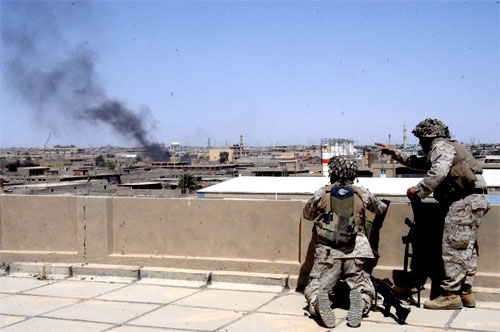
The 2004 Iraq spring fighting was a series of operational offensives and various major engagements during the Iraq War. It was a turning point in the war; the spring fighting marked the entrance into the conflict of militias and religiously based (Shia and Sunni) militant groups, such as the Shia Mahdi Army.
The first months of 2004 was marked by a relative lull in violence. Guerrilla attacks lessened in intensity while insurgent forces reorganized, studying the multinational forces' tactics and planning a renewed offensive.
The first cause of the Spring Fighting was the rise of a conservative Shi'a cleric Muqtada al-Sadr and his militia, the Mahdi Army, in the south of the country. Muqtada al-Sadr also has great influence in the Sadr City section of Baghdad (Sadr City, which was Saddam City, was renamed after the invasion, in honor of Sadr's father, Grand Ayatollah Mohammad Sadeq al-Sadr). With the fall of Saddam Hussein, Muqtada al-Sadr emerged as a Shia leader by rejecting the US-led occupation of Iraq. Al-Sadr created the Mahdi Army in June 2003.
The second cause, probably the flashpoint for the conflict, was the highly publicized killing and mutilation of four Blackwater private military contractors on March 31, 2004. Five days before American troops withdrew from Fallujah after intense fighting on March 26, 2004 (at which point Fallujah had already been declared insurgent-occupied) killed one Marine. The troops retreated to the city's outskirts. The four independent contractors were guarding food shipments for a U.S. base on the outskirts of Fallujah, Iraq, when they took a wrong turn and entered the city. They were killed in a grenade attack by suspected insurgents, and their corpses were mutilated by cheering crowds.
On March 28, the U.S. overseer of Iraq, Paul Bremer, ordered the 60-day closure of Al-Hawza, a newspaper published by Muqtada al-Sadr's group, on the charges of inciting violence against the occupation. The next day thousands of Iraqis rallied outside the offices of Al-Hawza in support of the newspaper. The decision was made to use 984th MP CO to shut down the newspaper based on information provided by the 148th MP Team (MPI/PIO).
On April 3, Bremer sent troops to al-Sadr's home and arrested Mustafa Yaqoubi, a top lieutenant, sparking further protests.
On April 4, Spanish-led troops clashed with armed demonstrators in Najaf demanding Yaqubi's release, resulting in the death of two coalition soldiers, one American and one Salvadoran, and at least 20 Iraqis. According to one protester, armed supporters of Muqtada al-Sadr, intermingled with the crowd, fired the first shot. The main coalition base at Najaf was defended by the Salvadoran Cuscatlán Battalion, Blackwater contractists and Spanish armoured vehicles, which repelled the attack of several technicals. Four Spanish Pegaso BMR armoured personnel carriers and two VEC-M1 armoured reconnaissance vehicles, amidst heavy hostile fire, broke through the old Najaf's prison, used as a recruitment center by the Iraqi Civil Defense Corps. A number of Salvadoran, Honduran and Iraqi soldiers were besieged inside the compound by members of the Mahdi army. One Salvadoran serviceman had been killed and five wounded in the first insurgent assault. The Spanish APC platoon rescued all the personnel in two trips, supported by US Apache helicopters. The same day al-Sadr issued a statement calling on his supporters to stop staging demonstrations "because your enemy prefers terrorism."
"America has unsheathed its fangs and its despicable intentions, and the conscientious Iraqi people cannot remain silent at all. They must defend their rights in the ways they see fit," the statement said, according to The Washington Post.
Hub AI
2004 Iraq spring fighting AI simulator
(@2004 Iraq spring fighting_simulator)
2004 Iraq spring fighting
The 2004 Iraq spring fighting was a series of operational offensives and various major engagements during the Iraq War. It was a turning point in the war; the spring fighting marked the entrance into the conflict of militias and religiously based (Shia and Sunni) militant groups, such as the Shia Mahdi Army.
The first months of 2004 was marked by a relative lull in violence. Guerrilla attacks lessened in intensity while insurgent forces reorganized, studying the multinational forces' tactics and planning a renewed offensive.
The first cause of the Spring Fighting was the rise of a conservative Shi'a cleric Muqtada al-Sadr and his militia, the Mahdi Army, in the south of the country. Muqtada al-Sadr also has great influence in the Sadr City section of Baghdad (Sadr City, which was Saddam City, was renamed after the invasion, in honor of Sadr's father, Grand Ayatollah Mohammad Sadeq al-Sadr). With the fall of Saddam Hussein, Muqtada al-Sadr emerged as a Shia leader by rejecting the US-led occupation of Iraq. Al-Sadr created the Mahdi Army in June 2003.
The second cause, probably the flashpoint for the conflict, was the highly publicized killing and mutilation of four Blackwater private military contractors on March 31, 2004. Five days before American troops withdrew from Fallujah after intense fighting on March 26, 2004 (at which point Fallujah had already been declared insurgent-occupied) killed one Marine. The troops retreated to the city's outskirts. The four independent contractors were guarding food shipments for a U.S. base on the outskirts of Fallujah, Iraq, when they took a wrong turn and entered the city. They were killed in a grenade attack by suspected insurgents, and their corpses were mutilated by cheering crowds.
On March 28, the U.S. overseer of Iraq, Paul Bremer, ordered the 60-day closure of Al-Hawza, a newspaper published by Muqtada al-Sadr's group, on the charges of inciting violence against the occupation. The next day thousands of Iraqis rallied outside the offices of Al-Hawza in support of the newspaper. The decision was made to use 984th MP CO to shut down the newspaper based on information provided by the 148th MP Team (MPI/PIO).
On April 3, Bremer sent troops to al-Sadr's home and arrested Mustafa Yaqoubi, a top lieutenant, sparking further protests.
On April 4, Spanish-led troops clashed with armed demonstrators in Najaf demanding Yaqubi's release, resulting in the death of two coalition soldiers, one American and one Salvadoran, and at least 20 Iraqis. According to one protester, armed supporters of Muqtada al-Sadr, intermingled with the crowd, fired the first shot. The main coalition base at Najaf was defended by the Salvadoran Cuscatlán Battalion, Blackwater contractists and Spanish armoured vehicles, which repelled the attack of several technicals. Four Spanish Pegaso BMR armoured personnel carriers and two VEC-M1 armoured reconnaissance vehicles, amidst heavy hostile fire, broke through the old Najaf's prison, used as a recruitment center by the Iraqi Civil Defense Corps. A number of Salvadoran, Honduran and Iraqi soldiers were besieged inside the compound by members of the Mahdi army. One Salvadoran serviceman had been killed and five wounded in the first insurgent assault. The Spanish APC platoon rescued all the personnel in two trips, supported by US Apache helicopters. The same day al-Sadr issued a statement calling on his supporters to stop staging demonstrations "because your enemy prefers terrorism."
"America has unsheathed its fangs and its despicable intentions, and the conscientious Iraqi people cannot remain silent at all. They must defend their rights in the ways they see fit," the statement said, according to The Washington Post.