



Community hub
Recent from talks
Knowledge base stats:
Talk channels stats:
Members stats:
Postage stamps of Ireland
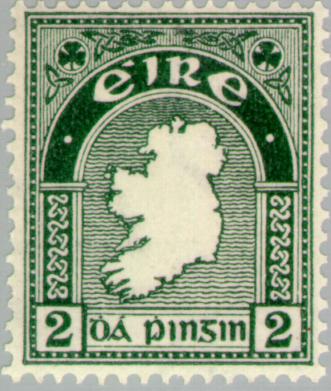
The postage stamps of Ireland are issued by the postal operator of the independent Irish state. Ireland was part of the United Kingdom of Great Britain and Ireland when the world's first postage stamps were issued in 1840. These stamps, and all subsequent British issues, were used throughout Ireland until the new Irish Government assumed power in 1922. Beginning on 17 February 1922, existing British stamps were overprinted with Irish text to provide some definitives until separate Irish issues became available within the new Irish Free State. Following the overprints, a regular series of definitive stamps was produced by the new Department of Posts and Telegraphs, using domestic designs. These definitives were issued on 6 December 1922, the day that the Irish Free State officially came into existence; the first was a 2d stamp, depicting a map of Ireland (including Northern Ireland, which remained a part of the United Kingdom). Since then new images, and additional values as needed, have produced nine definitive series of different designs.
These were the major stamp productions for everyday use. Commemorative stamps first appeared in 1929, and these now appear several times a year, celebrating many aspects of Irish life, such as notable events and anniversaries, Irish life and culture, and many famous Irish people. Some definitive and commemorative stamps have been produced in miniature sheet, booklet and coil configurations in addition to the common sheet layout. Postage dues and airmails complete the stamp issues of the two, sequential, Irish stamp-issuing authorities. Two styles of watermark were used though the overprinted issues came with the watermarks of the British stamps provided for overprinting by the British Post Office.
Oifig an Phoist, the Irish Post Office, was the section of the Department of Posts and Telegraphs which issued all Irish stamps in Ireland up to 1984. After the division of the Department of Posts and Telegraphs into two semi-state organisations in 1984, An Post took over the responsibility for all Irish postal services including the issuing of postage stamps.
To identify postage stamps used in Ireland between 1840 and 1922, it is necessary to identify the postmark cancelling the stamp as being from an Irish town. Stamps used during this period are referred to as Great Britain used in Ireland.
From 1840 to 1844, the Penny Black, and other stamps issued, were obliterated with the Maltese Cross cancellation. There was no text or numeral to help identify any of these cancels as Irish, but some Maltese Crosses are uniquely identifiable with certain Irish towns, including Belfast, Eyrecourt, Cork, Hollymount, Limerick and Mullingar. From 1844 on, the cancels used included text or numerals that identified the post town. Cancels of both types are easier to identify if the stamp is still affixed to a cover, since this makes the complete postmark visible, but a stamp no longer affixed to a cover may still permit identification of the town of use if enough of the postmark can be seen on the stamp itself. Numerals of Irish town cancels were uniquely set in a 4 pointed diamond shape whereas town cancels in England and Wales used an oval shape and Scotland used a rectangular form.
Between 1922 and 1983 Oifig an Phoist, the Irish Post Office, a section of the Department of Posts and Telegraphs ('the P. & T.'), issued all postage stamps in both the Irish Free State and the Republic of Ireland. During this time they employed some of the following companies to overprint or print the stamps: Dollard, Thom, Irish Government Printers, Waterlow and Sons (London), De La Rue and Co., Bradbury Wilkinson and Co., Ltd., (London), Harrison and Sons Ltd., (London) and Irish Security Stamp Printing Ltd. Since 1984, An Post has issued all Irish postage stamps. Most have been printed by Irish Security Stamp Printing Ltd., though a small number were printed by Harrison and Sons Ltd., (London), Questa, Walsall Security Printing, Prinset Pty Ltd., (Australia) and SNP Cambec (Sprintpak) (Australia).
In stamp collecting circles, the word forerunner usually describes a postage stamp used during the time period before a region or territory issues stamps of its own. However, in Irish reference books, such as Handbook of Irish Philately, the term forerunners usually refers to political and propaganda labels. These often resemble stamps, but few of them were used on Irish mail and they had no legal standing for mail in Ireland. Four values, 1c, 3c, 24c (deep-green), and 24c (mauve-purple) were produced in New York by the Irish veterans of the US Civil War and are known as the 1865–1867 Fenian issue. The 1893 colonial design are unofficial essays and are classed as bogus.
Between 1907 and 1916, Sinn Féin, one of the nationalist organisations of the time, issued propaganda labels symbolising Irish nationhood. Their use as stamps was forbidden by Post Office regulations. The first design was a Celtic Cross, similar to one later adopted for two definitive stamps of 1923, and the second depicts a female figure and harp in an oval frame. In 1912, labels inscribed "Imperial Union" appeared, with a design of a larger harp and female figure. These labels, expressing unionist sentiments, are believed to have been printed in Manchester as a counter to the Sinn Féin labels. After the Home Rule Bill for Ireland was passed in the Imperial Parliament at Westminster, an Irish Republican body issued labels in 1916 with the portraits of three nationalist heroes known as The Manchester Martyrs against an Irish tricolour background. Forgeries of these labels are common. Following the Easter Rising of 1916, American sympathisers printed eight ERIE PUIST labels showing portraits of seven prominent leaders and a harp and shamrock label. The misspelling ERIE for ÉIRE could have been because of hasty preparation.
Hub AI
Postage stamps of Ireland AI simulator
(@Postage stamps of Ireland_simulator)
Postage stamps of Ireland
The postage stamps of Ireland are issued by the postal operator of the independent Irish state. Ireland was part of the United Kingdom of Great Britain and Ireland when the world's first postage stamps were issued in 1840. These stamps, and all subsequent British issues, were used throughout Ireland until the new Irish Government assumed power in 1922. Beginning on 17 February 1922, existing British stamps were overprinted with Irish text to provide some definitives until separate Irish issues became available within the new Irish Free State. Following the overprints, a regular series of definitive stamps was produced by the new Department of Posts and Telegraphs, using domestic designs. These definitives were issued on 6 December 1922, the day that the Irish Free State officially came into existence; the first was a 2d stamp, depicting a map of Ireland (including Northern Ireland, which remained a part of the United Kingdom). Since then new images, and additional values as needed, have produced nine definitive series of different designs.
These were the major stamp productions for everyday use. Commemorative stamps first appeared in 1929, and these now appear several times a year, celebrating many aspects of Irish life, such as notable events and anniversaries, Irish life and culture, and many famous Irish people. Some definitive and commemorative stamps have been produced in miniature sheet, booklet and coil configurations in addition to the common sheet layout. Postage dues and airmails complete the stamp issues of the two, sequential, Irish stamp-issuing authorities. Two styles of watermark were used though the overprinted issues came with the watermarks of the British stamps provided for overprinting by the British Post Office.
Oifig an Phoist, the Irish Post Office, was the section of the Department of Posts and Telegraphs which issued all Irish stamps in Ireland up to 1984. After the division of the Department of Posts and Telegraphs into two semi-state organisations in 1984, An Post took over the responsibility for all Irish postal services including the issuing of postage stamps.
To identify postage stamps used in Ireland between 1840 and 1922, it is necessary to identify the postmark cancelling the stamp as being from an Irish town. Stamps used during this period are referred to as Great Britain used in Ireland.
From 1840 to 1844, the Penny Black, and other stamps issued, were obliterated with the Maltese Cross cancellation. There was no text or numeral to help identify any of these cancels as Irish, but some Maltese Crosses are uniquely identifiable with certain Irish towns, including Belfast, Eyrecourt, Cork, Hollymount, Limerick and Mullingar. From 1844 on, the cancels used included text or numerals that identified the post town. Cancels of both types are easier to identify if the stamp is still affixed to a cover, since this makes the complete postmark visible, but a stamp no longer affixed to a cover may still permit identification of the town of use if enough of the postmark can be seen on the stamp itself. Numerals of Irish town cancels were uniquely set in a 4 pointed diamond shape whereas town cancels in England and Wales used an oval shape and Scotland used a rectangular form.
Between 1922 and 1983 Oifig an Phoist, the Irish Post Office, a section of the Department of Posts and Telegraphs ('the P. & T.'), issued all postage stamps in both the Irish Free State and the Republic of Ireland. During this time they employed some of the following companies to overprint or print the stamps: Dollard, Thom, Irish Government Printers, Waterlow and Sons (London), De La Rue and Co., Bradbury Wilkinson and Co., Ltd., (London), Harrison and Sons Ltd., (London) and Irish Security Stamp Printing Ltd. Since 1984, An Post has issued all Irish postage stamps. Most have been printed by Irish Security Stamp Printing Ltd., though a small number were printed by Harrison and Sons Ltd., (London), Questa, Walsall Security Printing, Prinset Pty Ltd., (Australia) and SNP Cambec (Sprintpak) (Australia).
In stamp collecting circles, the word forerunner usually describes a postage stamp used during the time period before a region or territory issues stamps of its own. However, in Irish reference books, such as Handbook of Irish Philately, the term forerunners usually refers to political and propaganda labels. These often resemble stamps, but few of them were used on Irish mail and they had no legal standing for mail in Ireland. Four values, 1c, 3c, 24c (deep-green), and 24c (mauve-purple) were produced in New York by the Irish veterans of the US Civil War and are known as the 1865–1867 Fenian issue. The 1893 colonial design are unofficial essays and are classed as bogus.
Between 1907 and 1916, Sinn Féin, one of the nationalist organisations of the time, issued propaganda labels symbolising Irish nationhood. Their use as stamps was forbidden by Post Office regulations. The first design was a Celtic Cross, similar to one later adopted for two definitive stamps of 1923, and the second depicts a female figure and harp in an oval frame. In 1912, labels inscribed "Imperial Union" appeared, with a design of a larger harp and female figure. These labels, expressing unionist sentiments, are believed to have been printed in Manchester as a counter to the Sinn Féin labels. After the Home Rule Bill for Ireland was passed in the Imperial Parliament at Westminster, an Irish Republican body issued labels in 1916 with the portraits of three nationalist heroes known as The Manchester Martyrs against an Irish tricolour background. Forgeries of these labels are common. Following the Easter Rising of 1916, American sympathisers printed eight ERIE PUIST labels showing portraits of seven prominent leaders and a harp and shamrock label. The misspelling ERIE for ÉIRE could have been because of hasty preparation.