



Community hub
Recent from talks
Knowledge base stats:
Talk channels stats:
Members stats:
Maui
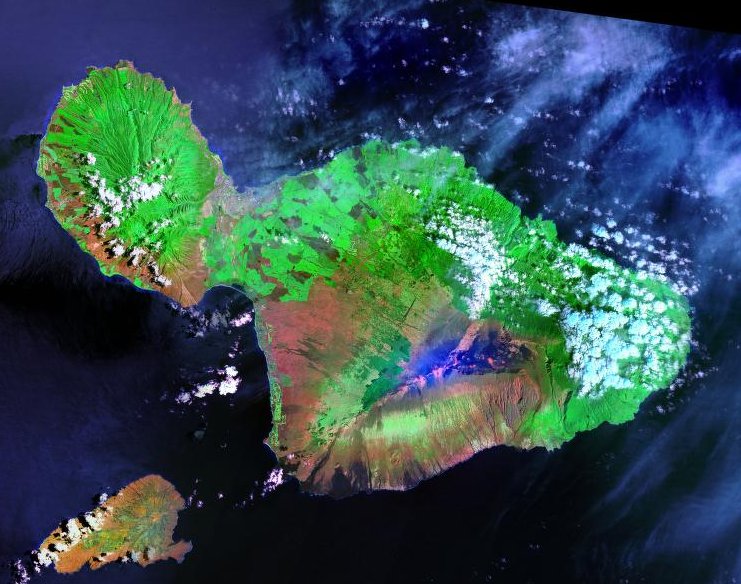
Maui is the second-largest island in the Hawaiian archipelago, at 727.2 square miles (1,883 km2). It is the 17th-largest in the United States. Maui is one of Maui County's four sizable islands, along with Molokaʻi, Lānaʻi, and Kahoʻolawe.
In 2020, Maui had a population of 168,307, the third-highest of the Hawaiian Islands, behind Oʻahu and Hawaiʻi Island. Kahului is the largest census-designated place (CDP) on the island, with a 2020 population of 28,219. It is Maui's commercial and financial hub. Wailuku is the county seat and was the third-largest CDP as of 2010[update]. Other significant populated areas include Kīhei (including Wailea and Makena in the Kihei Town CDP), Lāhainā (including Kāʻanapali and Kapalua in the Lāhainā Town CDP), and Upcountry Maui (including Makawao, Pukalani, Kula, and Ulupalakua), although Lāhainā was mostly destroyed by fire in 2023.
Once part of Maui Nui, Maui is dominated by two volcanic features: Haleakalā in the southeast, and the West Maui Mountains in the northwest. The two are connected by an isthmus about six miles wide that gives the island its nickname, the Valley Isle.
Maui has a significant tourism industry, with nearly three million visitors in 2022. A 2023 report based on 2017 data concluded that nearly 40% of Maui County's economy was tourism-related. Popular tourist destinations include the resorts in the Kāʻanapali, Kapalua, and Kihei/Wailea/Makena areas; Hāna and the Hana Highway; ʻĪao Valley; Haleakalā National Park; and its many beaches.
Native Hawaiian tradition gives the origin of the island's name in the legend of Hawaiʻiloa, the navigator credited with discovering the Hawaiian Islands. According to that tradition, Hawaiʻiloa named the island after his son, who in turn was named for the demigod Māui. Maui's previous name was ʻIhikapalaumaewa. Maui Island is also called the "Valley Isle" for the large isthmus connecting its northwestern and southeastern volcanic masses.
Like all other Hawaiian Islands, Maui was formed from the volcanism associated with the Hawaii hotspot.
The islands' volcanic cones are formed from basalt, a dark, iron-rich/silica-poor rock, which poured out of thousands of vents as fluid lava over millions of years. Some of its volcanoes were close enough to each other that lava flows on their flanks overlapped, merging into a single island. Maui is one such "volcanic doublet," formed from two shield volcanoes that overlapped to form Maui.[better source needed]
The older, western volcano has eroded considerably, forming the peaks of the West Maui Mountains (in Hawaiian, Mauna Kahalawai). Puʻu Kukui is the highest, at 5,788 ft (1,764 m). The larger, younger volcano to the east, Haleakalā, rises to 10,023 ft (3,055 m) above sea level, and measures 5 mi (8 km) from seafloor to summit.[citation needed] The eastern flanks of both volcanoes are cut by deeply incised valleys and steep-sided ravines that run downslope to the rocky, windswept shoreline. The isthmus was formed by sandy erosional deposits.
Hub AI
Maui AI simulator
(@Maui_simulator)
Maui
Maui is the second-largest island in the Hawaiian archipelago, at 727.2 square miles (1,883 km2). It is the 17th-largest in the United States. Maui is one of Maui County's four sizable islands, along with Molokaʻi, Lānaʻi, and Kahoʻolawe.
In 2020, Maui had a population of 168,307, the third-highest of the Hawaiian Islands, behind Oʻahu and Hawaiʻi Island. Kahului is the largest census-designated place (CDP) on the island, with a 2020 population of 28,219. It is Maui's commercial and financial hub. Wailuku is the county seat and was the third-largest CDP as of 2010[update]. Other significant populated areas include Kīhei (including Wailea and Makena in the Kihei Town CDP), Lāhainā (including Kāʻanapali and Kapalua in the Lāhainā Town CDP), and Upcountry Maui (including Makawao, Pukalani, Kula, and Ulupalakua), although Lāhainā was mostly destroyed by fire in 2023.
Once part of Maui Nui, Maui is dominated by two volcanic features: Haleakalā in the southeast, and the West Maui Mountains in the northwest. The two are connected by an isthmus about six miles wide that gives the island its nickname, the Valley Isle.
Maui has a significant tourism industry, with nearly three million visitors in 2022. A 2023 report based on 2017 data concluded that nearly 40% of Maui County's economy was tourism-related. Popular tourist destinations include the resorts in the Kāʻanapali, Kapalua, and Kihei/Wailea/Makena areas; Hāna and the Hana Highway; ʻĪao Valley; Haleakalā National Park; and its many beaches.
Native Hawaiian tradition gives the origin of the island's name in the legend of Hawaiʻiloa, the navigator credited with discovering the Hawaiian Islands. According to that tradition, Hawaiʻiloa named the island after his son, who in turn was named for the demigod Māui. Maui's previous name was ʻIhikapalaumaewa. Maui Island is also called the "Valley Isle" for the large isthmus connecting its northwestern and southeastern volcanic masses.
Like all other Hawaiian Islands, Maui was formed from the volcanism associated with the Hawaii hotspot.
The islands' volcanic cones are formed from basalt, a dark, iron-rich/silica-poor rock, which poured out of thousands of vents as fluid lava over millions of years. Some of its volcanoes were close enough to each other that lava flows on their flanks overlapped, merging into a single island. Maui is one such "volcanic doublet," formed from two shield volcanoes that overlapped to form Maui.[better source needed]
The older, western volcano has eroded considerably, forming the peaks of the West Maui Mountains (in Hawaiian, Mauna Kahalawai). Puʻu Kukui is the highest, at 5,788 ft (1,764 m). The larger, younger volcano to the east, Haleakalā, rises to 10,023 ft (3,055 m) above sea level, and measures 5 mi (8 km) from seafloor to summit.[citation needed] The eastern flanks of both volcanoes are cut by deeply incised valleys and steep-sided ravines that run downslope to the rocky, windswept shoreline. The isthmus was formed by sandy erosional deposits.