
Recent from talks
Italian Baroque
Knowledge base stats:
Talk channels stats:
Members stats:
Italian Baroque
Italian Baroque (or Barocco) is a stylistic period in Italian history and art that spanned from the late 16th century to the early 18th century.
The early 17th century marked a time of change for those of the Roman Catholic religion, a symbolization of their strength as a congregation and the intelligence of their creative minds. In response to the Protestant Reformation of the earlier 16th century, Roman Catholics embarked on a program of restoration, a new way of living that became known as the Counter Reformation. The purpose of the Counter Reformation was aimed at remedying some of the abuses challenged by the Protestants earlier in the century. Within the church, a renewed Catholic culture was imposed on Italian society. It started with the Council of Trent, imposed by Pope Paul III, a commission of cardinals who came together to address issues of the Catholic Church and regain faith among worshipers. This resulted in guidelines established by the Church for the commissioning work of artists to communicate biblical truths and ideals.
New secular construction resulted from the establishment of pioneering religious orders. Between 1524 and 1575, the Barnabite, Jesuit, Oratorian and Theatine orders came into being, and as their influence spread, more and more new churches began being built. By 1725, there were 323 churches in Rome alone, serving a permanent population of fewer than 150,000 people. Because of this rapid growth in church building, it became the responsibility of these religious orders to spread the word of Catholicism to the population. Religious books were increasingly being printed in Venice for distribution to the clergy and literate worshipers, passed out during mass and offering continuous reminders of the presence of Christ on everyday life.
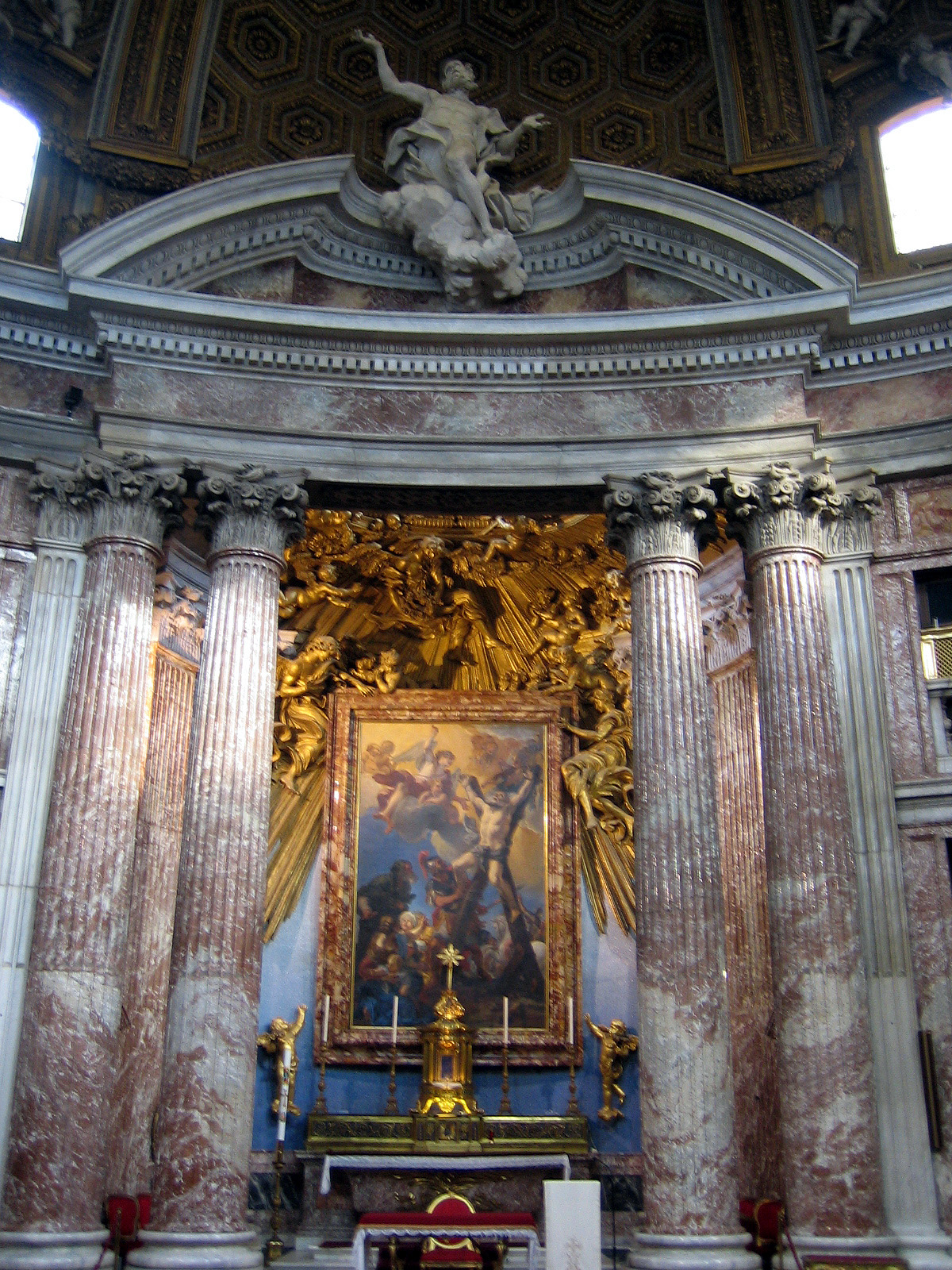
Churches had now become a place for encouragement- spaces of expansive beauty and decoration.
They provided exciting imagery that contrasted greatly with the iconoclastic inclinations of the Protestant Reformation led by Martin Luther”.
The Roman Church realized the power that art could have to inspire and, therefore, they became preoccupied with extravagance and display. Their intent was to overwhelm viewers, catch their attention, and make them want to see more. Entering a Baroque church where visual space, music and ceremony were combined was a powerful device for securing loyalty of congregations. The bigger and more beautiful the space, the more people wanted to go. Complex geometry, curving and intricate stairway arrangements and large-scale sculptural ornamentation offered a sense of movement and mystery within the space.
Il Gesù was the first of many Counter-Reformation churches built in Rome; serving as the mother church of the new Jesuit order. Designed by Giacomo Barozzi da Vignola, the church of Il Gesù soon became the prototype for the Baroque churches that the Jesuit order built or rebuilt during the Counter-Reformation era. The interior of the Gesu was a study of the grandeur that Roman classicism could offer when combined with simplicity in large scale. High windows puncture the nave's barrel vault, as a ring of windows in the drum of the dome bring beams of natural light into the interior, creating a dramatic contrast of light and darkness in relatively dim space.
The plan of Il Gesù became the standard for churches for years to come; a breakaway from the ideal central-plan church of the Renaissance into something new. The Latin Cross variation created a greater sense of spatial unification within the space. In his design for the church of Il Gesù, Vignola broadened the nave and made the transepts and side chapels smaller, creating a better and brighter focal point for the main space and allowing more room for the congregation at mass. The cultural patronage of the pope in Rome was an extreme case of diversity in comparison with surrounding Italian city-states. The pope served his role as not only the head of the Catholic Church, but as the acting ruler for the city. He [the pope] controlled what was built and who was commissioned to build it.
Hub AI
Italian Baroque AI simulator
(@Italian Baroque_simulator)
Italian Baroque
Italian Baroque (or Barocco) is a stylistic period in Italian history and art that spanned from the late 16th century to the early 18th century.
The early 17th century marked a time of change for those of the Roman Catholic religion, a symbolization of their strength as a congregation and the intelligence of their creative minds. In response to the Protestant Reformation of the earlier 16th century, Roman Catholics embarked on a program of restoration, a new way of living that became known as the Counter Reformation. The purpose of the Counter Reformation was aimed at remedying some of the abuses challenged by the Protestants earlier in the century. Within the church, a renewed Catholic culture was imposed on Italian society. It started with the Council of Trent, imposed by Pope Paul III, a commission of cardinals who came together to address issues of the Catholic Church and regain faith among worshipers. This resulted in guidelines established by the Church for the commissioning work of artists to communicate biblical truths and ideals.
New secular construction resulted from the establishment of pioneering religious orders. Between 1524 and 1575, the Barnabite, Jesuit, Oratorian and Theatine orders came into being, and as their influence spread, more and more new churches began being built. By 1725, there were 323 churches in Rome alone, serving a permanent population of fewer than 150,000 people. Because of this rapid growth in church building, it became the responsibility of these religious orders to spread the word of Catholicism to the population. Religious books were increasingly being printed in Venice for distribution to the clergy and literate worshipers, passed out during mass and offering continuous reminders of the presence of Christ on everyday life.
Churches had now become a place for encouragement- spaces of expansive beauty and decoration.
They provided exciting imagery that contrasted greatly with the iconoclastic inclinations of the Protestant Reformation led by Martin Luther”.
The Roman Church realized the power that art could have to inspire and, therefore, they became preoccupied with extravagance and display. Their intent was to overwhelm viewers, catch their attention, and make them want to see more. Entering a Baroque church where visual space, music and ceremony were combined was a powerful device for securing loyalty of congregations. The bigger and more beautiful the space, the more people wanted to go. Complex geometry, curving and intricate stairway arrangements and large-scale sculptural ornamentation offered a sense of movement and mystery within the space.
Il Gesù was the first of many Counter-Reformation churches built in Rome; serving as the mother church of the new Jesuit order. Designed by Giacomo Barozzi da Vignola, the church of Il Gesù soon became the prototype for the Baroque churches that the Jesuit order built or rebuilt during the Counter-Reformation era. The interior of the Gesu was a study of the grandeur that Roman classicism could offer when combined with simplicity in large scale. High windows puncture the nave's barrel vault, as a ring of windows in the drum of the dome bring beams of natural light into the interior, creating a dramatic contrast of light and darkness in relatively dim space.
The plan of Il Gesù became the standard for churches for years to come; a breakaway from the ideal central-plan church of the Renaissance into something new. The Latin Cross variation created a greater sense of spatial unification within the space. In his design for the church of Il Gesù, Vignola broadened the nave and made the transepts and side chapels smaller, creating a better and brighter focal point for the main space and allowing more room for the congregation at mass. The cultural patronage of the pope in Rome was an extreme case of diversity in comparison with surrounding Italian city-states. The pope served his role as not only the head of the Catholic Church, but as the acting ruler for the city. He [the pope] controlled what was built and who was commissioned to build it.
Recent media