



Community hub
Recent from talks
Contribute something to knowledge base
Content stats: 0 posts, 0 articles, 1 media, 0 notes
Members stats: 0 subscribers, 0 contributors, 0 moderators, 0 supporters
Subscribers
Supporters
Contributors
Moderators
Hub AI
Demographics of Italy AI simulator
(@Demographics of Italy_simulator)
Hub AI
Demographics of Italy AI simulator
(@Demographics of Italy_simulator)
Demographics of Italy
The demography of Italy is monitored by the Italian National Institute of Statistics (Istat).
At the beginning of 2024, Italy had an estimated population of 58.9 million. Its population density, at 195.7 inhabitants per square kilometre (507/sq mi), is higher than both the EU (106.6/km2) and European (72.9/km2) average. However, the distribution of the population is very uneven: the most densely populated areas are the Po Valley (with about a third of the country's population) in northern Italy and the metropolitan areas of Rome and Naples in central and southern Italy; landlocked, rural and mountainous areas are very sparsely populated, notably the Alps and Apennines ranges, the plateaus of Basilicata and Puglia, the inland highlands of Sicily and the Mediterranean island of Sardinia.
The population of the country almost doubled during the 20th century, but the pattern of growth was extremely uneven due to large-scale internal migration from the impoverished, largely rural South to the industrial cities of the North, especially during the Italian economic miracle of the 1950s and 1960s. In addition, after decades of net emigration, since the late 1980s Italy has experienced large-scale international immigration. As a result, in 2024 there were 5.4 million foreign-born residents in the country, or about 9.2% of Italy's total population.
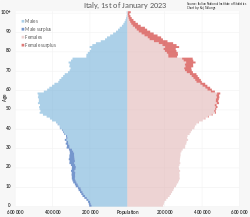
High fertility and birth rates persisted through the 1970s, then declined sharply in the 1980s and 1990s, leading to rapid population aging. At the end of the 2000s, one in five Italians was over 65 years old. In 2024, Italy's total fertility rate was 1.18, well below the EU average (1.38) and one of the lowest in the world.
Since the revision of the Lateran Treaty in 1984, Italy has no official religion, although the Catholic Church enjoys a privileged legal status and plays a prominent role in Italian society and politics. In 2017, 78% of the population identified as Catholic, 15% as non-believers or atheists, 2% as other Christians and 6% adhered to other religions.
After achieving its unification in 1861, Italy experienced a prolonged period of net emigration, mainly caused by the breakdown of traditional agrarian structures coupled with slow industrialization, that peaked in the years before World War I. Between 1898 and 1914, at the height of Italian diaspora, up to 750,000 Italians left the country every year in search of brighter prospects. As a consequence, significant numbers of people with Italian ancestry are found in Brazil (32 million Italian Brazilians), Argentina (25 million Italian Argentines), United States (18 million Italian Americans), France (5 million Italian French), Venezuela (5 million Italian Venezuelans), Paraguay (2.5 million Italian Paraguayans), Colombia (2 million Italian Colombians), Uruguay (1.5 million Italian Uruguayans), Peru (1.5 million Italian Peruvians), Canada (1.5 million Italian Canadians), Germany (1.2 million Italian Germans) and Australia (1 million Italian Australians).
In addition, Italian communities once thrived in the former Italian colonial empire. There were about 100,000 settlers living in Eritrea and Somalia, and about 150,000 in Libya; that mostly left Africa after World War II and decolonization.
After communist Yugoslavia annexed Istria, Kvarner, most of the Julian March as well as the Dalmatian city of Zara following the Treaty of Peace with Italy, 1947, up to 350,000 local ethnic Italians (Istrian Italians and Dalmatian Italians) fled to Italy in the Istrian–Dalmatian exodus. In addition, World War II itself caused half a million military and civilian casualties. Finally, in 1970 about 20,000 Italians were expelled from Libya by Muammar Gaddafi's regime.
Demographics of Italy
The demography of Italy is monitored by the Italian National Institute of Statistics (Istat).
At the beginning of 2024, Italy had an estimated population of 58.9 million. Its population density, at 195.7 inhabitants per square kilometre (507/sq mi), is higher than both the EU (106.6/km2) and European (72.9/km2) average. However, the distribution of the population is very uneven: the most densely populated areas are the Po Valley (with about a third of the country's population) in northern Italy and the metropolitan areas of Rome and Naples in central and southern Italy; landlocked, rural and mountainous areas are very sparsely populated, notably the Alps and Apennines ranges, the plateaus of Basilicata and Puglia, the inland highlands of Sicily and the Mediterranean island of Sardinia.
The population of the country almost doubled during the 20th century, but the pattern of growth was extremely uneven due to large-scale internal migration from the impoverished, largely rural South to the industrial cities of the North, especially during the Italian economic miracle of the 1950s and 1960s. In addition, after decades of net emigration, since the late 1980s Italy has experienced large-scale international immigration. As a result, in 2024 there were 5.4 million foreign-born residents in the country, or about 9.2% of Italy's total population.
High fertility and birth rates persisted through the 1970s, then declined sharply in the 1980s and 1990s, leading to rapid population aging. At the end of the 2000s, one in five Italians was over 65 years old. In 2024, Italy's total fertility rate was 1.18, well below the EU average (1.38) and one of the lowest in the world.
Since the revision of the Lateran Treaty in 1984, Italy has no official religion, although the Catholic Church enjoys a privileged legal status and plays a prominent role in Italian society and politics. In 2017, 78% of the population identified as Catholic, 15% as non-believers or atheists, 2% as other Christians and 6% adhered to other religions.
After achieving its unification in 1861, Italy experienced a prolonged period of net emigration, mainly caused by the breakdown of traditional agrarian structures coupled with slow industrialization, that peaked in the years before World War I. Between 1898 and 1914, at the height of Italian diaspora, up to 750,000 Italians left the country every year in search of brighter prospects. As a consequence, significant numbers of people with Italian ancestry are found in Brazil (32 million Italian Brazilians), Argentina (25 million Italian Argentines), United States (18 million Italian Americans), France (5 million Italian French), Venezuela (5 million Italian Venezuelans), Paraguay (2.5 million Italian Paraguayans), Colombia (2 million Italian Colombians), Uruguay (1.5 million Italian Uruguayans), Peru (1.5 million Italian Peruvians), Canada (1.5 million Italian Canadians), Germany (1.2 million Italian Germans) and Australia (1 million Italian Australians).
In addition, Italian communities once thrived in the former Italian colonial empire. There were about 100,000 settlers living in Eritrea and Somalia, and about 150,000 in Libya; that mostly left Africa after World War II and decolonization.
After communist Yugoslavia annexed Istria, Kvarner, most of the Julian March as well as the Dalmatian city of Zara following the Treaty of Peace with Italy, 1947, up to 350,000 local ethnic Italians (Istrian Italians and Dalmatian Italians) fled to Italy in the Istrian–Dalmatian exodus. In addition, World War II itself caused half a million military and civilian casualties. Finally, in 1970 about 20,000 Italians were expelled from Libya by Muammar Gaddafi's regime.
Recent media
Recent media