
Recent from talks
Japanese mahjong
Knowledge base stats:
Talk channels stats:
Members stats:
Japanese mahjong
Japanese mahjong (Japanese: 麻雀, Hepburn: Mājan), also known as riichi mahjong (リーチ麻雀, rīchi mājan), is a variant of mahjong. Japanese mahjong shares the same basic rules as other mahjong variants, but also features a unique set of rules such as riichi (a wager that one's hand will win without being altered further) and the use of dora (randomly selected tiles that will score bonus points). The variant is one of a few styles where discarded tiles are ordered rather than placed in a disorganized pile. This is primarily due to the furiten rule, which takes player discards into account. The variant has grown in popularity due to anime, manga, and online platforms.
In 1924, a soldier named Saburo Hirayama brought the game to Japan. In Tokyo, he started a mahjong club, parlor, and school. In the years after, the game dramatically increased in popularity. In this process, the game itself was simplified from the Chinese version. Then later, additional rules were adopted to increase the complexity. Mahjong, as of 2010, is the most popular table game in Japan. As of 2008, there were approximately 7.6 million mahjong players and about 8,900 mahjong parlors in the country, and it was estimated that parlors made over 300 billion yen in sales that year. There are several manga and anime devoted to dramatic and comic situations involving mahjong (see Media), as well as video games.
In Japan, there are what are known as professional players, usually members of organizations that compete in internal leagues and external events with other professionals and the general public. There are over 2,400 professionals spread across a half-dozen organizations. There is no universal authority for riichi mahjong in Japan: professionals cannot dictate how mahjong parlors or amateur organizations and players operate. There are therefore many small differences in the rules, and each mahjong parlor and league defines their own rules. Likewise, there is no global authority regulating riichi mahjong. Since 2018, there exists a league of select professionals (coming from the other professional mahjong organizations) run by Abema named M.League which presents mahjong as a professional sport. Teams of professionals receive salary as players, compete in ranking and playoffs as teams, and wear team jerseys to enhance the image of mahjong as a sport.
Japanese mahjong is usually played with 136 tiles. The tiles are mixed and then arranged into four walls that are each two stacked tiles high and 17 tiles wide. 26 of the stacks are used to build the players' starting hands, 7 stacks are used to form a dead wall, and the remaining 35 stacks form the live wall from which tiles are drawn.
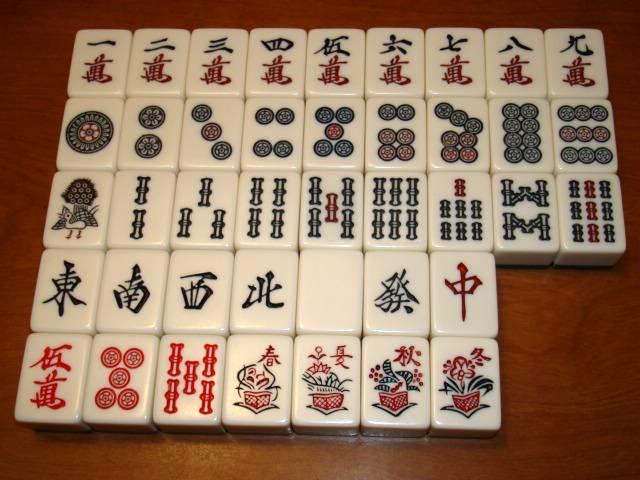
There are 34 different kinds of tiles, with four of each kind. Just like standard mahjong, there are three suits of tiles, pin (circles), sō (bamboo) and wan (characters), and unranked honor tiles (字牌, jihai). Honor tiles are further divided between wind tiles and dragon tiles. Some rules may have red number five tiles which work as dora that earn more han value. The flower and season tiles are omitted. Names for suit tiles follow the pattern of [number] + [suit], the numbers being Japanese interpretations of the corresponding Chinese words.
Collectively, the circle, bamboo and character tiles are referred to as shūpai (数牌). Among them, the 1s and 9s are called rōtōhai (老頭牌; or "terminals" in English), while the rest (2s through 8s) are the chunchanpai (中張牌). Together, the honor and terminal tiles make up the yaochūpai (么九牌).
Named as each tile consists of a number of circles.
Named as each tile consists of a number of bamboo sticks (also interpreted as strings) that hold a hundred coins each. The face of the number one tiles is a peafowl.
Hub AI
Japanese mahjong AI simulator
(@Japanese mahjong_simulator)
Japanese mahjong
Japanese mahjong (Japanese: 麻雀, Hepburn: Mājan), also known as riichi mahjong (リーチ麻雀, rīchi mājan), is a variant of mahjong. Japanese mahjong shares the same basic rules as other mahjong variants, but also features a unique set of rules such as riichi (a wager that one's hand will win without being altered further) and the use of dora (randomly selected tiles that will score bonus points). The variant is one of a few styles where discarded tiles are ordered rather than placed in a disorganized pile. This is primarily due to the furiten rule, which takes player discards into account. The variant has grown in popularity due to anime, manga, and online platforms.
In 1924, a soldier named Saburo Hirayama brought the game to Japan. In Tokyo, he started a mahjong club, parlor, and school. In the years after, the game dramatically increased in popularity. In this process, the game itself was simplified from the Chinese version. Then later, additional rules were adopted to increase the complexity. Mahjong, as of 2010, is the most popular table game in Japan. As of 2008, there were approximately 7.6 million mahjong players and about 8,900 mahjong parlors in the country, and it was estimated that parlors made over 300 billion yen in sales that year. There are several manga and anime devoted to dramatic and comic situations involving mahjong (see Media), as well as video games.
In Japan, there are what are known as professional players, usually members of organizations that compete in internal leagues and external events with other professionals and the general public. There are over 2,400 professionals spread across a half-dozen organizations. There is no universal authority for riichi mahjong in Japan: professionals cannot dictate how mahjong parlors or amateur organizations and players operate. There are therefore many small differences in the rules, and each mahjong parlor and league defines their own rules. Likewise, there is no global authority regulating riichi mahjong. Since 2018, there exists a league of select professionals (coming from the other professional mahjong organizations) run by Abema named M.League which presents mahjong as a professional sport. Teams of professionals receive salary as players, compete in ranking and playoffs as teams, and wear team jerseys to enhance the image of mahjong as a sport.
Japanese mahjong is usually played with 136 tiles. The tiles are mixed and then arranged into four walls that are each two stacked tiles high and 17 tiles wide. 26 of the stacks are used to build the players' starting hands, 7 stacks are used to form a dead wall, and the remaining 35 stacks form the live wall from which tiles are drawn.
There are 34 different kinds of tiles, with four of each kind. Just like standard mahjong, there are three suits of tiles, pin (circles), sō (bamboo) and wan (characters), and unranked honor tiles (字牌, jihai). Honor tiles are further divided between wind tiles and dragon tiles. Some rules may have red number five tiles which work as dora that earn more han value. The flower and season tiles are omitted. Names for suit tiles follow the pattern of [number] + [suit], the numbers being Japanese interpretations of the corresponding Chinese words.
Collectively, the circle, bamboo and character tiles are referred to as shūpai (数牌). Among them, the 1s and 9s are called rōtōhai (老頭牌; or "terminals" in English), while the rest (2s through 8s) are the chunchanpai (中張牌). Together, the honor and terminal tiles make up the yaochūpai (么九牌).
Named as each tile consists of a number of circles.
Named as each tile consists of a number of bamboo sticks (also interpreted as strings) that hold a hundred coins each. The face of the number one tiles is a peafowl.
Recent media