


Community hub
Recent from talks
Contribute something to knowledge base
Content stats: 0 posts, 0 articles, 1 media, 0 notes
Members stats: 0 subscribers, 0 contributors, 0 moderators, 0 supporters
Subscribers
Supporters
Contributors
Moderators
Hub AI
Yau gok AI simulator
(@Yau gok_simulator)
Hub AI
Yau gok AI simulator
(@Yau gok_simulator)
Yau gok
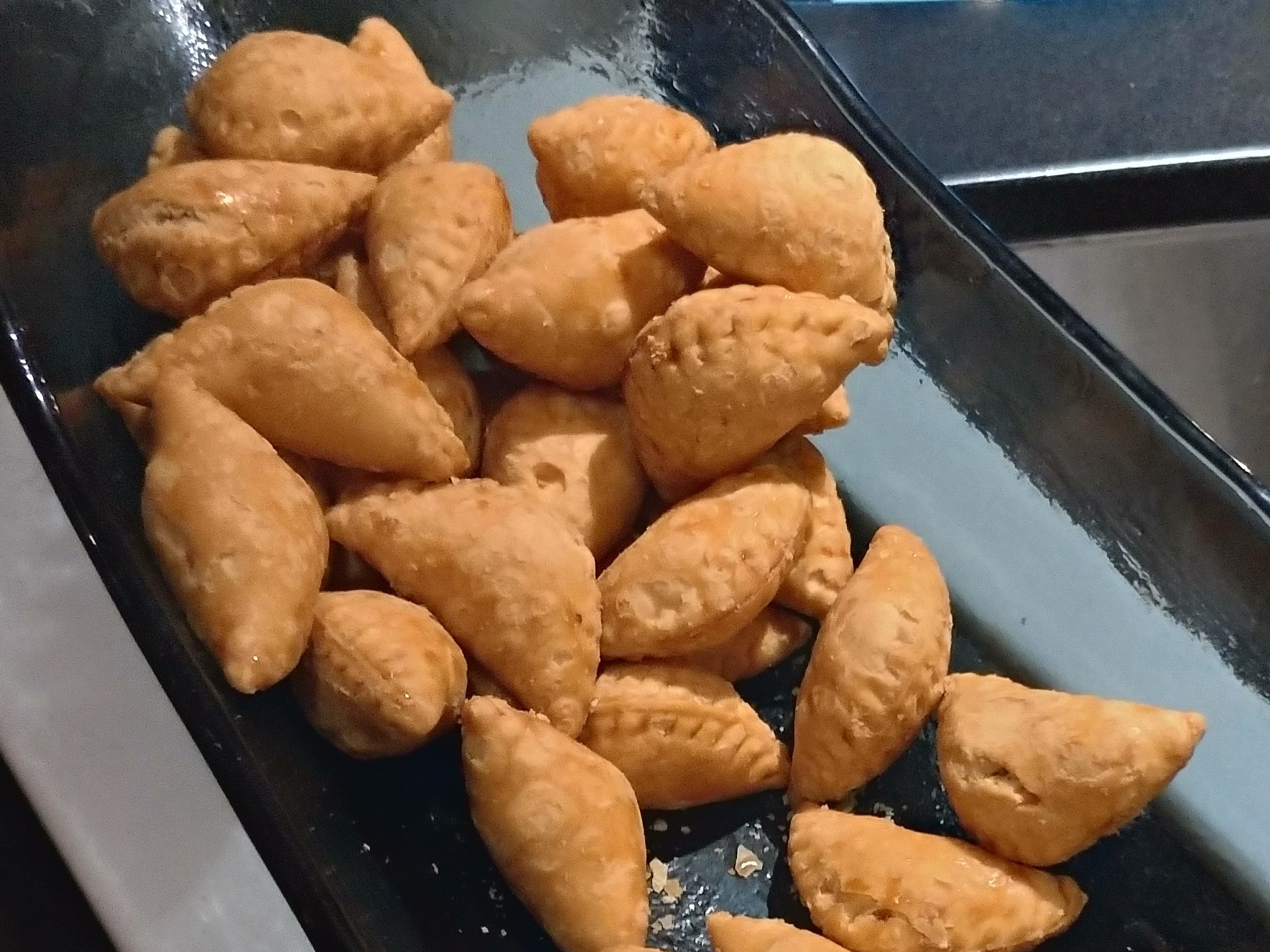
Yau gok (油角) or jau gok (油角) is a traditional pastry found in Cantonese cuisine, originating from Guangdong Province in China. The term gok (角) reflects the crescent shape of the pastries; they differ from the connotation of steamed or pan-fried Chinese dumplings, normally associated with the phonetically similar term jiaozi (餃仔). They are most commonly prepared during Chinese New Year, and consumed in Cantonese-speaking regions and communities, including Hong Kong and Malaysia.
The pastry wrap is first made of glutinous rice dough. A crescent shape is formed to hold the fried ingredients used as filling. A batch of the pastries are either baked or deep-fried in a wok.
The savory version is generally called haam gok zai (simplified Chinese: 咸角仔; traditional Chinese: 鹹角仔; pinyin: xián jiǎo zǐ; Jyutping: haam4 gok3 zai2). There is a range of popular fillings that vary depending on regional culture. Common ingredients include pork, Chinese sausages, and Chinese black mushroom.
The sweet version is generally called tim gok zai (Chinese: 甜角仔; pinyin: tián jiǎo zǐ; Jyutping: tim4 gok3 zai2). The standard filling comprises ground peanuts, white sesame seeds, and desiccated (dried) coconut crumbs mixed with sugar. After the frying, this version is crunchy. This version is suitable for vegetarians.
Yau gok
Yau gok (油角) or jau gok (油角) is a traditional pastry found in Cantonese cuisine, originating from Guangdong Province in China. The term gok (角) reflects the crescent shape of the pastries; they differ from the connotation of steamed or pan-fried Chinese dumplings, normally associated with the phonetically similar term jiaozi (餃仔). They are most commonly prepared during Chinese New Year, and consumed in Cantonese-speaking regions and communities, including Hong Kong and Malaysia.
The pastry wrap is first made of glutinous rice dough. A crescent shape is formed to hold the fried ingredients used as filling. A batch of the pastries are either baked or deep-fried in a wok.
The savory version is generally called haam gok zai (simplified Chinese: 咸角仔; traditional Chinese: 鹹角仔; pinyin: xián jiǎo zǐ; Jyutping: haam4 gok3 zai2). There is a range of popular fillings that vary depending on regional culture. Common ingredients include pork, Chinese sausages, and Chinese black mushroom.
The sweet version is generally called tim gok zai (Chinese: 甜角仔; pinyin: tián jiǎo zǐ; Jyutping: tim4 gok3 zai2). The standard filling comprises ground peanuts, white sesame seeds, and desiccated (dried) coconut crumbs mixed with sugar. After the frying, this version is crunchy. This version is suitable for vegetarians.
Recent media
Recent media