



Community hub
Recent from talks
Knowledge base stats:
Talk channels stats:
Members stats:
Trans-Siberian Orchestra
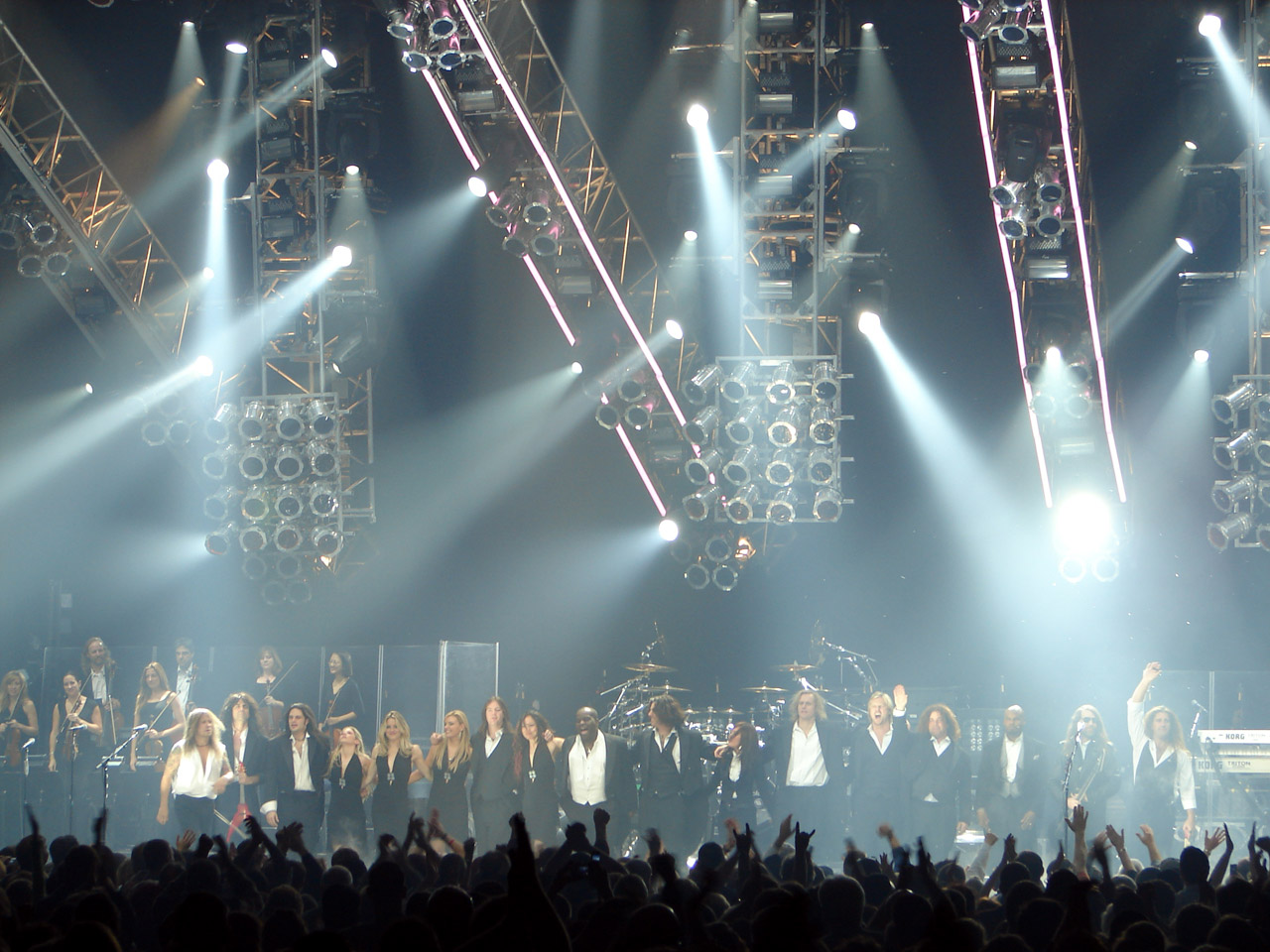
Trans-Siberian Orchestra (TSO) is an American rock band founded in 1996 by producer, composer, and lyricist Paul O'Neill, who brought together Jon Oliva and Al Pitrelli (both members of Savatage) and keyboardist and co-producer Robert Kinkel to form the core of the creative team. The band gained in popularity when they began touring in 1999 after completing their second album, The Christmas Attic, the year previous. In 2007, The Washington Post referred to them as "an arena-rock juggernaut" and described their music as "Pink Floyd meets Yes and the Who at Radio City Music Hall". TSO has sold more than ten million concert tickets and over ten million albums. The band has released a series of rock operas: Christmas Eve and Other Stories, The Christmas Attic, Beethoven's Last Night, The Lost Christmas Eve, their two-disc Night Castle and Letters from the Labyrinth. Trans-Siberian Orchestra is also known for their extensive charity work and elaborate concerts, which include a string section, a light show, lasers, moving trusses, video screens, and effects synchronized to music.
Both Billboard Magazine and Pollstar have ranked them as one of the top twenty-five ticket-selling bands in the first decade of the new millennium. Their path to success was unusual in that, according to O'Neill, TSO is the first major rock band to go straight to theaters and arenas, having never played at a club, never having been an opening act and never having had an opening act.
Paul O'Neill managed and produced rock bands including Aerosmith, Humble Pie, AC/DC, Joan Jett, and Scorpions, later producing and co-writing albums by the progressive metal band Savatage, where he began working with Robert Kinkel, Al Pitrelli and Jon Oliva. Oliva had left Savatage to spend time with his family and take care of personal matters. O'Neill took his first steps into rock music in the 1970s when he started the progressive rock band Slowburn, for whom he was the lyricist and co-composer. What was intended to be the band's debut album was recorded at Jimi Hendrix's Electric Lady Studios and engineered by Dave Wittman. Although Wittman's engineering was capturing the exact sound O'Neill was hearing in his head, O'Neill was having trouble with it because many of his melodies were between two and three octaves. Rather than releasing an album that he was not happy with, he shelved the project, but continued working in the industry at Contemporary Communications Corporation (also known as Leber & Krebs).[citation needed]
Over the years, O'Neill continued to work as a writer, producer, manager, and concert promoter. In 1996, he accepted Atlantic Records' offer to start his own band. He built the band on a foundation created by the marriage of classical and rock music and the artists he idolized, such as Emerson, Lake & Palmer, Queen, Yes, The Who, and Pink Floyd, and hard rock bands such as Aerosmith and Led Zeppelin and the multiple lead vocalists of the R&B groups the Temptations and the Four Tops. He brought in Oliva, Kinkel, and Pitrelli to help start the project. O'Neill has stated, "My original concept was six rock operas, a trilogy about Christmas and maybe one or two regular albums."
Trans-Siberian Orchestra has sold over 10 million albums in the United States, making it one of the most commercially successful touring acts combining rock and classical music.[1]
In the 1980s I was fortunate enough to have visited Russia. If anyone has ever seen Siberia, it is incredibly beautiful but incredibly harsh and unforgiving as well. The one thing that everyone who lives there has in common that runs across it in relative safety is the Trans-Siberian Railway. Life, too, can be incredibly beautiful but also incredibly harsh and unforgiving, and the one thing that we all have in common that runs across it in relative safety is music. It was a little bit overly philosophical, but it sounded different, and I like the initials, TSO.[citation needed]
Their debut album, the first installment of the intended Christmas Trilogy, was a rock opera called Christmas Eve and Other Stories, and was released in 1996. It remains among their best-selling albums. It contains the instrumental "Christmas Eve/Sarajevo 12/24" which originally appeared on Savatage's rock opera, Dead Winter Dead, a story about the Bosnian War. Their 1998 release The Christmas Attic, the sequel to Christmas Eve and Other Stories followed a similar format. This album produced the hit "Christmas Canon", a take on Johann Pachelbel's Canon in D major with lyrics and new melodies added. The Christmas Attic was first performed live in 2014.
Beethoven's Last Night was written and recorded in 1998 and 1999 and turned over to Atlantic Records in late 1999 for release in 2000. The story begins when Mephistopheles appears before Beethoven, whom Paul O'Neill refers to as "the world's first Heavy Metal Rock Star", to collect the great composer's soul. Of course Beethoven is horrified at the thought of eternal damnation, but the devil has an offer and the bargaining begins. There are numerous plot twists including the fate of his music, and the ending is based on a true but little known fact about Beethoven. Also in 1998, at the request of Scott Shannon of WPLJ, they performed live for the first time in a charity concert for Blythedale Children's Hospital. In 1999, at the urging of Bill Louis, a DJ for WNCX in Cleveland, they did their first tour, during which they debuted sections of Beethoven's Last Night. They performed the album in its entirety for the first time during the spring tour of 2010. In October 2011, Beethoven's Last Night was released in Europe to coincide with their European tour with new cover art by Greg Hildebrandt and the missing pages of poetry from the original release.
Hub AI
Trans-Siberian Orchestra AI simulator
(@Trans-Siberian Orchestra_simulator)
Trans-Siberian Orchestra
Trans-Siberian Orchestra (TSO) is an American rock band founded in 1996 by producer, composer, and lyricist Paul O'Neill, who brought together Jon Oliva and Al Pitrelli (both members of Savatage) and keyboardist and co-producer Robert Kinkel to form the core of the creative team. The band gained in popularity when they began touring in 1999 after completing their second album, The Christmas Attic, the year previous. In 2007, The Washington Post referred to them as "an arena-rock juggernaut" and described their music as "Pink Floyd meets Yes and the Who at Radio City Music Hall". TSO has sold more than ten million concert tickets and over ten million albums. The band has released a series of rock operas: Christmas Eve and Other Stories, The Christmas Attic, Beethoven's Last Night, The Lost Christmas Eve, their two-disc Night Castle and Letters from the Labyrinth. Trans-Siberian Orchestra is also known for their extensive charity work and elaborate concerts, which include a string section, a light show, lasers, moving trusses, video screens, and effects synchronized to music.
Both Billboard Magazine and Pollstar have ranked them as one of the top twenty-five ticket-selling bands in the first decade of the new millennium. Their path to success was unusual in that, according to O'Neill, TSO is the first major rock band to go straight to theaters and arenas, having never played at a club, never having been an opening act and never having had an opening act.
Paul O'Neill managed and produced rock bands including Aerosmith, Humble Pie, AC/DC, Joan Jett, and Scorpions, later producing and co-writing albums by the progressive metal band Savatage, where he began working with Robert Kinkel, Al Pitrelli and Jon Oliva. Oliva had left Savatage to spend time with his family and take care of personal matters. O'Neill took his first steps into rock music in the 1970s when he started the progressive rock band Slowburn, for whom he was the lyricist and co-composer. What was intended to be the band's debut album was recorded at Jimi Hendrix's Electric Lady Studios and engineered by Dave Wittman. Although Wittman's engineering was capturing the exact sound O'Neill was hearing in his head, O'Neill was having trouble with it because many of his melodies were between two and three octaves. Rather than releasing an album that he was not happy with, he shelved the project, but continued working in the industry at Contemporary Communications Corporation (also known as Leber & Krebs).[citation needed]
Over the years, O'Neill continued to work as a writer, producer, manager, and concert promoter. In 1996, he accepted Atlantic Records' offer to start his own band. He built the band on a foundation created by the marriage of classical and rock music and the artists he idolized, such as Emerson, Lake & Palmer, Queen, Yes, The Who, and Pink Floyd, and hard rock bands such as Aerosmith and Led Zeppelin and the multiple lead vocalists of the R&B groups the Temptations and the Four Tops. He brought in Oliva, Kinkel, and Pitrelli to help start the project. O'Neill has stated, "My original concept was six rock operas, a trilogy about Christmas and maybe one or two regular albums."
Trans-Siberian Orchestra has sold over 10 million albums in the United States, making it one of the most commercially successful touring acts combining rock and classical music.[1]
In the 1980s I was fortunate enough to have visited Russia. If anyone has ever seen Siberia, it is incredibly beautiful but incredibly harsh and unforgiving as well. The one thing that everyone who lives there has in common that runs across it in relative safety is the Trans-Siberian Railway. Life, too, can be incredibly beautiful but also incredibly harsh and unforgiving, and the one thing that we all have in common that runs across it in relative safety is music. It was a little bit overly philosophical, but it sounded different, and I like the initials, TSO.[citation needed]
Their debut album, the first installment of the intended Christmas Trilogy, was a rock opera called Christmas Eve and Other Stories, and was released in 1996. It remains among their best-selling albums. It contains the instrumental "Christmas Eve/Sarajevo 12/24" which originally appeared on Savatage's rock opera, Dead Winter Dead, a story about the Bosnian War. Their 1998 release The Christmas Attic, the sequel to Christmas Eve and Other Stories followed a similar format. This album produced the hit "Christmas Canon", a take on Johann Pachelbel's Canon in D major with lyrics and new melodies added. The Christmas Attic was first performed live in 2014.
Beethoven's Last Night was written and recorded in 1998 and 1999 and turned over to Atlantic Records in late 1999 for release in 2000. The story begins when Mephistopheles appears before Beethoven, whom Paul O'Neill refers to as "the world's first Heavy Metal Rock Star", to collect the great composer's soul. Of course Beethoven is horrified at the thought of eternal damnation, but the devil has an offer and the bargaining begins. There are numerous plot twists including the fate of his music, and the ending is based on a true but little known fact about Beethoven. Also in 1998, at the request of Scott Shannon of WPLJ, they performed live for the first time in a charity concert for Blythedale Children's Hospital. In 1999, at the urging of Bill Louis, a DJ for WNCX in Cleveland, they did their first tour, during which they debuted sections of Beethoven's Last Night. They performed the album in its entirety for the first time during the spring tour of 2010. In October 2011, Beethoven's Last Night was released in Europe to coincide with their European tour with new cover art by Greg Hildebrandt and the missing pages of poetry from the original release.