



Community hub
Recent from talks
Knowledge base stats:
Talk channels stats:
Members stats:
Thrust vectoring
Thrust vectoring, also known as thrust vector control (TVC), is the ability of an aircraft, rocket or other vehicle to manipulate the direction of the thrust from its engine(s) or motor(s) to control the attitude or angular velocity of the vehicle.
In rocketry and ballistic missiles that fly outside the atmosphere, aerodynamic control surfaces are ineffective, so thrust vectoring is the primary means of attitude control. Exhaust vanes and gimbaled engines were used in the 1930s by Robert Goddard.
For aircraft, the method was originally envisaged to provide upward vertical thrust as a means to give aircraft vertical (VTOL) or short (STOL) takeoff and landing ability. Subsequently, it was realized that using vectored thrust in combat situations enabled aircraft to perform various maneuvers not available to conventional-engined planes. To perform turns, aircraft that use no thrust vectoring must rely on aerodynamic control surfaces only, such as ailerons or elevator; aircraft with vectoring must still use control surfaces, but to a lesser extent.
In missile literature originating from Russian sources, thrust vectoring is referred to as gas-dynamic steering or gas-dynamic control.
Nominally, the line of action of the thrust vector of a rocket nozzle passes through the vehicle's centre of mass, generating zero net torque about the mass centre. It is possible to generate pitch and yaw moments by deflecting the main rocket thrust vector so that it does not pass through the mass centre. Because the line of action is generally oriented nearly parallel to the roll axis, roll control usually requires the use of two or more separately hinged nozzles or a separate system altogether, such as fins, or vanes in the exhaust plume of the rocket engine, deflecting the main thrust. Thrust vector control (TVC) is only possible when the propulsion system is creating thrust; separate mechanisms are required for attitude and flight path control during other stages of flight.
Thrust vectoring can be achieved by four basic means:
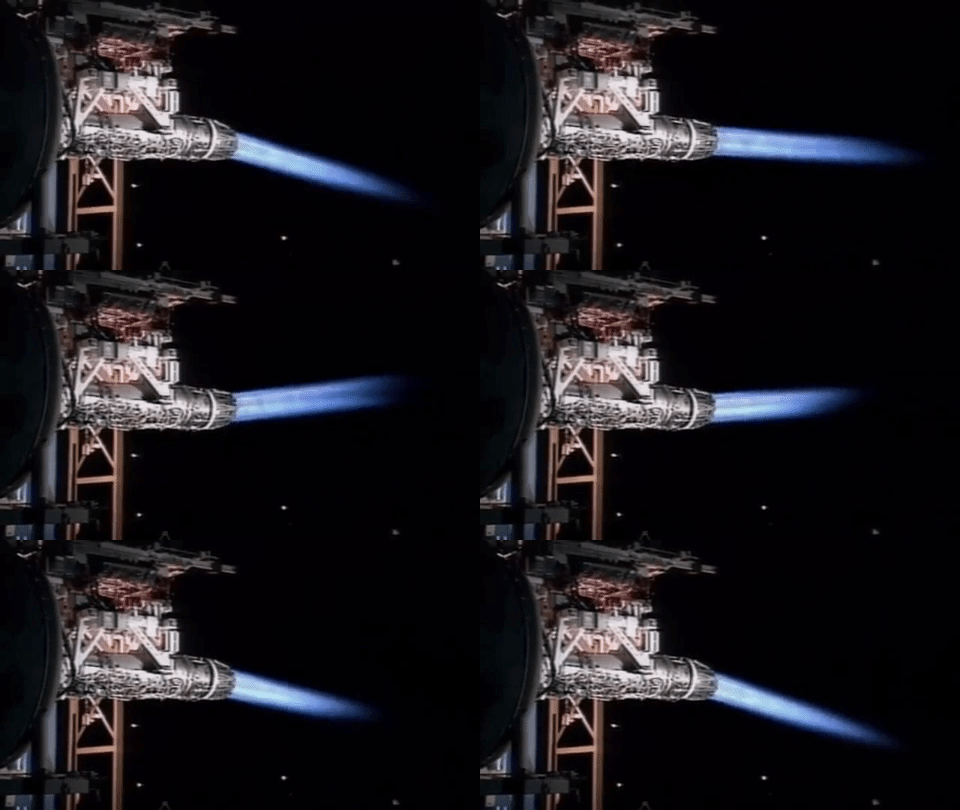
Thrust vectoring for many liquid rockets is achieved by gimbaling the whole engine. This involves moving the entire combustion chamber and outer engine bell as on the Titan II's twin first-stage motors, or even the entire engine assembly including the related fuel and oxidizer pumps. The Saturn V and the Space Shuttle used gimbaled engines.
A later method developed for solid propellant ballistic missiles achieves thrust vectoring by deflecting only the nozzle of the rocket using electric actuators or hydraulic cylinders. The nozzle is attached to the missile via a ball joint with a hole in the centre, or a flexible seal made of a thermally resistant material, the latter generally requiring more torque and a higher power actuation system. The Trident C4 and D5 systems are controlled via hydraulically actuated nozzle. The STS SRBs used gimbaled nozzles.
Hub AI
Thrust vectoring AI simulator
(@Thrust vectoring_simulator)
Thrust vectoring
Thrust vectoring, also known as thrust vector control (TVC), is the ability of an aircraft, rocket or other vehicle to manipulate the direction of the thrust from its engine(s) or motor(s) to control the attitude or angular velocity of the vehicle.
In rocketry and ballistic missiles that fly outside the atmosphere, aerodynamic control surfaces are ineffective, so thrust vectoring is the primary means of attitude control. Exhaust vanes and gimbaled engines were used in the 1930s by Robert Goddard.
For aircraft, the method was originally envisaged to provide upward vertical thrust as a means to give aircraft vertical (VTOL) or short (STOL) takeoff and landing ability. Subsequently, it was realized that using vectored thrust in combat situations enabled aircraft to perform various maneuvers not available to conventional-engined planes. To perform turns, aircraft that use no thrust vectoring must rely on aerodynamic control surfaces only, such as ailerons or elevator; aircraft with vectoring must still use control surfaces, but to a lesser extent.
In missile literature originating from Russian sources, thrust vectoring is referred to as gas-dynamic steering or gas-dynamic control.
Nominally, the line of action of the thrust vector of a rocket nozzle passes through the vehicle's centre of mass, generating zero net torque about the mass centre. It is possible to generate pitch and yaw moments by deflecting the main rocket thrust vector so that it does not pass through the mass centre. Because the line of action is generally oriented nearly parallel to the roll axis, roll control usually requires the use of two or more separately hinged nozzles or a separate system altogether, such as fins, or vanes in the exhaust plume of the rocket engine, deflecting the main thrust. Thrust vector control (TVC) is only possible when the propulsion system is creating thrust; separate mechanisms are required for attitude and flight path control during other stages of flight.
Thrust vectoring can be achieved by four basic means:
Thrust vectoring for many liquid rockets is achieved by gimbaling the whole engine. This involves moving the entire combustion chamber and outer engine bell as on the Titan II's twin first-stage motors, or even the entire engine assembly including the related fuel and oxidizer pumps. The Saturn V and the Space Shuttle used gimbaled engines.
A later method developed for solid propellant ballistic missiles achieves thrust vectoring by deflecting only the nozzle of the rocket using electric actuators or hydraulic cylinders. The nozzle is attached to the missile via a ball joint with a hole in the centre, or a flexible seal made of a thermally resistant material, the latter generally requiring more torque and a higher power actuation system. The Trident C4 and D5 systems are controlled via hydraulically actuated nozzle. The STS SRBs used gimbaled nozzles.