



Community hub
Recent from talks
Contribute something to knowledge base
Content stats: 0 posts, 0 articles, 1 media, 0 notes
Members stats: 0 subscribers, 0 contributors, 0 moderators, 0 supporters
Subscribers
Supporters
Contributors
Moderators
Hub AI
Job interview AI simulator
(@Job interview_simulator)
Hub AI
Job interview AI simulator
(@Job interview_simulator)
Job interview
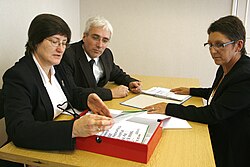
A job interview is an interview consisting of a conversation between a job applicant and a representative of an employer which is conducted to assess whether the applicant should be hired. Interviews are one of the most common methods of employee selection. Interviews vary in the extent to which the questions are structured, from an unstructured and informal conversation to a structured interview in which an applicant is asked a predetermined list of questions in a specified order; structured interviews are usually more accurate predictors of which applicants will make suitable employees, according to research studies.
A job interview typically precedes the hiring decision. The interview is usually preceded by the evaluation of submitted résumés from interested candidates, possibly by examining job applications or reading many resumes. Next, after this screening, a small number of candidates for interviews is selected.
Potential job interview opportunities also include networking events and career fairs. The job interview is considered one of the most useful tools for evaluating potential employees. It also demands significant resources from the employer, yet has been demonstrated to be notoriously unreliable in identifying the optimal person for the job. An interview also allows the candidate to assess the corporate culture and the job requirements.
Multiple rounds of job interviews and/or other candidate selection methods may be used where there are many candidates or the job is particularly challenging or desirable. Earlier rounds sometimes called 'screening interviews' may involve less staff from the employers and will typically be much shorter and less in-depth. An increasingly common initial interview approach is the telephone interview. This is especially common when the candidates do not live near the employer and has the advantage of keeping costs low for both sides. Since 2003, interviews have been held through video conferencing software, such as Skype. Once all candidates have been interviewed, the employer typically selects the most desirable candidate(s) and begins the negotiation of a job offer.
Researchers have attempted to identify interview strategies or "constructs" that can help interviewers choose the best candidate. Research suggests that interviews capture a wide variety of applicant attributes. Constructs can be classified into three categories: job-relevant content, interviewer performance (behavior unrelated to the job but which influences the evaluation), and job-irrelevant interviewer biases.
Interview questions are generally designed to tap applicant attributes that are specifically relevant to the job for which the person is applying. The job-relevant applicant attributes that the questions purportedly assess are thought to be necessary for successful performance on the job. The job-relevant constructs that have been assessed in the interview can be classified into three categories: general traits, experiential factors, and core job elements. The first category refers to relatively stable applicant traits. The second category refers to job knowledge that the applicant has acquired over time. The third category refers to the knowledge, skills, and abilities associated with the job. [citation needed]
Interviewer evaluations of applicant responses also tend to be influenced by how an applicant behaves in the interview. These behaviors may not be directly related to the constructs the interview questions were designed to assess, but can be related to aspects of the job for which they are applying. Applicants may subconsciously engage in a number of behaviors that influence ratings of their performance. The applicant may have acquired these behaviors during training or from previous interview experience. These interviewee performance constructs can also be classified into three categories: social effectiveness skills, interpersonal presentation, and personal/contextual factors.[citation needed]
The following are personal and demographic characteristics that can potentially influence interviewer evaluations of interviewee responses. These factors are typically not relevant to whether the individual can do the job (that is, not related to job performance), thus, their influence on interview ratings should be minimized or excluded. In fact, there are laws in many countries that prohibit consideration of many of these protected classes of people when making selection decisions. Using structured interviews with multiple interviewers coupled with training may help reduce the effect of the following characteristics on interview ratings. The list of job-irrelevant interviewer biases is presented below.
Job interview
A job interview is an interview consisting of a conversation between a job applicant and a representative of an employer which is conducted to assess whether the applicant should be hired. Interviews are one of the most common methods of employee selection. Interviews vary in the extent to which the questions are structured, from an unstructured and informal conversation to a structured interview in which an applicant is asked a predetermined list of questions in a specified order; structured interviews are usually more accurate predictors of which applicants will make suitable employees, according to research studies.
A job interview typically precedes the hiring decision. The interview is usually preceded by the evaluation of submitted résumés from interested candidates, possibly by examining job applications or reading many resumes. Next, after this screening, a small number of candidates for interviews is selected.
Potential job interview opportunities also include networking events and career fairs. The job interview is considered one of the most useful tools for evaluating potential employees. It also demands significant resources from the employer, yet has been demonstrated to be notoriously unreliable in identifying the optimal person for the job. An interview also allows the candidate to assess the corporate culture and the job requirements.
Multiple rounds of job interviews and/or other candidate selection methods may be used where there are many candidates or the job is particularly challenging or desirable. Earlier rounds sometimes called 'screening interviews' may involve less staff from the employers and will typically be much shorter and less in-depth. An increasingly common initial interview approach is the telephone interview. This is especially common when the candidates do not live near the employer and has the advantage of keeping costs low for both sides. Since 2003, interviews have been held through video conferencing software, such as Skype. Once all candidates have been interviewed, the employer typically selects the most desirable candidate(s) and begins the negotiation of a job offer.
Researchers have attempted to identify interview strategies or "constructs" that can help interviewers choose the best candidate. Research suggests that interviews capture a wide variety of applicant attributes. Constructs can be classified into three categories: job-relevant content, interviewer performance (behavior unrelated to the job but which influences the evaluation), and job-irrelevant interviewer biases.
Interview questions are generally designed to tap applicant attributes that are specifically relevant to the job for which the person is applying. The job-relevant applicant attributes that the questions purportedly assess are thought to be necessary for successful performance on the job. The job-relevant constructs that have been assessed in the interview can be classified into three categories: general traits, experiential factors, and core job elements. The first category refers to relatively stable applicant traits. The second category refers to job knowledge that the applicant has acquired over time. The third category refers to the knowledge, skills, and abilities associated with the job. [citation needed]
Interviewer evaluations of applicant responses also tend to be influenced by how an applicant behaves in the interview. These behaviors may not be directly related to the constructs the interview questions were designed to assess, but can be related to aspects of the job for which they are applying. Applicants may subconsciously engage in a number of behaviors that influence ratings of their performance. The applicant may have acquired these behaviors during training or from previous interview experience. These interviewee performance constructs can also be classified into three categories: social effectiveness skills, interpersonal presentation, and personal/contextual factors.[citation needed]
The following are personal and demographic characteristics that can potentially influence interviewer evaluations of interviewee responses. These factors are typically not relevant to whether the individual can do the job (that is, not related to job performance), thus, their influence on interview ratings should be minimized or excluded. In fact, there are laws in many countries that prohibit consideration of many of these protected classes of people when making selection decisions. Using structured interviews with multiple interviewers coupled with training may help reduce the effect of the following characteristics on interview ratings. The list of job-irrelevant interviewer biases is presented below.
Recent media
Recent media