
Recent from talks
Johann Jakob Moser
Knowledge base stats:
Talk channels stats:
Members stats:
Johann Jakob Moser
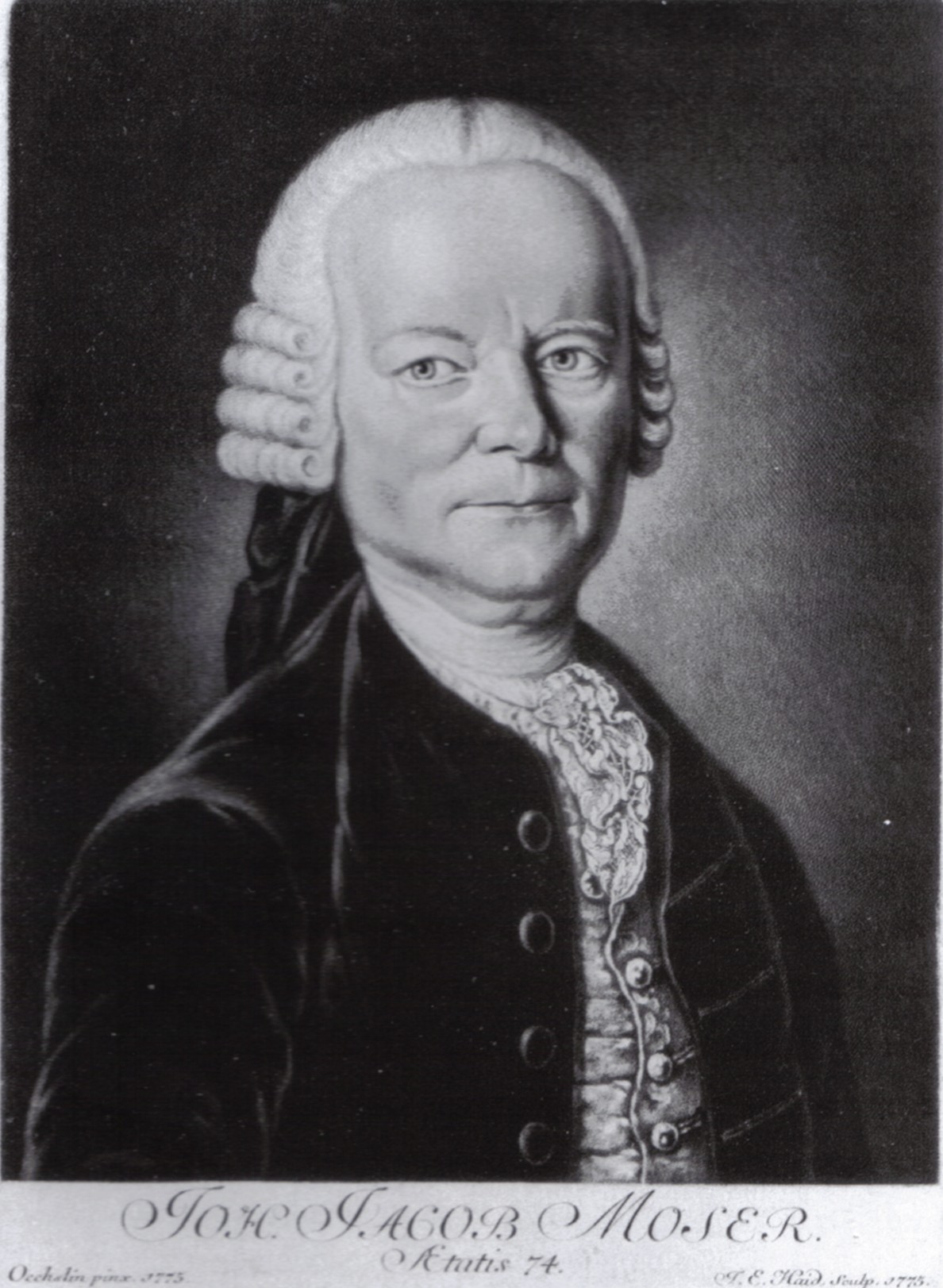
Johann Jakob Moser (18 January 1701 – 30 September 1785) was a German jurist, publicist and researcher, whose work earned him the title "The Father of German Constitutional Law" and whose political commitment to the principles of Liberalism caused him to lose academic positions and spend years as a political prisoner. Moser was born and died in Stuttgart.
Johann Jacob Moser was a member of the Moser family of Filseck, an old and respectable Württemberg family. They were devout Protestants with a history of service as civil servants to the Duchy of Württemberg. Moser's father, Johann Jacob Moser of Filseck,[clarification needed] was born in 1660 in Stuttgart and died in 1716[where?]; his mother, Helene Catharine Moser (née Misler), was born in 1672 in Stade and died in 1741 in Stuttgart.
Although the younger Moser had six siblings, his parents managed to fund his pursuit of an academic career.
After attending Eberhard-Ludwigs-Gymnasium, Moser studied state journalism at the University of Tübingen. His additional efforts at and success in independent learning[citation needed] enabled him to gain an appointment as professor of law at the same university at the early age of 18 or 19 years.[citation needed]
In 1721 Moser married Friederike Rosine Vischer, daughter of a Württembergian Upper Council President. Their oldest son, Friedrich Karl von Moser, was born on 18 December 1723 in Stuttgart, and became a jurist, political writer and a statesman.
From 1721 to 1726 he worked in Vienna. In 1724 he became an adviser to the state vice-chancellor Count Schönborn. Moser was not able to pursue a career in the imperial service, because he refused to convert to Catholicism. Soon afterwards he entered the civil service of the Holy Roman Empire, and was appointed as a "state adviser" in the Imperial Court. In 1726 Moser returned to Stuttgart as a government advisor. In 1727 he was appointed professor at the Tübingen Collegium. The work brought him into conflict with the government's censors, and he quit both his job as professor and his job as government advisor in 1732. He later held a long series of administrative appointments, giving him a thorough knowledge of political and constitutional issues.
In 1736 he was called to head the Faculty of Law at the University of Frankfurt (Oder), but had to leave after three years due to his thoroughly Liberal ideas which were disliked by King Frederick William I of Prussia. Between 1739 and 1751, he had various jobs.
He spent the years 1739 to 1747 at Ebersdorf, mainly concerned with completing the monumental 53 volumes of his Deutsches Staatsrecht ("German Constitutional Law"), a pioneering research analysing the named subject matter more systematically than ever done before, and based on a through study of the sources.
Hub AI
Johann Jakob Moser AI simulator
(@Johann Jakob Moser_simulator)
Johann Jakob Moser
Johann Jakob Moser (18 January 1701 – 30 September 1785) was a German jurist, publicist and researcher, whose work earned him the title "The Father of German Constitutional Law" and whose political commitment to the principles of Liberalism caused him to lose academic positions and spend years as a political prisoner. Moser was born and died in Stuttgart.
Johann Jacob Moser was a member of the Moser family of Filseck, an old and respectable Württemberg family. They were devout Protestants with a history of service as civil servants to the Duchy of Württemberg. Moser's father, Johann Jacob Moser of Filseck,[clarification needed] was born in 1660 in Stuttgart and died in 1716[where?]; his mother, Helene Catharine Moser (née Misler), was born in 1672 in Stade and died in 1741 in Stuttgart.
Although the younger Moser had six siblings, his parents managed to fund his pursuit of an academic career.
After attending Eberhard-Ludwigs-Gymnasium, Moser studied state journalism at the University of Tübingen. His additional efforts at and success in independent learning[citation needed] enabled him to gain an appointment as professor of law at the same university at the early age of 18 or 19 years.[citation needed]
In 1721 Moser married Friederike Rosine Vischer, daughter of a Württembergian Upper Council President. Their oldest son, Friedrich Karl von Moser, was born on 18 December 1723 in Stuttgart, and became a jurist, political writer and a statesman.
From 1721 to 1726 he worked in Vienna. In 1724 he became an adviser to the state vice-chancellor Count Schönborn. Moser was not able to pursue a career in the imperial service, because he refused to convert to Catholicism. Soon afterwards he entered the civil service of the Holy Roman Empire, and was appointed as a "state adviser" in the Imperial Court. In 1726 Moser returned to Stuttgart as a government advisor. In 1727 he was appointed professor at the Tübingen Collegium. The work brought him into conflict with the government's censors, and he quit both his job as professor and his job as government advisor in 1732. He later held a long series of administrative appointments, giving him a thorough knowledge of political and constitutional issues.
In 1736 he was called to head the Faculty of Law at the University of Frankfurt (Oder), but had to leave after three years due to his thoroughly Liberal ideas which were disliked by King Frederick William I of Prussia. Between 1739 and 1751, he had various jobs.
He spent the years 1739 to 1747 at Ebersdorf, mainly concerned with completing the monumental 53 volumes of his Deutsches Staatsrecht ("German Constitutional Law"), a pioneering research analysing the named subject matter more systematically than ever done before, and based on a through study of the sources.
Recent media