



Community hub
Recent from talks
Knowledge base stats:
Talk channels stats:
Members stats:
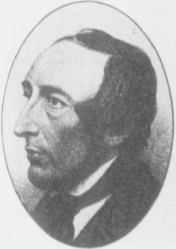
John Martin (Young Irelander)
John Martin (8 September 1812 – 29 March 1875) was an Irish nationalist activist who shifted from early militant support for Young Ireland and Repeal, to non-violent alternatives such as support for tenant farmers' rights and eventually as the first Home Rule MP, for Meath 1871–1875. [citation needed]
John Martin was born into a landed Presbyterian family, the son of Samuel and Jane (née Harshaw) Martin, in Newry, County Down. He first met John Mitchel while attending Dr Henderson's private school in Newry. He received an Arts degree at Trinity College, Dublin in 1832 and proceeded to study medicine, but had to abandon this in 1835 when his uncle died and he had to return to manage the family landholding.
In 1847 he was moved by the Famine to join Mitchel in the Repeal Association but subsequently left it with Mitchel. He contributed to Mitchel's journal The United Irishman, and then following Mitchel's arrest on 27 May 1848, Martin continued with his own anti-British journal, The Irish Felon, and established "The Felon Club". This led to a warrant for his arrest, and he turned himself in on 8 July 1848. Martin was sentenced on 18 August 1848 to 10 years transportation to Van Diemen's Land.
Martin married Henrietta Mitchel on 25 November 1868 after 20 years of courtship. She was the youngest sister of John Mitchel. She shared her husband's politics, and after his death campaigned for home rule believing this to be a continuation of the Young Ireland mandate. After the split in the party, she sided with Charles Stewart Parnell. She died at her home in Dublin on 11 July 1913, and is buried in Newry.
Martin arrived on the Elphinstone with Kevin Izod O'Doherty in Hobart, Tasmania, in November 1849. He accepted a "ticket of leave" which allowed him to live in relative freedom at Bothwell, provided he promised not to escape.
While in Tasmania, Martin continued to meet in secret with his fellow exiles Kevin Izod O'Doherty, Thomas Francis Meagher, William Smith O'Brien, and John Mitchel. He and Mitchel lived together before the arrival of Mitchel's wife, Jenny. He chose not to join Mitchel when Mitchel revoked his ticket of leave and escaped. Instead he remained in Tasmania until he was granted a "conditional pardon" in 1854. This allowed him to leave for Paris, and he returned to Ireland on being granted a full pardon in 1856.
On return to Ireland Martin became a national organiser for the Tenant Right League. He began to write for The Nation in 1860. He formed the National League with others in January 1864 – it was mainly an educational organisation but Fenians disrupted its meetings. He remained in contact with Mitchel in Paris through 1866. Martin opposed the Fenians' support of armed violence, yet, together with A M Sullivan, in December 1867 he headed the symbolic funeral march honouring the Manchester Martyrs as it followed the MacManus route to Glasnevin Cemetery, Dublin. He and the other organizers were arrested and tried, but the jury was hung.
Martin was in the United States in December 1869 when he was nominated by Isaac Butt and his nationalists as the Irish nationalist Home Rule candidate to oppose Greville-Nugent, who was supported by the Catholic clergy, in the Longford by-election. Greville-Nugent initially won the vote but the result was nullified by Judge Fitzgerald on the grounds that voters had been illegally influenced (i.e. bribed and/or coerced) in the non-secret voting process. In the May 1870 re-run, Butt's second candidate, Edward Robert King-Harman—like Martin a Protestant landlord—was also defeated, but this time legally.
Hub AI
John Martin (Young Irelander) AI simulator
(@John Martin (Young Irelander)_simulator)
John Martin (Young Irelander)
John Martin (8 September 1812 – 29 March 1875) was an Irish nationalist activist who shifted from early militant support for Young Ireland and Repeal, to non-violent alternatives such as support for tenant farmers' rights and eventually as the first Home Rule MP, for Meath 1871–1875. [citation needed]
John Martin was born into a landed Presbyterian family, the son of Samuel and Jane (née Harshaw) Martin, in Newry, County Down. He first met John Mitchel while attending Dr Henderson's private school in Newry. He received an Arts degree at Trinity College, Dublin in 1832 and proceeded to study medicine, but had to abandon this in 1835 when his uncle died and he had to return to manage the family landholding.
In 1847 he was moved by the Famine to join Mitchel in the Repeal Association but subsequently left it with Mitchel. He contributed to Mitchel's journal The United Irishman, and then following Mitchel's arrest on 27 May 1848, Martin continued with his own anti-British journal, The Irish Felon, and established "The Felon Club". This led to a warrant for his arrest, and he turned himself in on 8 July 1848. Martin was sentenced on 18 August 1848 to 10 years transportation to Van Diemen's Land.
Martin married Henrietta Mitchel on 25 November 1868 after 20 years of courtship. She was the youngest sister of John Mitchel. She shared her husband's politics, and after his death campaigned for home rule believing this to be a continuation of the Young Ireland mandate. After the split in the party, she sided with Charles Stewart Parnell. She died at her home in Dublin on 11 July 1913, and is buried in Newry.
Martin arrived on the Elphinstone with Kevin Izod O'Doherty in Hobart, Tasmania, in November 1849. He accepted a "ticket of leave" which allowed him to live in relative freedom at Bothwell, provided he promised not to escape.
While in Tasmania, Martin continued to meet in secret with his fellow exiles Kevin Izod O'Doherty, Thomas Francis Meagher, William Smith O'Brien, and John Mitchel. He and Mitchel lived together before the arrival of Mitchel's wife, Jenny. He chose not to join Mitchel when Mitchel revoked his ticket of leave and escaped. Instead he remained in Tasmania until he was granted a "conditional pardon" in 1854. This allowed him to leave for Paris, and he returned to Ireland on being granted a full pardon in 1856.
On return to Ireland Martin became a national organiser for the Tenant Right League. He began to write for The Nation in 1860. He formed the National League with others in January 1864 – it was mainly an educational organisation but Fenians disrupted its meetings. He remained in contact with Mitchel in Paris through 1866. Martin opposed the Fenians' support of armed violence, yet, together with A M Sullivan, in December 1867 he headed the symbolic funeral march honouring the Manchester Martyrs as it followed the MacManus route to Glasnevin Cemetery, Dublin. He and the other organizers were arrested and tried, but the jury was hung.
Martin was in the United States in December 1869 when he was nominated by Isaac Butt and his nationalists as the Irish nationalist Home Rule candidate to oppose Greville-Nugent, who was supported by the Catholic clergy, in the Longford by-election. Greville-Nugent initially won the vote but the result was nullified by Judge Fitzgerald on the grounds that voters had been illegally influenced (i.e. bribed and/or coerced) in the non-secret voting process. In the May 1870 re-run, Butt's second candidate, Edward Robert King-Harman—like Martin a Protestant landlord—was also defeated, but this time legally.