Hubbry Logo
Associative entityAssociative entityMain
Open search
Associative entity
Community hub
Associative entity
logo
8 pages, 0 posts
0 subscribers
Be the first to start a discussion here.
Associative entity
Associative entity
from Wikipedia

An associative entity is a term used in relational and entity–relationship theory. A relational database requires the implementation of a base relation (or base table) to resolve many-to-many relationships. A base relation representing this kind of entity is called, informally, an associative table.

An associative entity (using Chen notation)

As mentioned above, associative entities are implemented in a database structure using associative tables, which are tables that can contain references to columns from the same or different database tables within the same database.

Concept of a mapping table

An associative (or junction) table maps two or more tables together by referencing the primary keys (PK) of each data table. In effect, it contains a number of foreign keys (FK), each in a many-to-one relationship from the junction table to the individual data tables. The PK of the associative table is typically composed of the FK columns themselves.

Associative tables are colloquially known under many names, including association table, bridge table, cross-reference table, crosswalk, intermediary table, intersection table, join table, junction table, link table, linking table, many-to-many resolver, map table, mapping table, pairing table, pivot table (as used in Laravel—not to be confused with the use of pivot table in spreadsheets), or transition table.

Using associative tables

[edit]

An example of the practical use of an associative table would be to assign permissions to users. There can be multiple users, and each user can be assigned zero or more permissions. Individual permissions may be granted to one or more users.

CREATE TABLE Users (
    UserLogin varchar(50) PRIMARY KEY,
    UserPassword varchar(50) NOT NULL,
    UserName varchar(50) NOT NULL
);

CREATE TABLE Permissions (
    PermissionKey varchar(50) PRIMARY KEY,
    PermissionDescription varchar(500) NOT NULL
);

-- This is the junction table.
CREATE TABLE UserPermissions (
    UserLogin varchar(50) REFERENCES Users (UserLogin),
    PermissionKey varchar(50) REFERENCES Permissions (PermissionKey),
    PRIMARY KEY (UserLogin, PermissionKey)
);
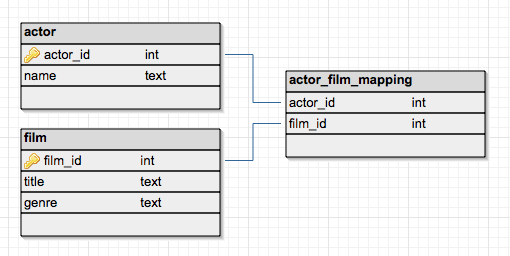
A visual depiction of the table schema described, with relationships indicated

A SELECT-statement on a junction table usually involves joining the main table with the junction table:

SELECT * FROM Users
JOIN UserPermissions USING (UserLogin);

This will return a list of all users and their permissions.

Inserting into a junction table involves multiple steps: first inserting into the main table(s), then updating the junction table.

-- Creating a new User
INSERT INTO Users (UserLogin, UserPassword, UserName)
VALUES ('SomeUser', 'SecretPassword', 'UserName');

-- Creating a new Permission
INSERT INTO Permissions (PermissionKey, PermissionDescription)
VALUES ('TheKey', 'A key used for several permissions');

-- Finally, updating the junction
INSERT INTO UserPermissions (UserLogin, PermissionKey)
VALUES ('SomeUser', 'TheKey');

Using foreign keys, the database will automatically dereference the values of the UserPermissions table to their own tables.

See also

[edit]

References

[edit]
Revisions and contributorsEdit on WikipediaRead on Wikipedia
from Grokipedia
In entity-relationship (ER) modeling, an associative entity is a specialized type that represents a many-to-many relationship between two or more other , serving as an intermediary to resolve such relationships into two one-to-many associations in design. This , also known as a junction table or bridge table, typically includes foreign keys referencing the of the connected , forming a composite , and can incorporate additional attributes that describe the nature of the relationship itself. Associative entities play a crucial role in by eliminating redundancy and maintaining , as they allow for the storage of relationship-specific data without embedding it directly in the participating entities. For instance, in a database, an associative entity such as "Enrollment" might link "" and "Course" entities, with attributes like enrollment date or grade to capture details of the association. In ER diagrams, these entities are often depicted as rectangles connected to the related entities via lines indicating the one-to-many relationships, distinguishing them from simple relationship diamonds used for attribute-less associations. The concept of associative entities extends the foundational ER model introduced by Peter Chen in 1976, enhancing its ability to model complex real-world scenarios in relational databases, and they are commonly implemented in systems like SQL databases where many-to-many links require explicit tables. While primarily used in conceptual and logical , associative entities also support advanced features such as surrogate keys for and additional metadata columns in implementations.

Definition and Fundamentals

Core Concept

An associative entity is a specialized construct in entity-relationship (ER) modeling that represents a many-to-many relationship between two or more entities by transforming it into two one-to-many relationships, thereby enabling the association to be treated as an entity in its own right. This approach allows the relationship to possess its own attributes and identifiers, distinguishing it from simple linking mechanisms in relational schemas. The concept of associative entities builds upon Peter Chen's foundational ER model, introduced in 1976, where relationships with attributes were formalized and could effectively function as entities in many-to-many scenarios when implemented in relational databases. This idea evolved alongside E.F. Codd's relational database theory from the early 1970s, which emphasized normalization and the decomposition of complex relations to avoid redundancy, influencing how such associations are implemented in practice. The primary purpose of an associative entity is to capture and store instances of relationships that necessitate additional descriptive attributes beyond mere references, such as timestamps, quantities, or roles, thereby enhancing the semantic richness of the .

Key Characteristics

Associative entities are distinguished by their composite primary key, which is formed by concatenating the primary keys of the entities they connect, thereby ensuring the uniqueness of each relationship instance without requiring a . In addition to this identifying structure, associative entities may incorporate optional non-key attributes that pertain specifically to the relationship, such as effective dates, quantities, or status indicators, allowing for richer description of the association beyond mere linkage. When an associative entity represents a mandatory relationship, the connected entities demonstrate total participation, requiring that every instance of those entities engage in at least one instance of the relationship. Unlike weak entities, which rely solely on a single owner for complete identification and , associative entities derive their composite identifier from multiple entities and function independently to encapsulate relationship-specific details, positioning them as robust representations of inter-entity connections within entity-relationship modeling.

Role in Entity-Relationship Modeling

Resolving Many-to-Many Relationships

In entity-relationship (ER) modeling, many-to-many relationships between two entities, such as students and courses where a student can enroll in multiple courses and a course can have multiple students, cannot be directly implemented in relational databases without resolution. To address this, an associative entity is introduced to decompose the many-to-many relationship into two one-to-many relationships: the associative entity connects to each original entity via a one-to-many link, typically using foreign keys from both as a composite primary key. This process involves identifying the relationship, creating the new entity (e.g., "Enrollment" for students and courses), and redefining the connections to reflect the one-to-many cardinalities. In ER diagrams, the resolution is visually represented by transforming the original diamond-shaped many-to-many relationship into a rectangular associative entity, with relationship lines extending from this entity to the two participating , often using crow's foot notation to denote the one-to-many cardinalities. For instance, the line from "Student" to "Enrollment" might show one student relating to many enrollments, while "Course" to "Enrollment" indicates one course to many enrollments. Associative entities are essential for resolving many-to-many relationships when the relationship itself possesses attributes, such as enrollment date or grade, which become attributes of the new ; in basic cases without attributes, a simple junction table with foreign keys may suffice, but the entity approach provides better structure for complex models. This method is particularly useful in scenarios revealing additional relational details, like associating a specific time with a course enrollment. The impact on ensures by enforcing participation constraints: for example, mandatory participation might require at least one instance in the associative entity, preventing orphaned records, while optional participation allows zero instances, all maintained through the one-to-many links and composite keys. This resolution eliminates key inclusion loops and supports unique identification of relationship instances, enhancing data consistency without altering the underlying semantics of the original many-to-many association.

Integration with Other ER Elements

Associative entities enhance the expressiveness of entity-relationship (ER) models by accommodating relationship-specific attributes that cannot be directly attached to simple relationships. For instance, in a many-to-many relationship between entities like "" and "Course," an associative entity such as "Enrollment" can include attributes like enrollment date or grade, which describe the specifics of the association rather than the entities themselves. This integration allows for more detailed modeling without altering the primary keys of the participating entities. In extended ER (EER) models, associative entities can link subtypes or supertypes while preserving hierarchies and resolving multiplicity issues. For example, if "Employee" is a supertype with subtypes like "Full-time" and "Part-time," an associative entity can connect these subtypes to another entity, such as "," ensuring that specialized attributes or constraints are maintained across the without violating rules. This approach supports specialization and by allowing associations at various levels of the entity . Associative entities also integrate with aggregation in ER models, where relationships are treated as higher-level entities in complex abstractions. In such cases, an associative entity can represent an aggregated relationship, incorporating a discriminator attribute to specify subtypes or components within the aggregation, enabling further relationships to be defined on the aggregated whole. This facilitates modeling scenarios where parts form a composite entity that participates in additional associations. Post-resolution of many-to-many relationships, associative entities incorporate structural constraints, such as ratios (e.g., 1:N between the associative entity and original entities), to enforce business rules like participation requirements or . These constraints ensure that the resolved model adheres to domain-specific rules, such as mandatory associations or limits on multiplicities, without compromising the overall schema integrity.

Database Implementation

Associative Tables

In relational databases, associative entities are physically represented as associative tables, which serve as junction or bridge tables to link two or more entities in a many-to-many relationship. The core structure of such a table includes foreign keys that the s of the participating entities; these foreign keys collectively form a composite to uniquely identify each relationship instance and prevent duplicates. Additional columns may be added to capture attributes inherent to the relationship itself, such as dates, statuses, or quantities, enhancing the table's utility without violating normalization principles. To implement an associative table, a basic (DDL) statement in SQL can be used to define its , incorporating the foreign keys, primary key constraint, and any relationship-specific attributes. For instance, consider a many-to-many relationship between "Employees" and "Projects" with an attribute for the role in the project:

sql

CREATE TABLE EmployeeProjects ( Employee_ID INT NOT NULL, Project_ID INT NOT NULL, Role VARCHAR(50), [PRIMARY KEY](/page/Primary_key) (Employee_ID, Project_ID), [FOREIGN KEY](/page/Foreign_key) (Employee_ID) REFERENCES Employees(Employee_ID), [FOREIGN KEY](/page/Foreign_key) (Project_ID) REFERENCES Projects(Project_ID) );

CREATE TABLE EmployeeProjects ( Employee_ID INT NOT NULL, Project_ID INT NOT NULL, Role VARCHAR(50), [PRIMARY KEY](/page/Primary_key) (Employee_ID, Project_ID), [FOREIGN KEY](/page/Foreign_key) (Employee_ID) REFERENCES Employees(Employee_ID), [FOREIGN KEY](/page/Foreign_key) (Project_ID) REFERENCES Projects(Project_ID) );

This DDL establishes the table with the composite on the foreign keys and enforces through the foreign key constraints. For optimal performance in queries involving joins across the related entities, associative tables benefit from composite indexes on the foreign key columns, as these facilitate efficient lookups and reduce scan times during relationship traversals. Such indexes should cover the columns (the foreign keys) to support common join operations without full table scans. Populating an associative table involves inserting rows that represent specific relationship instances, specifying values for the s and any additional attributes. For example:

sql

INSERT INTO EmployeeProjects (Employee_ID, Project_ID, Role) VALUES (101, 5001, 'Developer');

INSERT INTO EmployeeProjects (Employee_ID, Project_ID, Role) VALUES (101, 5001, 'Developer');

constraints on the table ensure by validating that each inserted value corresponds to an existing in the referenced tables, thereby preventing the insertion of invalid or orphaned relationship records that could lead to inconsistencies.

Schema Design Considerations

Associative tables play a crucial role in achieving (3NF) within relational schemas by separating relationship-specific data from the attributes of the participating entities, thereby eliminating transitive dependencies that could otherwise lead to and update anomalies. In scenarios involving many-to-many relationships, embedding multivalued attributes directly into one of the entity tables would violate 2NF or introduce transitive dependencies, as non-key attributes would depend on other non-key attributes through the repeated keys; the associative table resolves this by storing only the foreign keys of the related entities as its composite , along with any relationship attributes, ensuring that all non-prime attributes depend solely on the primary key. The performance implications of associative tables stem primarily from the necessity of joins to retrieve related , which can introduce computational overhead, especially in queries spanning large volumes of records across multiple tables. For instance, a simple retrieval of associated entities might require inner joins on the associative table, potentially slowing response times in high-throughput environments due to index lookups and data merging operations. To mitigate this, designers recommend creating database views to encapsulate common join logic or using materialized views, which store precomputed join results and refresh periodically, thereby accelerating frequent read operations without altering the underlying . Scalability challenges arise when associative tables manage extensive many-to-many relationships, as the table size can balloon with millions or billions of associations, straining storage and query execution on single nodes. Effective strategies include horizontal partitioning of the associative table, such as range partitioning based on one of the foreign keys or hash partitioning on the , which distributes rows across multiple physical partitions or to enable parallel processing and reduce contention during inserts and selects. In distributed systems like or Azure SQL, this partitioning supports load balancing and , allowing the schema to handle high-volume data growth without proportional increases in latency. Migrating associative entities from an entity-relationship (ER) model to relational tables follows a structured process to preserve the semantics of the original design. First, identify the associative entity and create a dedicated table with a composite primary key formed by the primary keys of the two (or more) related entities, serving as foreign keys to enforce . Next, incorporate any attributes unique to the relationship—such as timestamps or quantities—directly into this table; for optional attributes that may not apply to every instance, define them as nullable columns to accommodate partial data without forcing artificial defaults. Finally, establish foreign key constraints pointing to the parent entity tables and consider indexes on the foreign keys to optimize join performance during implementation.

Practical Examples

Basic Example

A classic illustration of an associative entity arises in a university database modeling the relationship between students and courses, where multiple students can enroll in multiple courses, forming a many-to-many relationship resolved through an enrollment entity. In the entity-relationship (ER) diagram, the Student entity connects to the Enrollment associative entity via a one-to-many relationship (one student to many enrollments), while the Enrollment entity links to the Course entity via another one-to-many relationship (many enrollments to one course), effectively bridging the original many-to-many association. The Enrollment table, as the database implementation of this associative entity, includes attributes such as Student_ID ( referencing the table), Course_ID ( referencing the Course table), and Enrollment_Date to capture when the enrollment occurred. For instance, a simple SQL query to retrieve all student-course enrollment pairs might be:

sql

SELECT Student_ID, Course_ID FROM Enrollment;

SELECT Student_ID, Course_ID FROM Enrollment;

This returns the linked pairs, demonstrating how the associative entity facilitates querying the resolved relationship.

Advanced Example with Attributes

A common advanced scenario for associative entities arises in organizational databases tracking employee assignments to projects, where the relationship captures not only the connection but also descriptive attributes like hours worked and the employee's in the . This setup addresses a many-to-many relationship between Employee and entities, where each employee can participate in multiple s, and each project can involve multiple employees. The associative entity, named Assignments, resolves this by serving as an with its own attributes, enabling detailed tracking of assignment specifics. In the entity-relationship (ER) model, the Employee entity includes attributes such as Employee_ID (primary key), Name, and Department, while the Project entity has Project_ID (primary key), Name, and Budget. The Assignments associative entity links these via foreign keys Employee_ID and Project_ID, forming a composite primary key, and adds attributes Hours (representing weekly hours allocated) and Role (e.g., "Developer" or "Manager"). Cardinality constraints specify a one-to-many relationship from Employee to Assignments (with partial participation, as employees may have zero or more assignments) and from Project to Assignments (partial participation, as projects may exist without assignments initially). This structure enforces and allows constraints like Hours > 0. Textually, the ER diagram depicts Employee as a rectangle connected by a line labeled "assigned to" to a rectangle for Assignments (indicating the associative entity), with a further line from Assignments to the rectangle labeled "contributes to." The lines include crow's foot notation: one side (Employee to Assignments) shows one-to-many with single lines for partial participation; the Project side shows one-to-many with single lines for partial participation. When mapped to a relational , Assignments becomes a table with the specified columns, ensuring normalization and avoiding redundancy in the base entities. The following table illustrates sample data rows in the Assignments table, demonstrating how attributes capture nuanced assignment details:
Employee_IDProject_IDHoursRole
1001P00140Developer
1001P00220Tester
1002P00135Manager
1003P00230Analyst
These rows show Employee 1001 splitting time across two projects in different roles, highlighting the associative entity's role in modeling complex, attribute-rich associations. To illustrate the utility of these attributes, consider a SQL query retrieving employee names, project names, roles, and total hours per employee-project pair (assuming potential multiple records per pair for aggregation, such as over time periods):

sql

SELECT e.Name AS Employee_Name, p.Name AS [Project_Name](/page/Project), a.[Role](/page/Role), SUM(a.Hours) AS Total_Hours FROM Assignments a JOIN Employee e ON a.Employee_ID = e.Employee_ID JOIN [Project](/page/Project) p ON a.Project_ID = p.Project_ID GROUP BY e.Employee_ID, p.Project_ID, e.Name, p.Name, a.Role;

SELECT e.Name AS Employee_Name, p.Name AS [Project_Name](/page/Project), a.[Role](/page/Role), SUM(a.Hours) AS Total_Hours FROM Assignments a JOIN Employee e ON a.Employee_ID = e.Employee_ID JOIN [Project](/page/Project) p ON a.Project_ID = p.Project_ID GROUP BY e.Employee_ID, p.Project_ID, e.Name, p.Name, a.Role;

This join-based query leverages the associative entity's attributes to provide actionable insights, such as workload distribution, without embedding such details in the primary entities—demonstrating how associative entities enhance query flexibility and data granularity in database implementations.

Advantages and Limitations

Benefits in

Associative entities enhance the expressiveness of entity-relationship (ER) models by enabling the representation of attributes directly on many-to-many relationships, which would otherwise require cumbersome workarounds such as denormalized fields or additional surrogate entities. This approach treats the relationship itself as a first-class construct, allowing for the modeling of complex n-ary associations without compromising the clarity of the schema, thereby facilitating a more natural depiction of real-world scenarios like enrollment details between students and courses. In terms of , associative entities enforce constraints at the relationship level through their implementation as junction tables with concatenated primary keys from participating entities, which ensures and minimizes update anomalies common in unresolved many-to-many relationships. By resolving these relationships into normalized structures, they reduce and support consistent enforcement of business rules, such as constraints, thereby preventing inconsistencies that could arise from direct multi-valued attributes. Associative entities promote reusability in by supporting modular architectures where relationship logic can be queried and maintained independently of the core entities involved. This allows for flexible adaptations, such as evolving a one-to-many relationship into many-to-many without extensive redesign, enhancing overall in large-scale systems. Furthermore, associative entities align with foundational relational principles outlined in E.F. Codd's extended , particularly through association integrity (Rule 6), which governs insertions, updates, and deletions of relationship instances to preserve semantic meaning and logical consistency. This compliance ensures that databases adhere to Codd's rules for treating relationships as robust, queryable components, upholding the integrity and orthogonality of the relational paradigm.

Potential Drawbacks

Associative entities, while essential for resolving many-to-many relationships in entity-relationship modeling, introduce several potential drawbacks in practical database implementation. One primary concern is increased complexity in the and query operations. By adding an extra table to represent the relationship, associative entities necessitate additional joins in SQL queries, which can complicate query writing, , and optimization, particularly in large-scale systems where multiple such relationships exist. This added layer also heightens maintenance efforts, as changes or migrations must account for the interdependencies across more tables. In simple many-to-many relationships lacking additional attributes, the use of an associative entity can lead to unnecessary bloat, introducing an extra table that expands the overall database structure without proportional benefits, potentially overwhelming schema documentation and administration tools. Furthermore, if not properly designed with constraints like foreign keys, associative entities risk update anomalies, where modifications to related entities (e.g., deleting a record) may result in inconsistent or orphaned relationship data, compromising data accuracy. Tooling limitations represent another challenge, particularly with object-relational mapping (ORM) frameworks that struggle with the composite primary keys typical of associative entities. For example, in Doctrine ORM, entities using composite keys cannot employ automatic ID generation strategies beyond "NONE," requiring developers to manually manage key values and complicating entity persistence and retrieval. Legacy systems or certain database management tools, such as , may also inadequately enforce or visualize relationships involving associative entities, leading to design inconsistencies or enforcement gaps. These issues underscore trade-offs in schema design, where the normalization benefits must be weighed against implementation hurdles.

References

Add your contribution
Related Hubs
User Avatar
No comments yet.