
Recent from talks
Junkers W 33
Knowledge base stats:
Talk channels stats:
Members stats:
Junkers W 33
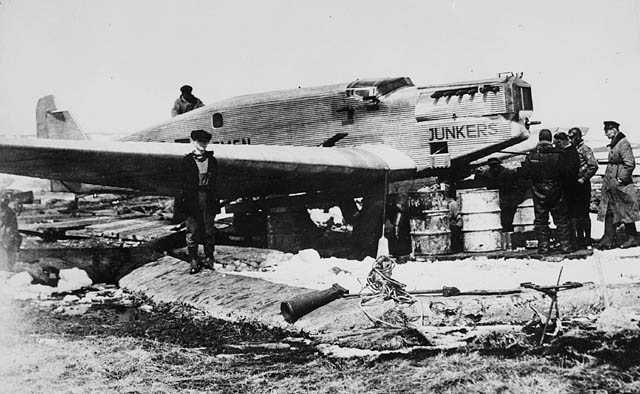
The Junkers W 33 was a German 1920s single-engine low-wing monoplane transport aircraft that followed Junkers standard practice making extensive use of corrugated aluminium alloy over an aluminium alloy tube frame, that was developed from the similar but slightly smaller Junkers F 13, and evolved into the similar W 34. One example, named Bremen, was the first aircraft to complete the much more difficult east–west non-stop heavier-than-air crossing of the Atlantic.
Like all Junkers designs from the J 7 fighter onwards, it used a duraluminum aluminium alloy structure covered with Junkers' characteristic corrugated dural skin. While the Junkers W 33 was unusual when compared to the contemporary biplanes in use in the UK and the US, cantilever monoplanes were a popular design choice in continental Europe during the period, and the Junkers designs were unusual only in their extensive use of closely corrugated metal skins. Unlike the skins on the contemporary Rohrbach Roland, those on the Junkers aircraft were not load bearing and it did not have a stressed skin structure. The Junkers W 33 was a direct evolution of the 1919 four-seat airliner, the Junkers F 13. The F 13 was similar to the W 33, but slightly smaller and had some detail differences. Considerable evolution occurred in the structure of the F 13, so that later models shared more details with the W 33. The wings had the same span as the late F 13s, though the planform differed slightly, while the length was the same as the F 13fe.
A slightly different fuselage cross section gave the W 33 a squarer cabin with a hunch-backed appearance compared to that of the F 13 and a door was provided on the port side to provide access to the freight compartment. Early examples of the W 33 had an open cockpit much like the F 13, although it lacked the structural member that divided the pilot and co-pilot, and the corresponding and very distinctive coamings. Some examples, such as the transatlantic machines had an early enclosed cockpit.
The 228 kW (306 hp) Junkers L5 upright inline water-cooled engine was also the same as used in the F 13fe, a more powerful engine than used in many of the F 13 variants. The W 33 differed primarily from the W 34 in normally using an inline engine (aside from the rare dGao variant, which served as a prototype for the W 34), while the W 34 generally used various radial engines and had some minor detail improvements, such as a larger enclosed cockpit.
As was common for the time, when a wheeled undercarriage was fitted, a conventional fixed undercarriage was used with a tailwheel. Early examples had a similar undercarriage to that used on the F 13, in which a hinged cross axle connected the two main wheels, while later examples provided an independent three-legged structure for each wheel. The Junkers W letter may have denoted the type as a seaplane (for Wasserflugzeuge), but in practice W 33s were equipped as either landplanes or seaplanes, as needed. As a floatplane, the W 33 was equipped with two main floats, braced to the fuselage with a forest of struts.
The prototype W 33, registered D-921, first flew as a seaplane from Leopoldshafen, on the river Elbe near Dessau on 17 June 1926. Production began in 1927 and ran until 1934 and most of the 198 production machines were built at the Junkers works at Dessau, but a small number were assembled at Junker's Swedish subsidiary AB Flygindustri at Limhamn near Malmö, and at Fili, near Moscow in the USSR. Both of these plants had originally been built to avoid Allied post-war restrictions on aircraft manufacturing in Germany following World War One, that had been considerably eased by the time the W 33 was flying.
In 1934 a Junkers W33 was used to test the Junkers Jumo 210 engine. It was flown with a 680 hp version on 5 July 1934.
Soon after their first flights the first two W 33 prototypes competed at the Deutschen Seeflug seaplane competition at Warnemünde in July 1926, with the first prototype W 33 competing as no.7, and coming in second in the contest while the second prototype, a W 33a, competed as no.8.
Hub AI
Junkers W 33 AI simulator
(@Junkers W 33_simulator)
Junkers W 33
The Junkers W 33 was a German 1920s single-engine low-wing monoplane transport aircraft that followed Junkers standard practice making extensive use of corrugated aluminium alloy over an aluminium alloy tube frame, that was developed from the similar but slightly smaller Junkers F 13, and evolved into the similar W 34. One example, named Bremen, was the first aircraft to complete the much more difficult east–west non-stop heavier-than-air crossing of the Atlantic.
Like all Junkers designs from the J 7 fighter onwards, it used a duraluminum aluminium alloy structure covered with Junkers' characteristic corrugated dural skin. While the Junkers W 33 was unusual when compared to the contemporary biplanes in use in the UK and the US, cantilever monoplanes were a popular design choice in continental Europe during the period, and the Junkers designs were unusual only in their extensive use of closely corrugated metal skins. Unlike the skins on the contemporary Rohrbach Roland, those on the Junkers aircraft were not load bearing and it did not have a stressed skin structure. The Junkers W 33 was a direct evolution of the 1919 four-seat airliner, the Junkers F 13. The F 13 was similar to the W 33, but slightly smaller and had some detail differences. Considerable evolution occurred in the structure of the F 13, so that later models shared more details with the W 33. The wings had the same span as the late F 13s, though the planform differed slightly, while the length was the same as the F 13fe.
A slightly different fuselage cross section gave the W 33 a squarer cabin with a hunch-backed appearance compared to that of the F 13 and a door was provided on the port side to provide access to the freight compartment. Early examples of the W 33 had an open cockpit much like the F 13, although it lacked the structural member that divided the pilot and co-pilot, and the corresponding and very distinctive coamings. Some examples, such as the transatlantic machines had an early enclosed cockpit.
The 228 kW (306 hp) Junkers L5 upright inline water-cooled engine was also the same as used in the F 13fe, a more powerful engine than used in many of the F 13 variants. The W 33 differed primarily from the W 34 in normally using an inline engine (aside from the rare dGao variant, which served as a prototype for the W 34), while the W 34 generally used various radial engines and had some minor detail improvements, such as a larger enclosed cockpit.
As was common for the time, when a wheeled undercarriage was fitted, a conventional fixed undercarriage was used with a tailwheel. Early examples had a similar undercarriage to that used on the F 13, in which a hinged cross axle connected the two main wheels, while later examples provided an independent three-legged structure for each wheel. The Junkers W letter may have denoted the type as a seaplane (for Wasserflugzeuge), but in practice W 33s were equipped as either landplanes or seaplanes, as needed. As a floatplane, the W 33 was equipped with two main floats, braced to the fuselage with a forest of struts.
The prototype W 33, registered D-921, first flew as a seaplane from Leopoldshafen, on the river Elbe near Dessau on 17 June 1926. Production began in 1927 and ran until 1934 and most of the 198 production machines were built at the Junkers works at Dessau, but a small number were assembled at Junker's Swedish subsidiary AB Flygindustri at Limhamn near Malmö, and at Fili, near Moscow in the USSR. Both of these plants had originally been built to avoid Allied post-war restrictions on aircraft manufacturing in Germany following World War One, that had been considerably eased by the time the W 33 was flying.
In 1934 a Junkers W33 was used to test the Junkers Jumo 210 engine. It was flown with a 680 hp version on 5 July 1934.
Soon after their first flights the first two W 33 prototypes competed at the Deutschen Seeflug seaplane competition at Warnemünde in July 1926, with the first prototype W 33 competing as no.7, and coming in second in the contest while the second prototype, a W 33a, competed as no.8.
Recent media