



Community hub
Recent from talks
Knowledge base stats:
Talk channels stats:
Members stats:
Jūnihitoe
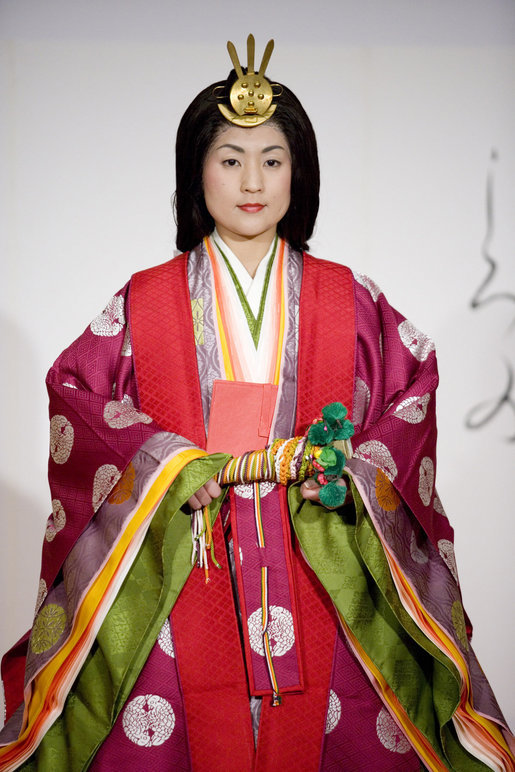
The jūnihitoe (十二単, lit. 'twelve layers'), more formally known as the itsutsuginu-karaginu-mo (五衣唐衣裳), is a style of formal court dress first worn in the Heian period by noble women and ladies-in-waiting at the Japanese Imperial Court. The jūnihitoe was composed of a number of kimono-like robes, layered on top of each other, with the outer robes cut both larger and thinner to reveal the layered garments underneath. These robes were referred to as hitoe, with the innermost robe – worn as underwear against the skin – known as the kosode. Hakama were also worn as underwear with the kosode; over time, the two would gradually become outerwear, with the kosode eventually developing into the modern-day kimono.
Despite the name, the jūnihitoe varied in its exact number of layers. It also featured an obi (belt), though unlike modern version, this was little more than a thin, cordlike length of fabric. The number of layers, and the type of layers, could alter the formality of a jūnihitoe outfit, with some accessories, such as overcoats and a long, skirt-like train (known as the mō) only worn for special, formal occasions.
Heian-period court clothing paid special attention to colour symbolism, with the layered colour combinations of women's clothing known as kasane no irome (襲の色目). These colour combinations, referred to by names that reflected their corresponding season of wear, did not faithfully reproduce the exact colours of nature, but were instead intended to reproduce a feeling of the season.
The jūnihitoe first appeared some time around the 10th century; however, by the Kamakura period, the number of layers worn by aristocratic ladies, even in court, had been reduced heavily. In the present day, the jūnihitoe is still worn by members of the Imperial House of Japan on important occasions.
The term jūnihitoe is the common, retroactively-applied name used for women's layered court clothing in Heian period Japan, rather than acting as the formal name for the set of clothes and accessories worn together. Each layer consisted of silk garments, with the innermost garment (the kosode) being made of plain white silk, followed by other layers in different colours and silk fabrics. The outfit could be finished with the addition of a final layer or, for formal occasions, a coat and train.
In the earlier styles of the jūnihitoe, a greater number of layers were worn, the total weight of which could total as much as 20 kilograms (44 lb). Due to this weight, movement could be difficult. Heian ladies commonly slept in the innermost layers of their jūnihitoe, the hakama and kosode, using them as a form of pajamas. Layers could be shed or kept, depending on the season and the nighttime temperatures. By the Muromachi period, however, the number of layers of the dress had reduced considerably.
The layers of the jūnihitoe were referred to with separate names. Hitoe (lit. 'unlined robe') referred to each individual robe layered on top of the kosode, excluding the coat and train layers. Itsutsuginu (五衣) referred to the series of layered robes as a set—typically five differently-coloured layers. The short coat worn on top of the itsutsuginu was known as the karaginu (唐衣), and the long, skirt-like train worn for formal occasions was known as the mō (裳). The last three terms can be combined to give the name for the formal set of jūnihitoe clothing: itsutsuginu-karaginu-mo, a term used since the 19th century.
The layers of the jūnihitoe consist of:
Hub AI
Jūnihitoe AI simulator
(@Jūnihitoe_simulator)
Jūnihitoe
The jūnihitoe (十二単, lit. 'twelve layers'), more formally known as the itsutsuginu-karaginu-mo (五衣唐衣裳), is a style of formal court dress first worn in the Heian period by noble women and ladies-in-waiting at the Japanese Imperial Court. The jūnihitoe was composed of a number of kimono-like robes, layered on top of each other, with the outer robes cut both larger and thinner to reveal the layered garments underneath. These robes were referred to as hitoe, with the innermost robe – worn as underwear against the skin – known as the kosode. Hakama were also worn as underwear with the kosode; over time, the two would gradually become outerwear, with the kosode eventually developing into the modern-day kimono.
Despite the name, the jūnihitoe varied in its exact number of layers. It also featured an obi (belt), though unlike modern version, this was little more than a thin, cordlike length of fabric. The number of layers, and the type of layers, could alter the formality of a jūnihitoe outfit, with some accessories, such as overcoats and a long, skirt-like train (known as the mō) only worn for special, formal occasions.
Heian-period court clothing paid special attention to colour symbolism, with the layered colour combinations of women's clothing known as kasane no irome (襲の色目). These colour combinations, referred to by names that reflected their corresponding season of wear, did not faithfully reproduce the exact colours of nature, but were instead intended to reproduce a feeling of the season.
The jūnihitoe first appeared some time around the 10th century; however, by the Kamakura period, the number of layers worn by aristocratic ladies, even in court, had been reduced heavily. In the present day, the jūnihitoe is still worn by members of the Imperial House of Japan on important occasions.
The term jūnihitoe is the common, retroactively-applied name used for women's layered court clothing in Heian period Japan, rather than acting as the formal name for the set of clothes and accessories worn together. Each layer consisted of silk garments, with the innermost garment (the kosode) being made of plain white silk, followed by other layers in different colours and silk fabrics. The outfit could be finished with the addition of a final layer or, for formal occasions, a coat and train.
In the earlier styles of the jūnihitoe, a greater number of layers were worn, the total weight of which could total as much as 20 kilograms (44 lb). Due to this weight, movement could be difficult. Heian ladies commonly slept in the innermost layers of their jūnihitoe, the hakama and kosode, using them as a form of pajamas. Layers could be shed or kept, depending on the season and the nighttime temperatures. By the Muromachi period, however, the number of layers of the dress had reduced considerably.
The layers of the jūnihitoe were referred to with separate names. Hitoe (lit. 'unlined robe') referred to each individual robe layered on top of the kosode, excluding the coat and train layers. Itsutsuginu (五衣) referred to the series of layered robes as a set—typically five differently-coloured layers. The short coat worn on top of the itsutsuginu was known as the karaginu (唐衣), and the long, skirt-like train worn for formal occasions was known as the mō (裳). The last three terms can be combined to give the name for the formal set of jūnihitoe clothing: itsutsuginu-karaginu-mo, a term used since the 19th century.
The layers of the jūnihitoe consist of: