
Recent from talks
KH-7 Gambit
Knowledge base stats:
Talk channels stats:
Members stats:
KH-7 Gambit
BYEMAN codenamed GAMBIT, the KH-7 (Air Force Program 206) was a reconnaissance satellite used by the United States from July 1963 to June 1967. Like the older CORONA system, it acquired imagery intelligence by taking photographs and returning the undeveloped film to earth. It achieved a typical ground-resolution of 2 ft (0.61 m) to 3 ft (0.91 m). In 2002, all KH-7 satellite imagery, with the exception of some facilities in Israel, was declassified. Other details of the satellite program and construction remained classified until 2011.
In its summary report following the conclusion of the program, the National Reconnaissance Office concluded that the GAMBIT program was considered highly successful in that it produced the first high-resolution satellite photography, 69.4% of the images having a resolution under 3 ft (0.91 m); its record of successful launches, orbits, and recoveries far surpassed the records of earlier systems; and it advanced the state of the art to the point where follow-on larger systems could be developed and flown successfully. The report also stated that Gambit had provided the intelligence community with the first high-resolution satellite photography of denied areas, the intelligence value of which was considered "extremely high". In particular, its overall success stood in sharp contrast to the two first-generation photoreconnaissance programs, Corona, which suffered far too many malfunctions to achieve any consistent success, and SAMOS, which was essentially a complete failure with all satellites either being lost in launch mishaps or returning no usable imagery.
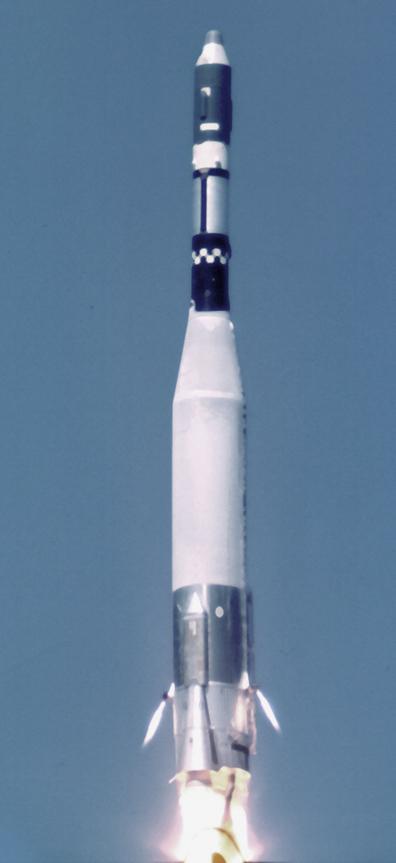
GAMBIT emerged in 1962 as an alternative to the less-than-successful CORONA and the completely failed SAMOS, although CORONA was not cancelled and in fact continued operating alongside the newer program into the early 1970s. While CORONA used the Thor-Agena launch vehicle family, GAMBIT would be launched on Atlas-Agena, the booster used for SAMOS. After the improved KH-8 GAMBIT-3 satellite was developed during 1965, operations shifted to the larger Titan IIIB launch vehicle.
Each GAMBIT-1 satellite was about 15 ft (4.6 m) long, 5 ft (1.5 m) wide, weighed about 1,154 lb (523 kg), and carried about 3,000 ft (910 m) of film.
A feasibility study for the Geodetic Orbital Photographic Satellite System reveals three subsystems for U.S. optical reconnaissance satellites in the 1960s: the Orbital (or Orbiting) Control Vehicle (OCV), the Data Collection Module (DCM), and the Recovery Section (RS). For the KH-7, the DCM is also called the Camera Optics Module (COM), and is integrated in the OCV, which has a length of 5.5 m (18 ft) and a diameter of 1.52 m (5 ft 0 in).
The Camera Optics Module of KH-7 consists of three cameras: a single strip camera, a stellar camera, and an index camera.
In the strip camera the ground image is reflected by a steerable flat mirror to a 1.21 m (4 ft 0 in) diameter stationary concave primary mirror. The primary mirror reflects the light through an opening in the flat mirror and through a Ross corrector. It took images of a 6.3° wide ground swath by exposing a 22 cm (8.7 in) wide moving portion of film through a small slit aperture. The initial ground resolution of the satellite was 1.2 m (3 ft 11 in), but improved to 0.6 m (2 ft 0 in) by 1966. Each satellite weighed about 2,000 kg (4,400 lb), and returned a single film bucket per mission. The camera and film transport system were manufactured by Eastman Kodak Company.
The index camera is a copy of cameras systems previously used in the KH-4 and KH-6 satellites, and takes exposures of Earth in direction of the vehicle roll position for attitude determination. The stellar camera takes images of star fields with a reseau grid being superimposed on the image plane. The S/I camera was provided by Itek, and horizon sensors were provided by Barnes Engineering Co.
Hub AI
KH-7 Gambit AI simulator
(@KH-7 Gambit_simulator)
KH-7 Gambit
BYEMAN codenamed GAMBIT, the KH-7 (Air Force Program 206) was a reconnaissance satellite used by the United States from July 1963 to June 1967. Like the older CORONA system, it acquired imagery intelligence by taking photographs and returning the undeveloped film to earth. It achieved a typical ground-resolution of 2 ft (0.61 m) to 3 ft (0.91 m). In 2002, all KH-7 satellite imagery, with the exception of some facilities in Israel, was declassified. Other details of the satellite program and construction remained classified until 2011.
In its summary report following the conclusion of the program, the National Reconnaissance Office concluded that the GAMBIT program was considered highly successful in that it produced the first high-resolution satellite photography, 69.4% of the images having a resolution under 3 ft (0.91 m); its record of successful launches, orbits, and recoveries far surpassed the records of earlier systems; and it advanced the state of the art to the point where follow-on larger systems could be developed and flown successfully. The report also stated that Gambit had provided the intelligence community with the first high-resolution satellite photography of denied areas, the intelligence value of which was considered "extremely high". In particular, its overall success stood in sharp contrast to the two first-generation photoreconnaissance programs, Corona, which suffered far too many malfunctions to achieve any consistent success, and SAMOS, which was essentially a complete failure with all satellites either being lost in launch mishaps or returning no usable imagery.
GAMBIT emerged in 1962 as an alternative to the less-than-successful CORONA and the completely failed SAMOS, although CORONA was not cancelled and in fact continued operating alongside the newer program into the early 1970s. While CORONA used the Thor-Agena launch vehicle family, GAMBIT would be launched on Atlas-Agena, the booster used for SAMOS. After the improved KH-8 GAMBIT-3 satellite was developed during 1965, operations shifted to the larger Titan IIIB launch vehicle.
Each GAMBIT-1 satellite was about 15 ft (4.6 m) long, 5 ft (1.5 m) wide, weighed about 1,154 lb (523 kg), and carried about 3,000 ft (910 m) of film.
A feasibility study for the Geodetic Orbital Photographic Satellite System reveals three subsystems for U.S. optical reconnaissance satellites in the 1960s: the Orbital (or Orbiting) Control Vehicle (OCV), the Data Collection Module (DCM), and the Recovery Section (RS). For the KH-7, the DCM is also called the Camera Optics Module (COM), and is integrated in the OCV, which has a length of 5.5 m (18 ft) and a diameter of 1.52 m (5 ft 0 in).
The Camera Optics Module of KH-7 consists of three cameras: a single strip camera, a stellar camera, and an index camera.
In the strip camera the ground image is reflected by a steerable flat mirror to a 1.21 m (4 ft 0 in) diameter stationary concave primary mirror. The primary mirror reflects the light through an opening in the flat mirror and through a Ross corrector. It took images of a 6.3° wide ground swath by exposing a 22 cm (8.7 in) wide moving portion of film through a small slit aperture. The initial ground resolution of the satellite was 1.2 m (3 ft 11 in), but improved to 0.6 m (2 ft 0 in) by 1966. Each satellite weighed about 2,000 kg (4,400 lb), and returned a single film bucket per mission. The camera and film transport system were manufactured by Eastman Kodak Company.
The index camera is a copy of cameras systems previously used in the KH-4 and KH-6 satellites, and takes exposures of Earth in direction of the vehicle roll position for attitude determination. The stellar camera takes images of star fields with a reseau grid being superimposed on the image plane. The S/I camera was provided by Itek, and horizon sensors were provided by Barnes Engineering Co.
Recent media