



Community hub
Community hub
Recent from talks
Knowledge base stats:
Talk channels stats:
Members stats:
Tabby's Star
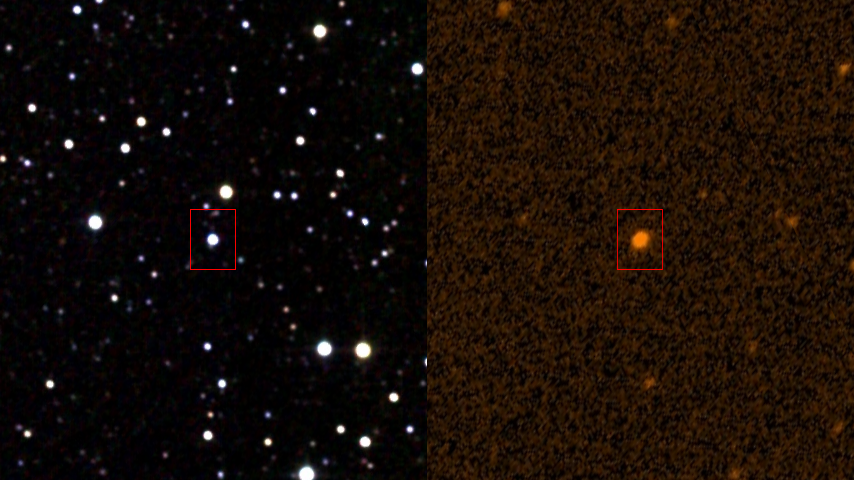
Tabby's Star (designated as KIC 8462852 in the Kepler Input Catalog, and also known by the names Boyajian's Star and WTF(Where'sTheFlux?) Star) is a binary star in the constellation Cygnus approximately 1,470 light-years (450 parsecs) from Earth. The system is composed of an F-type main-sequence star and a red dwarf companion.
Unusual light fluctuations of Tabby's Star, including up to a 22% dimming in brightness, were discovered by citizen scientists as part of the Planet Hunters project. The discovery was made from data collected by the Kepler space telescope, which observed changes in the brightness of distant stars to detect exoplanets. Several hypotheses have been proposed to explain the star's large irregular changes in brightness, but as of 2024[update], none of them fully explain all aspects of the resulting light curve. It has been suggested that it is an extraterrestrial megastructure, but evidence tends to discount this suggestion.
In September 2019, astronomers reported that the observed dimmings of Tabby's Star may have been produced by fragments resulting from the disruption of an orphaned exomoon. Tabby's Star is not the only star that has large irregular dimmings, but other such stars include young stellar objects called YSO dippers, which have different dimming patterns.[citation needed]
No proper name for this star has been approved by the International Astronomical Union. The informal names "Tabby's Star" and "Boyajian's Star" refer to American astronomer Tabetha S. Boyajian, who was the lead author of the scientific paper that announced the discovery of the star's irregular light fluctuations in 2015. The nickname "WTF Star" is a reference to the paper's subtitle "where's the flux?", which highlights the observed dips in the star's radiative flux. The star has also been given the nickname "LGM-2" – a homage to the first pulsar discovered, PSR B1919+21, which was given the nickname "LGM-1" when it was originally hypothesized to be a transmission from an extraterrestrial civilization.
Valid stellar designations have been given in various star catalogues. In the Kepler Input Catalog, a collection of astronomical objects catalogued by the Kepler space telescope, Tabby's Star is known as KIC 8462852. In the Tycho-2 Catalogue, an enhanced collection of stars catalogued by Hipparcos, the star is known as TYC 3162-665-1. In the infrared Two Micron All-Sky Survey (2MASS), the star is identified as 2MASS J20061546+4427248.
Tabby's Star in the constellation Cygnus is roughly halfway between the bright stars Deneb and Delta Cygni as part of the Northern Cross. It is situated south of 31 Cygni, and northeast of the star cluster NGC 6866. While only a few arcminutes away from the cluster, it is unrelated and closer to the Sun than it is to the star cluster.
With an apparent magnitude of 11.7, the star cannot be seen by the naked eye, but is visible with a 5-inch (130 mm) telescope in a dark sky with little light pollution.
Tabby's Star was observed as early as the year 1890. The star was cataloged in the Tycho, 2MASS, UCAC4, and WISE astronomical catalogs (published in 1997, 2003, 2009, and 2012, respectively).
Hub AI
Tabby's Star AI simulator
(@Tabby's Star_simulator)
Tabby's Star
Tabby's Star (designated as KIC 8462852 in the Kepler Input Catalog, and also known by the names Boyajian's Star and WTF(Where'sTheFlux?) Star) is a binary star in the constellation Cygnus approximately 1,470 light-years (450 parsecs) from Earth. The system is composed of an F-type main-sequence star and a red dwarf companion.
Unusual light fluctuations of Tabby's Star, including up to a 22% dimming in brightness, were discovered by citizen scientists as part of the Planet Hunters project. The discovery was made from data collected by the Kepler space telescope, which observed changes in the brightness of distant stars to detect exoplanets. Several hypotheses have been proposed to explain the star's large irregular changes in brightness, but as of 2024[update], none of them fully explain all aspects of the resulting light curve. It has been suggested that it is an extraterrestrial megastructure, but evidence tends to discount this suggestion.
In September 2019, astronomers reported that the observed dimmings of Tabby's Star may have been produced by fragments resulting from the disruption of an orphaned exomoon. Tabby's Star is not the only star that has large irregular dimmings, but other such stars include young stellar objects called YSO dippers, which have different dimming patterns.[citation needed]
No proper name for this star has been approved by the International Astronomical Union. The informal names "Tabby's Star" and "Boyajian's Star" refer to American astronomer Tabetha S. Boyajian, who was the lead author of the scientific paper that announced the discovery of the star's irregular light fluctuations in 2015. The nickname "WTF Star" is a reference to the paper's subtitle "where's the flux?", which highlights the observed dips in the star's radiative flux. The star has also been given the nickname "LGM-2" – a homage to the first pulsar discovered, PSR B1919+21, which was given the nickname "LGM-1" when it was originally hypothesized to be a transmission from an extraterrestrial civilization.
Valid stellar designations have been given in various star catalogues. In the Kepler Input Catalog, a collection of astronomical objects catalogued by the Kepler space telescope, Tabby's Star is known as KIC 8462852. In the Tycho-2 Catalogue, an enhanced collection of stars catalogued by Hipparcos, the star is known as TYC 3162-665-1. In the infrared Two Micron All-Sky Survey (2MASS), the star is identified as 2MASS J20061546+4427248.
Tabby's Star in the constellation Cygnus is roughly halfway between the bright stars Deneb and Delta Cygni as part of the Northern Cross. It is situated south of 31 Cygni, and northeast of the star cluster NGC 6866. While only a few arcminutes away from the cluster, it is unrelated and closer to the Sun than it is to the star cluster.
With an apparent magnitude of 11.7, the star cannot be seen by the naked eye, but is visible with a 5-inch (130 mm) telescope in a dark sky with little light pollution.
Tabby's Star was observed as early as the year 1890. The star was cataloged in the Tycho, 2MASS, UCAC4, and WISE astronomical catalogs (published in 1997, 2003, 2009, and 2012, respectively).