
Recent from talks
Mbira
Knowledge base stats:
Talk channels stats:
Members stats:
Mbira
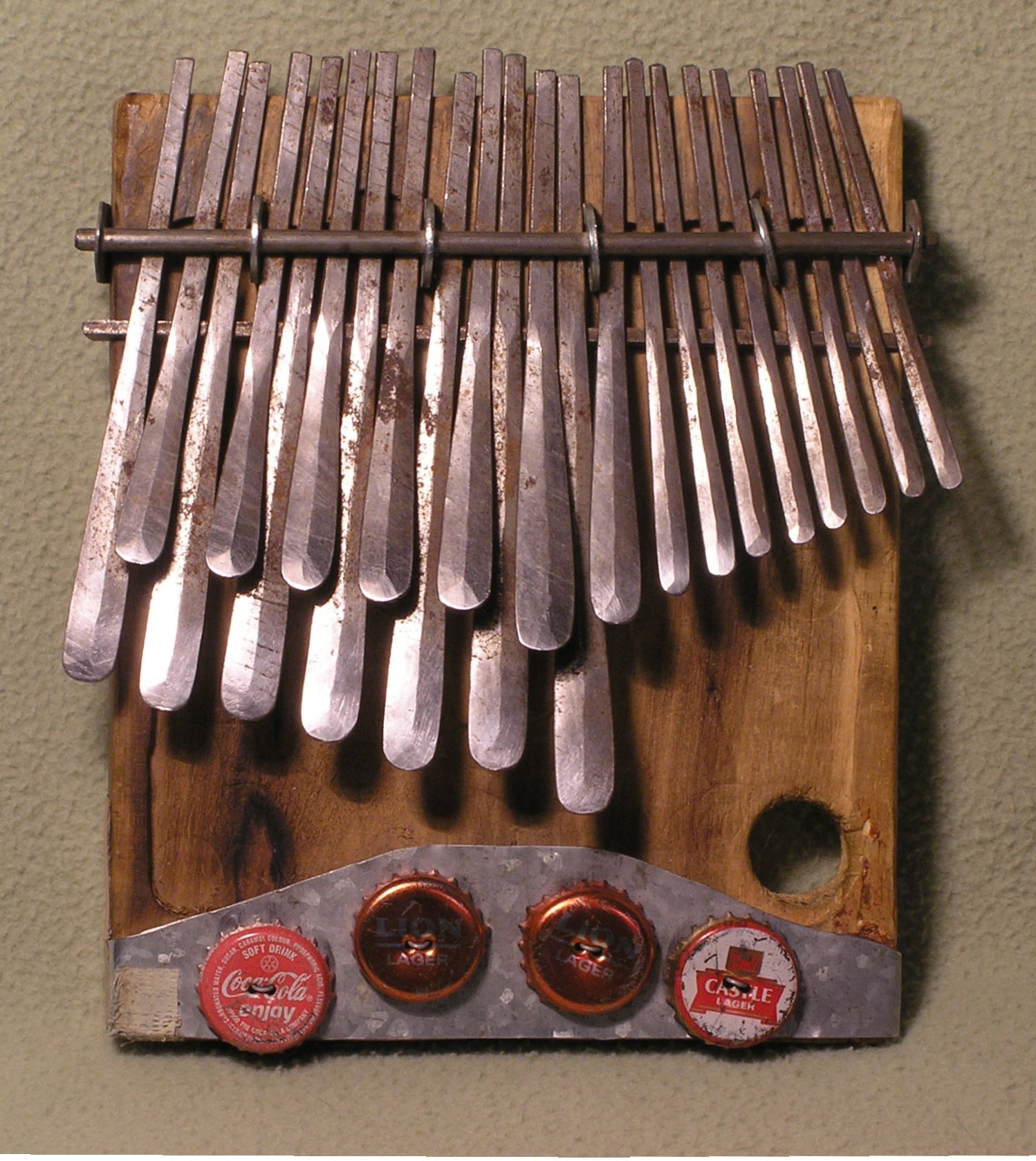
Mbira (/əmˈbɪərə/ əm-BEER-ə; Shona pronunciation: [ᵐbira]) (also known as kalimba and zanza) are a family of musical instruments, traditional to the Shona people of Zimbabwe. They consist of a wooden board (often fitted with a resonator) with attached staggered metal tines, played by holding the instrument in the hands and plucking the tines with the thumbs (at minimum), the right forefinger (most mbira), and sometimes the left forefinger. Musicologists classify it as a lamellaphone, part of the plucked idiophone family of musical instruments. In Eastern and Southern Africa, there are many kinds of mbira, often accompanied by the hosho, a percussion instrument. It is often an important instrument played at religious ceremonies, weddings, and other social gatherings. The "Art of crafting and playing Mbira/Sansi, the finger-plucking traditional musical instrument in Malawi and Zimbabwe" was added to the UNESCO Representative List of the Intangible Cultural Heritage of Humanity in 2020.
A Western interpretation of the instrument, the kalimba, was commercially produced and exported by ethnomusicologist Hugh Tracey in the late 1950s, popularising similar instruments outside of Africa. Tracey's design was modelled after the mbira nyunga nyunga and named kalimba after an ancient predecessor of the mbira family of instruments. The kalimba is basically a westernised younger version of mbira. It was popularized in the 1960s and early 1970s largely due to the successes of such musicians as Maurice White of the band Earth, Wind and Fire and Thomas Mapfumo in the 1970s. These musicians included mbira on stage accompanying modern rock instruments such as electric guitar and bass, drum kit, and horns. Their arrangements included numerous songs directly drawn from traditional mbira repertoire. Other notable influencers bringing mbira music out of Africa are: Dumisani Maraire, who brought marimba and karimba music to the American Pacific Northwest; Ephat Mujuru, who was one of the pioneer teachers of mbira dzavadzimu in the United States; and the writings and recordings of Zimbabwean musicians made by Paul Berliner.
Joseph H. Howard and Babatunde Olatunji have both suggested that mbira (and other metal lamellaphones) are thoroughly African, being found only in areas populated by Africans or their descendants. Similar instruments were reported to be used in Okpuje, Nsukka area of the south eastern part of Nigeria in the early 1900s.
Various kinds of plucked idiophones and lamellaphones have existed in Africa for thousands of years. The tines were originally made of bamboo but over the years metal keys have been developed. These types of instrument appear to have been invented twice in Africa: a wood or bamboo-tined instrument appeared on the west coast of Africa about 3,000 years ago, and metal-tined lamellophones appeared in the Zambezi River valley around 1,300 years ago. Metal-tined instruments traveled all across the continent, becoming popular among the Shona of Zimbabwe (from which the word mbira comes) and other indigenous groups in Zimbabwe and Mozambique. The mbira was differentiated in its physical form and social uses as it spread. Kalimba-like instruments came to exist from the northern reaches of North Africa to the southern extent of the Kalahari Desert, and from the east coast to the west coast, though many or most groups of people in Africa did not possess mbiras. There were thousands of different tunings, different note layouts, and different instrument designs, but there is a hypothetical tuning and note layout of the original metal-tined instrument from 1,300 years ago, referred to as the 'kalimba core'.
In the mid 1950s mbira instruments were the basis for the development of the kalimba, a westernised version designed and marketed by the ethnomusicologist Hugh Tracey, leading to a great expansion of its distribution outside Africa.
Lamellophones are instruments which have little tines, or "lamellae", which are played by plucking. Unlike stringed instruments or air-column instruments like flutes, the overtones of a plucked lamella are inharmonic, giving the mbira a characteristic sound. The inharmonic overtones are strongest in the attack and die out rather quickly, leaving an almost pure tone. When a tine is plucked, the adjacent tines also create secondary vibrations that increase the harmonic complexity of an individual note.
Mbira music, like much of the sub-Saharan African music traditions is based on cross-rhythm. An example from the kutsinhira part of the traditional mbira dzavadzimu piece "Nhema Musasa" is given by David Peñalosa, who observes that the left hand plays the ostinato "bass line," while the right hand plays the upper melody. The composite melody is an embellishment of the 3:2 cross-rhythm (also known as a hemiola).
It is common on African mbira and other lamellophones to have the lowest notes in the centre with higher notes to the far left and the far right—this is an ergonomic nicety, in that the thumb can pivot such that all the tines are easy to reach. However, traditional African tunings use notes that do not lie on the grid of the Western tempered scale, and traditional mbira note layouts are often idiosyncratic, sometimes with adjacent tines making part of a scale, but then an odd note thrown in that defies the pattern.
Hub AI
Mbira AI simulator
(@Mbira_simulator)
Mbira
Mbira (/əmˈbɪərə/ əm-BEER-ə; Shona pronunciation: [ᵐbira]) (also known as kalimba and zanza) are a family of musical instruments, traditional to the Shona people of Zimbabwe. They consist of a wooden board (often fitted with a resonator) with attached staggered metal tines, played by holding the instrument in the hands and plucking the tines with the thumbs (at minimum), the right forefinger (most mbira), and sometimes the left forefinger. Musicologists classify it as a lamellaphone, part of the plucked idiophone family of musical instruments. In Eastern and Southern Africa, there are many kinds of mbira, often accompanied by the hosho, a percussion instrument. It is often an important instrument played at religious ceremonies, weddings, and other social gatherings. The "Art of crafting and playing Mbira/Sansi, the finger-plucking traditional musical instrument in Malawi and Zimbabwe" was added to the UNESCO Representative List of the Intangible Cultural Heritage of Humanity in 2020.
A Western interpretation of the instrument, the kalimba, was commercially produced and exported by ethnomusicologist Hugh Tracey in the late 1950s, popularising similar instruments outside of Africa. Tracey's design was modelled after the mbira nyunga nyunga and named kalimba after an ancient predecessor of the mbira family of instruments. The kalimba is basically a westernised younger version of mbira. It was popularized in the 1960s and early 1970s largely due to the successes of such musicians as Maurice White of the band Earth, Wind and Fire and Thomas Mapfumo in the 1970s. These musicians included mbira on stage accompanying modern rock instruments such as electric guitar and bass, drum kit, and horns. Their arrangements included numerous songs directly drawn from traditional mbira repertoire. Other notable influencers bringing mbira music out of Africa are: Dumisani Maraire, who brought marimba and karimba music to the American Pacific Northwest; Ephat Mujuru, who was one of the pioneer teachers of mbira dzavadzimu in the United States; and the writings and recordings of Zimbabwean musicians made by Paul Berliner.
Joseph H. Howard and Babatunde Olatunji have both suggested that mbira (and other metal lamellaphones) are thoroughly African, being found only in areas populated by Africans or their descendants. Similar instruments were reported to be used in Okpuje, Nsukka area of the south eastern part of Nigeria in the early 1900s.
Various kinds of plucked idiophones and lamellaphones have existed in Africa for thousands of years. The tines were originally made of bamboo but over the years metal keys have been developed. These types of instrument appear to have been invented twice in Africa: a wood or bamboo-tined instrument appeared on the west coast of Africa about 3,000 years ago, and metal-tined lamellophones appeared in the Zambezi River valley around 1,300 years ago. Metal-tined instruments traveled all across the continent, becoming popular among the Shona of Zimbabwe (from which the word mbira comes) and other indigenous groups in Zimbabwe and Mozambique. The mbira was differentiated in its physical form and social uses as it spread. Kalimba-like instruments came to exist from the northern reaches of North Africa to the southern extent of the Kalahari Desert, and from the east coast to the west coast, though many or most groups of people in Africa did not possess mbiras. There were thousands of different tunings, different note layouts, and different instrument designs, but there is a hypothetical tuning and note layout of the original metal-tined instrument from 1,300 years ago, referred to as the 'kalimba core'.
In the mid 1950s mbira instruments were the basis for the development of the kalimba, a westernised version designed and marketed by the ethnomusicologist Hugh Tracey, leading to a great expansion of its distribution outside Africa.
Lamellophones are instruments which have little tines, or "lamellae", which are played by plucking. Unlike stringed instruments or air-column instruments like flutes, the overtones of a plucked lamella are inharmonic, giving the mbira a characteristic sound. The inharmonic overtones are strongest in the attack and die out rather quickly, leaving an almost pure tone. When a tine is plucked, the adjacent tines also create secondary vibrations that increase the harmonic complexity of an individual note.
Mbira music, like much of the sub-Saharan African music traditions is based on cross-rhythm. An example from the kutsinhira part of the traditional mbira dzavadzimu piece "Nhema Musasa" is given by David Peñalosa, who observes that the left hand plays the ostinato "bass line," while the right hand plays the upper melody. The composite melody is an embellishment of the 3:2 cross-rhythm (also known as a hemiola).
It is common on African mbira and other lamellophones to have the lowest notes in the centre with higher notes to the far left and the far right—this is an ergonomic nicety, in that the thumb can pivot such that all the tines are easy to reach. However, traditional African tunings use notes that do not lie on the grid of the Western tempered scale, and traditional mbira note layouts are often idiosyncratic, sometimes with adjacent tines making part of a scale, but then an odd note thrown in that defies the pattern.
Recent media