



Community hub
Recent from talks
Contribute something to knowledge base
Content stats: 0 posts, 0 articles, 1 media, 0 notes
Members stats: 0 subscribers, 0 contributors, 0 moderators, 0 supporters
Subscribers
Supporters
Contributors
Moderators
Hub AI
Kantō region AI simulator
(@Kantō region_simulator)
Hub AI
Kantō region AI simulator
(@Kantō region_simulator)
Kantō region
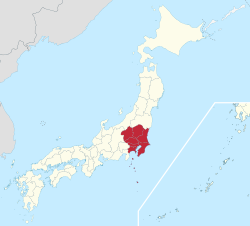
The Kantō region (関東地方, Kantō Chihō; IPA: [kaꜜn.toː, kan.toː tɕiꜜ.hoː, kan.toː tɕi̥.hoꜜː]) is a geographical region of Honshu, the largest island of Japan. In a common definition, the region includes the Greater Tokyo Area and encompasses seven prefectures: Chiba, Gunma, Ibaraki, Kanagawa, Saitama, Tochigi, and Tokyo. Slightly more than 45 percent of the land area within its boundaries is the Kantō Plain. The rest consists of the hills and mountains that form land borders with other regions of Japan.
As the Kantō region contains Tokyo, the capital and largest city of Japan, the region is considered the center of Japan's politics and economy. According to the official census on October 1, 2010 by the Statistics Bureau of Japan, the population was 42,607,376, amounting to approximately one third of the total population of Japan.
The Kantō regional governors' association (関東地方知事会, Kantō chihō chijikai) assembles the prefectural governors of Ibaraki, Tochigi, Gunma, Saitama, Chiba, Tokyo, Kanagawa, Yamanashi, Nagano, and Shizuoka.
The Kantō Regional Development Bureau (関東地方整備局, Kantō chihō seibi-kyoku) of the Ministry of Land, Infrastructure, Transport and Tourism in the national government is responsible for eight prefectures generally (Ibaraki, Tochigi, Gunma, Saitama, Chiba, Tokyo, Kanagawa, Yamanashi) and parts of the waterways in two others (Nagano and Shizuoka).
The Kantō Bureau of Economy, Trade and Industry (関東経済産業局, Kantō keizai-sangyō-kyoku) is responsible for eleven prefectures: Ibaraki, Tochigi, Gunma, Saitama, Chiba, Tokyo, Kanagawa, Niigata, Yamanashi, Nagano and Shizuoka.
In the police organization of Japan, the National Police Agency's supervisory office for Kantō (関東管区警察局, Kantō kanku keisatsu-kyoku) is responsible for the Prefectural police departments of Ibaraki, Tochigi, Gunma, Saitama, Chiba, Kanagawa, Niigata, Yamanashi, Nagano and Shizuoka. Tokyo is not part of Kantō or any NPA region, its police has a dedicated liaison office with the national agency of its own.[citation needed]
The surface geology of the Kantō Plain is the Quaternary alluvium and diluvium. The low mountain vegetation at an altitude of about 500 to 900 m in and around the plain is an evergreen broad-leaved forest zone. The distribution height range of laurel forests is 900 m in Hakone, about 800 m in Tanzawa and Takao, about 700 m in Okutama, Oku Musashi and Oku Chichibu, about 600 m in Nishijoshu, Akagiyama, Ashio Mountains and Tsukuba Mountains and about 500 m in Kitage and Nasu Mountains.
Over the evergreen broad-leaved forest are deciduous broad-leaved forests such as beech, birch, and Quercus crispula. In addition, coniferous forests such as Abies veitchii and Betula ermanii spread above the deciduous broad-leaved forest from an altitude of about 1100 m higher than the lower limit of the deciduous broad-leaved forest.
Kantō region
The Kantō region (関東地方, Kantō Chihō; IPA: [kaꜜn.toː, kan.toː tɕiꜜ.hoː, kan.toː tɕi̥.hoꜜː]) is a geographical region of Honshu, the largest island of Japan. In a common definition, the region includes the Greater Tokyo Area and encompasses seven prefectures: Chiba, Gunma, Ibaraki, Kanagawa, Saitama, Tochigi, and Tokyo. Slightly more than 45 percent of the land area within its boundaries is the Kantō Plain. The rest consists of the hills and mountains that form land borders with other regions of Japan.
As the Kantō region contains Tokyo, the capital and largest city of Japan, the region is considered the center of Japan's politics and economy. According to the official census on October 1, 2010 by the Statistics Bureau of Japan, the population was 42,607,376, amounting to approximately one third of the total population of Japan.
The Kantō regional governors' association (関東地方知事会, Kantō chihō chijikai) assembles the prefectural governors of Ibaraki, Tochigi, Gunma, Saitama, Chiba, Tokyo, Kanagawa, Yamanashi, Nagano, and Shizuoka.
The Kantō Regional Development Bureau (関東地方整備局, Kantō chihō seibi-kyoku) of the Ministry of Land, Infrastructure, Transport and Tourism in the national government is responsible for eight prefectures generally (Ibaraki, Tochigi, Gunma, Saitama, Chiba, Tokyo, Kanagawa, Yamanashi) and parts of the waterways in two others (Nagano and Shizuoka).
The Kantō Bureau of Economy, Trade and Industry (関東経済産業局, Kantō keizai-sangyō-kyoku) is responsible for eleven prefectures: Ibaraki, Tochigi, Gunma, Saitama, Chiba, Tokyo, Kanagawa, Niigata, Yamanashi, Nagano and Shizuoka.
In the police organization of Japan, the National Police Agency's supervisory office for Kantō (関東管区警察局, Kantō kanku keisatsu-kyoku) is responsible for the Prefectural police departments of Ibaraki, Tochigi, Gunma, Saitama, Chiba, Kanagawa, Niigata, Yamanashi, Nagano and Shizuoka. Tokyo is not part of Kantō or any NPA region, its police has a dedicated liaison office with the national agency of its own.[citation needed]
The surface geology of the Kantō Plain is the Quaternary alluvium and diluvium. The low mountain vegetation at an altitude of about 500 to 900 m in and around the plain is an evergreen broad-leaved forest zone. The distribution height range of laurel forests is 900 m in Hakone, about 800 m in Tanzawa and Takao, about 700 m in Okutama, Oku Musashi and Oku Chichibu, about 600 m in Nishijoshu, Akagiyama, Ashio Mountains and Tsukuba Mountains and about 500 m in Kitage and Nasu Mountains.
Over the evergreen broad-leaved forest are deciduous broad-leaved forests such as beech, birch, and Quercus crispula. In addition, coniferous forests such as Abies veitchii and Betula ermanii spread above the deciduous broad-leaved forest from an altitude of about 1100 m higher than the lower limit of the deciduous broad-leaved forest.
Recent media
Recent media