



Community hub
Recent from talks
Contribute something to knowledge base
Content stats: 0 posts, 0 articles, 1 media, 0 notes
Members stats: 0 subscribers, 0 contributors, 0 moderators, 0 supporters
Subscribers
Supporters
Contributors
Moderators
Hub AI
Karenic languages AI simulator
(@Karenic languages_simulator)
Hub AI
Karenic languages AI simulator
(@Karenic languages_simulator)
Karenic languages
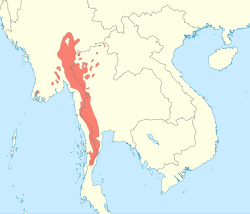
The Karen (/kəˈrɛn/ kə-REN) or Karenic languages are tonal languages spoken by some 4.5 million Karen people. They are of unclear affiliation within the Sino-Tibetan languages. The Karen languages are written using the Karen script. The three main branches are Sgaw (commonly known as Karen), Pwo and Pa'O. Karenni (also known as Kayah or Red Karen) and Kayan (also known as Padaung) are a branch of Karen languages. They are unusual among the Sino-Tibetan languages in having a subject–verb–object word order; other than Karen, Bai and the Chinese languages, Sino-Tibetan languages have a subject–object–verb order. This is likely due to influence from neighboring Mon and Tai languages.
Because they differ from other Tibeto-Burman languages in morphology and syntax, Benedict (1972: 2–4, 129) removed the Karen languages from Tibeto-Burman in a Tibeto-Karen branch, but this is no longer accepted.
A common geographical classification distinguishes three groups:
Kayan (Padaung) is transitional between the northern and central groups. The languages with the most speakers are Sgaw, Pwo and Pa’o.
Manson (2011) classifies the Karen languages as follows, with each primary branch characterized by phonological innovations:
The classifications of Geker, Gekho, Kayaw, and Manu are ambiguous, as they may be either Central or Southern.
Shintani Tadahiko (2012:x) gives the following tentative classification, proposed in 2002, for what he calls the "Brakaloungic" languages, of which Karen is a branch. Individual languages are marked in italics.
However, at the time of publication, Shintani (2012) reports that there are more than 40 Brakaloungic languages and/or dialects, many of which have only been recently reported and documented. Shintani also reports that Mon influence is present in all Brakaloungic languages, while some also have significant Burmese and Shan influence.
Karenic languages
The Karen (/kəˈrɛn/ kə-REN) or Karenic languages are tonal languages spoken by some 4.5 million Karen people. They are of unclear affiliation within the Sino-Tibetan languages. The Karen languages are written using the Karen script. The three main branches are Sgaw (commonly known as Karen), Pwo and Pa'O. Karenni (also known as Kayah or Red Karen) and Kayan (also known as Padaung) are a branch of Karen languages. They are unusual among the Sino-Tibetan languages in having a subject–verb–object word order; other than Karen, Bai and the Chinese languages, Sino-Tibetan languages have a subject–object–verb order. This is likely due to influence from neighboring Mon and Tai languages.
Because they differ from other Tibeto-Burman languages in morphology and syntax, Benedict (1972: 2–4, 129) removed the Karen languages from Tibeto-Burman in a Tibeto-Karen branch, but this is no longer accepted.
A common geographical classification distinguishes three groups:
Kayan (Padaung) is transitional between the northern and central groups. The languages with the most speakers are Sgaw, Pwo and Pa’o.
Manson (2011) classifies the Karen languages as follows, with each primary branch characterized by phonological innovations:
The classifications of Geker, Gekho, Kayaw, and Manu are ambiguous, as they may be either Central or Southern.
Shintani Tadahiko (2012:x) gives the following tentative classification, proposed in 2002, for what he calls the "Brakaloungic" languages, of which Karen is a branch. Individual languages are marked in italics.
However, at the time of publication, Shintani (2012) reports that there are more than 40 Brakaloungic languages and/or dialects, many of which have only been recently reported and documented. Shintani also reports that Mon influence is present in all Brakaloungic languages, while some also have significant Burmese and Shan influence.
Recent media
Recent media