Hubbry Logo
Crater Lake–Klamath Regional AirportCrater Lake–Klamath Regional AirportMain
Open search
Crater Lake–Klamath Regional Airport
Community hub
Crater Lake–Klamath Regional Airport
logo
8 pages, 0 posts
0 subscribers
Be the first to start a discussion here.
Crater Lake–Klamath Regional Airport
from Wikipedia

Crater Lake–Klamath Regional Airport (Klamath Falls Airport) (IATA: LMT[2], ICAO: KLMT, FAA LID: LMT) is a public use airport in Klamath County, Oregon, United States, five miles southeast of Klamath Falls, which owns it.[1] It is used by general aviation, military aviation and a few airline flights. In 2013, the name of the airport was changed to Crater Lake-Klamath Regional Airport.

Key Information

The National Plan of Integrated Airport Systems for 2011–2015 categorized it as a primary commercial service airport since it has over 10,000 passenger boardings (enplanements) per year.[3] Federal Aviation Administration records say the airport had 15,856 enplanements in 2011, a decrease from 21,353 in 2010.[4]

As Kingsley Field Air National Guard Base, the airport is the home of the Oregon Air National Guard's 173d Fighter Wing (173 FW) flying the F-15 Eagle. An Air Education and Training Command (AETC)-gained unit, the 173 FW specializes as an advanced air-to-air combat training center for Regular Air Force and Air National Guard F-15 pilots, as well as hosting joint and combined air combat exercises for all US military services and those of Canada. Kingsley Field is home to a USAF flight surgeon training school. The 173d Fighter Wing is currently under the command of Colonel Jeff Smith.

History

[edit]

In 1928, the citizens of Klamath Falls approved the sale of $50,000 worth of bonds to build Klamath Falls Municipal Airport. It had gravel runways and one Fixed-Base Operator; in 1942, it was selected for a Naval Air Station later named NAS Klamath Falls. In 1945, the airport was transferred back to civil use; the January 1952 C&GS diagram shows runway 7 (5258 ft long), 14 (7134 ft) and 18 (5164 ft).

In 1954, the airport was selected as a U.S. Air Force Air Defense Command base, becoming a joint-use civil-military location. The 408th Fighter Group arrived to supervise these activities, authorized Mighty Mouse rocket and airborne intercept radar equipped North American F-86 Sabres.[5] But for some years the assigned 518th Fighter-Interceptor Squadron was not made operational, remaining inactive.

In 1957 the airport was dedicated as Kingsley Field in honor of 2nd Lieutenant David R. Kingsley, USAAF, an Oregonian killed in action on June 23, 1944, after a Boeing B-17 Flying Fortress bombing mission over the oil fields of Ploiesti, Roumania. The 827th Aircraft Control and Warning Squadron (later 827th Radar Squadron) was activated at Kingsley Field the same year.[6] While the administrative and support sections of the squadron were located on the airfield, the squadrons operational element and radars were located nearby at what was named Keno Air Force Station in February 1959.[6]

The 408th Fighter Group was reassigned to the 25th Air Division on 1 March 1959; to the Portland Air Defense Sector on 15 April 1960; to the 26th Air Division on 1 April 1966; and the 25th Air Division on 15 September 1969. The group was inactivated on 1 October 1970.[6]

Fighter-interceptor squadrons which operated from Kingsley Field were:[6]

In 1976, ADC was inactivated and control passed to Tactical Air Command (TAC). In 1978, the Department of Defense transferred the facilities from the active duty Air Force to the Oregon Air National Guard. The now-827th Radar Squadron was inactivated on 1 October 1979.[6]

In August 2020, it was announced that Kingsley Field would host the Air Force's first F-15EX formal training unit from 2022. The F-15EX is intended to replace the aging F-15C/D Eagle, which is expected to run out of service life by the mid-2020s.[8]

These plans were revised in May 2023, with it being announced that Kingsley Field would instead host a Lockheed Martin F-35 Lightning II training unit. It is intended that 20 of the type will be based at Kingsley Field from approximately 2025.[9]

Facilities

[edit]

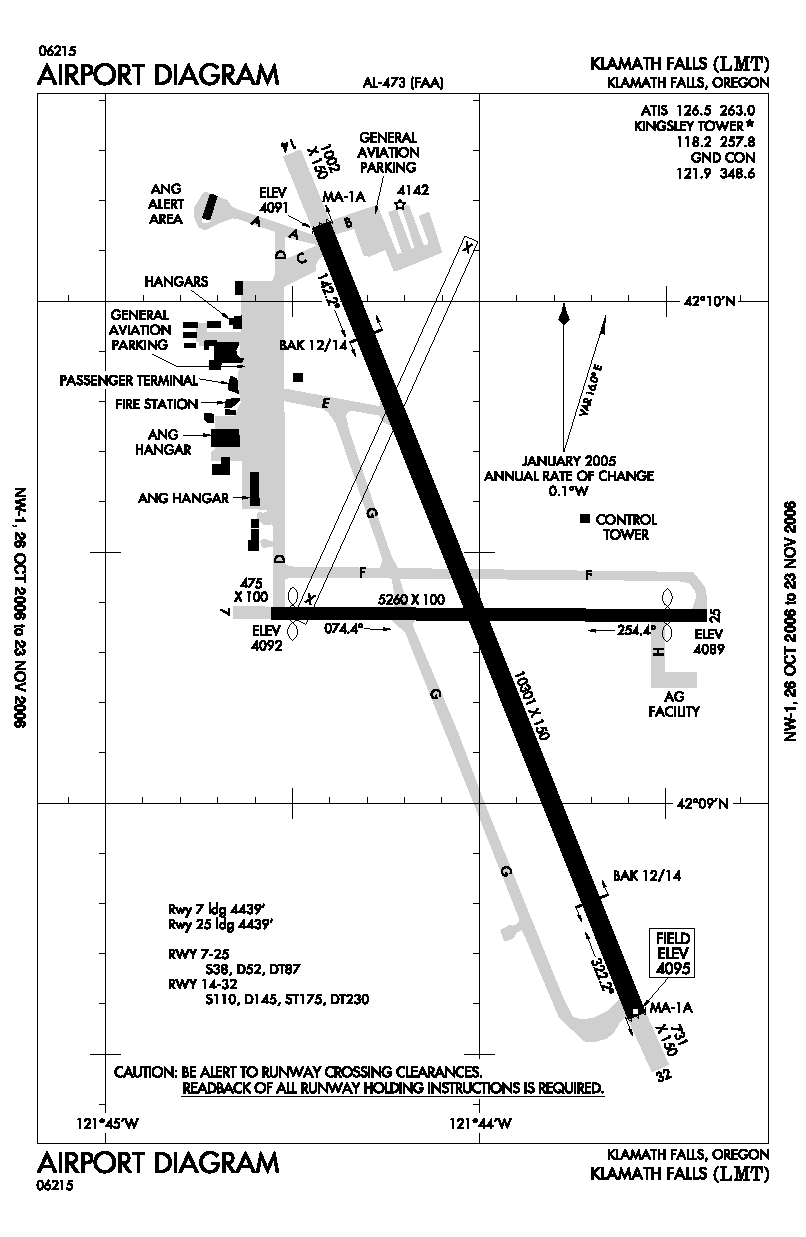
Crater Lake–Klamath Regional Airport covers 1,251 acres (506 ha) at an elevation of 4,095 feet (1,248 m). It has two runways: 14/32 is 10,302 by 150 feet (3,140 x 46 m) asphalt and concrete; 7/25 is 5,258 by 100 feet (1,603 x 30 m) asphalt.[1]

In the year ending December 31, 2021, the airport had 35,123 aircraft operations, average 96 per day: 54% general aviation, 37% military, and 9% air taxi. 111 aircraft were then based at the airport: 63 single-engine, 18 jet, 18 military, 10 multi-engine, and 2 helicopter.[1]

The airport is home to the Klamath Falls Interagency Fire Center, the Klamath Falls Airtanker Base and the Tanker 61 Memorial, commemorating a TBM Inc. firebomber lost in 1992.[10][11]

As of April 2025, the airport is currently open on weekdays year round for public use, the airport also includes airline refueling, a flight school and car rentals. Fuel prices are around $6.00 and currently a landing fee is charged to incoming aircraft.

Airline history

[edit]

Until 1959, United Airlines Douglas DC-3s and Convair 340s served Klamath Falls; later West Coast Airlines flew Fairchild F-27s to cities in Oregon and California. West Coast merged with Bonanza Air Lines and Pacific Air Lines to form Air West which subsequently changed its name to Hughes Airwest and was then later merged into Republic Airlines. Air West and Hughes Airwest continued to serve the airport with F-27s. Hughes Airwest introduced the first jets, Douglas DC-9-10 and McDonnell Douglas DC-9-30s, and was operating nonstop flights to Redding, CA and Redmond, OR as well as direct service to San Francisco, Seattle and Eugene, OR in 1980;[12] successor Republic DC-9s continued to serve the airport with nonstop flights to Redding and Redmond as well as flying direct jet service to San Francisco, Seattle and Portland, OR in 1982 before ceasing serving Klamath Falls in 1983.[13] United Airlines returned with Boeing 737 jets direct to San Francisco in March, 1986 but the service ended in November, 1987.

From the late 1970s to early 1980s, Air Oregon Fairchild Swearingen Metroliners flew direct to Portland, Seattle and other cities. In the mid-1980s, Pacific Express BAC One-Eleven jets flew to San Francisco via Redding and to Portland via Redmond. Horizon Air, a subsidiary of Alaska Airlines, flew de Havilland Canada DHC-8 Dash 8s and Fairchild Swearingen Metroliners to Portland and Seattle. From the mid-1980s to the early 1990s American Eagle Fairchild Swearingen Metroliners flew direct to San Francisco and San Jose, CA via Chico, CA or Redding on behalf of American Airlines.[14][15] WestAir operating as United Express) flew BAe Jetstream 31s to San Francisco while Reno Air Express operated by Mid Pacific Air on behalf of Reno Air) flew BAe Jetstream 31s to San Jose, CA. United Express operated by SkyWest Airlines pulled out of Klamath Falls in the late 1990s but then resumed flights when Horizon Air ceased serving the airport.

SkyWest Embraer EMB-120 Brasilias operated the last United Express service into Klamath Falls. In late 2010, SkyWest dropped one flight to Portland. Passenger count dropped in 2011, but passengers per flight increased.[16] United Express, operated by SkyWest on behalf of United Airlines, terminated service to Portland and San Francisco on June 5, 2014.[17]

PenAir started Saab 340B flights from Klamath Falls to Portland on October 6, 2016. Initially, the proposed service by PenAir was on hold from 2015 due to federal Transportation Security Administration (TSA) refusal to station security personnel at the terminal.[18] As of August 2017, this service has ended, following PenAir filing for bankruptcy.

Airlines and destinations

[edit]

Cargo

[edit]
AirlinesDestinations
Ameriflight Medford, Portland (OR)
FedEx Feeder Portland (OR), Redmond/Bend

Funding

[edit]

The Airport City Fund operates the airport's civilian and military interest. Revenue mainly is from city property taxes, transient room taxes and the rental activities in the airport itself. Because of the commercial flights at the airport, the Federal Aviation Administration contributes funds to keep the runways and taxiways in good conditions.[16]

Accidents at or near LMT

[edit]
  • On March 10, 1967, West Coast Airlines Flight 720, a Fairchild F-27, crashed 2 minutes after takeoff in snowy conditions into Stukel Mountain 4.1 miles SE of Klamath Airport because of ice accretion on the airframe surfaces and was not de-iced by crews prior to takeoff. All 4 occupants (3 crew, 1 passenger) were killed.[19]

See also

[edit]

References

[edit]
[edit]
Revisions and contributorsEdit on WikipediaRead on Wikipedia
from Grokipedia
Crater Lake–Klamath Regional Airport (IATA: LMT, ICAO: KLMT), also known as Klamath Falls Airport, is a midsized public-use airport located approximately four miles southeast of Klamath Falls, Oregon, United States, at an elevation of 4,095 feet (1,248 meters) above sea level. It operates as a joint civil-military facility, primarily supporting general aviation, cargo, and the Oregon Air National Guard's 173rd Fighter Wing at the adjacent Kingsley Field Air National Guard Base, with no scheduled commercial passenger service as of 2025. The airport features two runways, including the primary 14/32 at 10,302 by 150 feet, equipped with an instrument landing system (ILS), and serves as a key transportation hub in southern Oregon despite its high-altitude and mountainous surroundings. The airport's origins trace back to the late 1930s as the Klamath Municipal Airport, opening in November 1937, though its development accelerated during World War II when it was selected by the U.S. Navy in 1941 as a primary flight training base despite concerns over its 4,000-foot elevation and nearby terrain. During the war, the facility, then known as Naval Air Station Klamath Falls, hosted up to 150 aircraft and trained over 600 pilots annually with more than 2,000 flights per week, supported by a $12 million investment (equivalent to about $220 million today). Deactivated by the Navy in 1948 and returned to city control, it remained largely dormant until reactivation in 1954 as a Cold War-era jet interceptor base under Air Defense Command, hosting squadrons of F-94, F-101, and F-106 aircraft; it was renamed Kingsley Field in the 1950s after World War II Medal of Honor recipient David R. Kingsley. The site transitioned to Oregon Air National Guard oversight in the 1980s, becoming the U.S. Air Force's sole F-15C training base in 2011 and currently preparing for F-35A operations. Owned and operated by the City of Klamath Falls, the airport provides essential services including 100LL and Jet A fuel, major airframe and powerplant maintenance, hangars, tie-downs, and a control tower operating Monday through Friday from 0700 to 2000 local time, with additional operations as published by NOTAM. Its secondary runway (08/26) measures 5,258 by 100 feet and supports non-precision approaches, while the facility maintains an Airport Rescue and Firefighting (ARFF) Index A rating and imposes landing fees for certain operations. The terminal building at 3000 Airport Way accommodates general aviation users and aviation-related businesses, with ongoing FAA-funded improvements such as the ANG Ramp Project enhancing infrastructure. Military activities at Kingsley Field include over 5,000 flight hours and 20 to 50 sorties daily, employing over 1,100 personnel, including approximately 110 active-duty Airmen, as of June 2025. Economically, the airport generates an annual impact of $85 million for the region and supports approximately 750 jobs, underscoring its role in fostering aviation businesses and regional connectivity in Klamath County. Despite the absence of commercial airlines, it remains a vital gateway for visitors to nearby attractions like Crater Lake National Park, approximately 80 miles north, and contributes to the area's defense and emergency response capabilities through its military integration.

General Information

Location and Access

Crater Lake–Klamath Regional Airport is situated five miles southeast of Klamath Falls, Oregon, within Klamath County, at coordinates 42°09′22″N 121°43′59″W. This positioning places it in a high desert landscape characteristic of southern Oregon, facilitating regional air travel while serving nearby communities. The airport lies approximately 60 miles south of Crater Lake National Park, acting as a key gateway for tourists exploring the park's volcanic caldera and surrounding natural features. Its proximity enhances access to outdoor recreation in the Klamath Basin, drawing visitors for hiking, wildlife viewing, and other activities in the region. Access to the airport is primarily via Oregon Route 140, where travelers from the east or west take Exit 3 onto Washburn Way, then proceed south to Joe Wright Road and follow signs to the facility. Ground transportation options from Klamath Falls include taxis, hotel shuttles, and rental car services available on-site or nearby. At an elevation of 4,095 feet (1,248 m), the airport's high desert terrain influences operations, as the altitude contributes to higher density altitude conditions that can reduce aircraft lift and engine performance, requiring pilots to adjust for safer takeoffs and landings. The facility operates jointly with Kingsley Field Air National Guard Base, sharing infrastructure for both civilian and military aviation activities.

Ownership and Management

The Crater Lake–Klamath Regional Airport has been owned by the City of Klamath Falls since 1928, following a public vote to issue $50,000 in bonds for acquiring the initial land and developing the facility. The city oversees day-to-day operations through its Airport Department, led by an Airport Director who reports directly to the City Manager and handles administrative responsibilities, including compliance with federal regulations and coordination of aeronautical activities. Current key personnel include Airport Business Manager Linda Tepper and Airport Operations Manager Kelby Miller, supported by operations specialists. The airport operates under a joint use agreement with the U.S. Air Force, extended in 2025, sharing facilities with Kingsley Field Air National Guard Base, which serves as the home of the Oregon Air National Guard's 173rd Fighter Wing and occupies approximately 254 acres of leased exclusive-use land from the city (out of the airport's total 1,166 acres), alongside 526 acres of joint-use areas. This arrangement enables concurrent civilian general aviation, occasional commercial services, and military training missions while ensuring shared infrastructure such as runways and air traffic control. Staffing consists of a core team of city employees focused on operations, maintenance, and administration, with air traffic control services provided by Federal Aviation Administration (FAA) personnel through a contract tower. The airport maintains regulatory compliance as a certified public-use facility under FAA Part 139, which governs safety standards for airports supporting scheduled passenger operations (Class IV, Index A for aircraft rescue and firefighting) and accommodates military activities without separate certification requirements for the joint-use base. Biennial FAA inspections, including those for Part 139, confirm adherence to these standards.

Facilities and Infrastructure

Runways and Aprons

The Crater Lake–Klamath Regional Airport is equipped with two runways that support diverse aviation needs, from heavy military aircraft to general aviation operations. The primary runway, designated 14/32, spans 10,302 feet in length by 150 feet in width (3,140 m × 46 m) and features a composite surface of asphalt and concrete that has been grooved to enhance traction during wet conditions. This runway boasts a substantial weight-bearing capacity of 120,000 pounds for single-wheel gear, enabling it to handle large transport and fighter aircraft effectively. The secondary runway, 8/26 (noted as 7/25 in some prior documentation due to magnetic variation updates), measures 5,258 feet by 100 feet (1,603 m × 30 m) and is surfaced entirely in asphalt, also grooved for improved performance. Primarily utilized by general aviation aircraft, it includes displaced thresholds of 306 feet on the 8 end and 512 feet on the 26 end to account for obstacles, with a more modest single-wheel capacity of 41,000 pounds. Apron areas at the airport encompass extensive ramp space shared between civilian and military uses, including specialized facilities for the Oregon Air National Guard's 173rd Fighter Wing at Kingsley Field, which operates F-15 Eagle jets. General aviation tie-downs and parking are available through on-site fixed-base operators, accommodating a variety of smaller aircraft without ramp fees in many cases. These ground movement areas, connected by taxiways with restrictions for high-wingspan operations near military zones, ensure efficient aircraft maneuvering while prioritizing safety.

Terminals and Hangars

The Crater Lake–Klamath Regional Airport features a single passenger terminal building that serves both commercial and general aviation passengers. The terminal includes basic amenities such as restrooms, seating areas, and baggage claim facilities, with rental car counters located inside for major providers. A restaurant operates on the second floor, providing dining options for travelers and visitors. Aircraft storage at the airport is supported by multiple hangar structures catering to general aviation and military operations. General aviation users have access to several hangars, including two notable ones each measuring approximately 11,250 square feet, along with a larger 37,400 square-foot facility available for lease. The Oregon Air National Guard's 173rd Fighter Wing, based at the collocated Kingsley Field, utilizes dedicated military hangars totaling around 100,000 square feet for maintenance and storage of fighter aircraft. Additional general aviation hangars provide a combined capacity of about 50,000 square feet, supporting a range of private and corporate aircraft. These facilities integrate efficiently with the airport's runways for quick access during operations. Cargo handling is limited, with a warehouse primarily dedicated to military logistics under U.S. Air Force contracts. This setup supports essential supply chain needs for the Air National Guard while accommodating occasional general cargo for regional businesses. The terminal and surrounding areas incorporate accessibility features compliant with the Americans with Disabilities Act (ADA), including ramps for wheelchair access and designated parking spaces. The airport provides parking, with free options available near the terminal to facilitate easy access for passengers and visitors. The Crater Lake–Klamath Regional Airport (KLMT) operates under Class D airspace during air traffic control tower hours from 0700 to 2000 local time daily, transitioning to Class E airspace outside those periods to ensure controlled airspace management for arriving and departing aircraft. The Kingsley Tower provides 24-hour monitoring capability but staffed operations occur from 0700 to 2000 local time on frequency 133.975 MHz, coordinating with Seattle ARTCC for approach and departure services on 123.675 MHz during specified hours or 127.6 MHz otherwise. Navigation aids at the airport include the LMT VORTAC operating on 115.9 MHz, providing distance measuring equipment for precision approaches, alongside an ILS system on 109.5 MHz (Category I) specifically for runway 32 to support instrument landings in low-visibility conditions. RNAV (GPS) approaches are available for both runway 14 and runway 32, enabling area navigation with minimum descent altitudes tailored to the surrounding terrain, such as LNAV MDA of 4644 ft for runway 32. Runway lighting systems enhance night and low-visibility operations, with high-intensity runway edge lights (HIRL) installed on the primary runway 14/32, activated via pilot-controlled lighting on CTAF 133.975 MHz (or tower UHF 257.8 MHz for compatible radios), complemented by a 1,400 ft MALSF for runway 14 and a 1,400 ft MALSR for runway 32. Runway 07/25 features medium-intensity runway edge lights (MIRL), while visual approach aids include a 4-light precision approach path indicator (PAPI) on the left side of runway 14 (3.2° glide angle) and a 4-box visual approach slope indicator (VASI) on the left side of runway 32 (3° glide angle), both operating continuously. Safety protocols at the airport include an authorized wildlife hazard management program, implemented annually to mitigate risks from bird strikes in the vicinity of the Klamath Basin marshes, which attract large populations of waterfowl and other avian species. The facility also accommodates military training flights from the adjacent Kingsley Field Air National Guard Base, integrating these operations within its navigation and airspace procedures without dedicated separate systems.

Historical Development

Early Establishment (1928–1940s)

In 1928, voters in Klamath Falls approved a $50,000 bond measure to fund the construction of a municipal airport, marking the beginning of organized aviation infrastructure in the region. The city acquired land southeast of the urban area, and initial development focused on basic facilities, including gravel runways completed in 1929 that supported limited general aviation activities. Ownership remained with the City of Klamath Falls, which managed the site as a public-use facility with one fixed-base operator providing services to early pilots and visitors. During , primarily functioned as a modest field. By the end of the , it had become a vital stopover in , though commercial service remained sparse until later decades. With the onset of , the U.S. acquired in , converting it into (NAS) Klamath Falls for primary of naval aviators. Commissioned in January 1944 after extensive construction of hangars, barracks, and support buildings, the facility utilized Stearman N2S Kaydet biplanes— the naval variant of the PT-17—for basic pilot instruction, training hundreds of cadets in response to wartime demands. Runway extensions and paving were completed during this period to accommodate increased military traffic, transforming the site into a key training hub until the war's end. Following Japan's surrender in 1945, NAS Klamath Falls was decommissioned in 1946 and returned to civilian control under the City of Klamath Falls via the Surplus Property Act, retaining the military-era paved runways and infrastructure for postwar general aviation use. This transition preserved the airport's role as a regional asset while setting the stage for future expansions.

Military Expansion (1940s–1970s)

Following the U.S. Navy's closure of the Klamath Falls Naval Air Station in 1946 at the end of World War II, the facility remained largely inactive until Cold War tensions necessitated its reactivation by the U.S. Air Force in 1954. Designated as a jet interceptor base under Air Defense Command, it served as a critical link in the continental air defense network between Portland and San Francisco, focusing on training and operations to counter potential Soviet bomber incursions. The base's revival included the establishment of all-weather fighter-interceptor squadrons and supporting aircraft control units, marking the beginning of a significant military expansion that transformed the airport into a strategic asset. On July 3, 1956, the base was officially renamed Kingsley Field in honor of Second Lieutenant David R. Kingsley, an Oregon World War II aviator awarded the Medal of Honor for his heroism. This period saw rapid infrastructure growth to support jet-era demands, including the extension of runway 14/32 to 10,000 feet by 1956, which accommodated heavier supersonic aircraft and enhanced operational capabilities for intercept missions. Throughout the late 1950s and 1960s, Kingsley Field hosted multiple fighter-interceptor squadrons equipped with advanced aircraft such as the F-94 Starfire (introduced around 1955), F-101 Voodoo, and F-106 Delta Dart, participating in Air Defense Command exercises that simulated real-world aerial threats and refined interception tactics. By the 1970s, Kingsley Field began transitioning toward integration with the Oregon Air National Guard while the active-duty Air Force maintained primary operations until the early 1980s. The ORANG established an initial foothold in 1971 with the activation of the 104th Tactical Control Squadron, providing radar and control support that laid the groundwork for reserve component expansion. This shift reflected broader Department of Defense efforts to leverage National Guard units for air defense roles during the waning years of the Cold War, with the base's infrastructure—bolstered by prior expansions—ensuring sustained readiness for heavy jet activities.

Modern Era and Name Change (1980s–Present)

In the 1980s, the Oregon Air National Guard's 114th Tactical Fighter Training Squadron at Kingsley Field transitioned to the F-16 Fighting Falcon, receiving a fleet of 18 aircraft in 1988, marking a shift toward advanced fighter training operations. This upgrade built on the base's post-World War II military foundations from 1954, enhancing its role in air defense and pilot instruction within the joint civil-military framework. During the 1990s and 2000s, the facility formalized its dual-use status, with the 173rd Fighter Wing activated in 1996 to oversee operations. Passenger enplanements reached a peak in 2000 before declining amid fluctuating commercial service levels. By 1998, the wing received its first F-15 Eagle aircraft, establishing Kingsley Field as the primary training site for F-15 pilots across the Air National Guard and Regular Air Force. In 2013, the airport underwent a rebranding to Crater Lake–Klamath Regional Airport, aimed at highlighting its proximity to Crater Lake National Park and boosting regional tourism. From the 2010s onward, the Air National Guard's mission at the base evolved to emphasize advanced air-to-air combat training, solidifying its position as the U.S. Air Force's sole F-15C conversion training facility. As of 2025, the base is preparing for transition to F-35A operations. Civilian operations have stabilized, recording approximately 42,000 annual aircraft movements in 2024, primarily driven by general aviation and military activities. The COVID-19 pandemic disrupted aviation nationwide in 2020, prompting temporary reductions in operations at Oregon airports including Crater Lake–Klamath Regional; recovery efforts prioritized general aviation and military training to maintain essential services.

Operations

General and Military Aviation

General aviation at Crater Lake–Klamath Regional Airport constitutes the predominant share of non-commercial flight activities, accounting for approximately 70% of the roughly 42,000 annual operations recorded in 2024. The airport accommodates about 117 based aircraft, ranging from single-engine piston planes to business jets and helicopters, fostering a vibrant local aviation community. These operations include flight training programs offered by resident schools and clubs, such as the Klamath Basin Flyers, which supports pilot development through structured curricula and aircraft rentals. Additionally, the facility plays a critical role in aerial firefighting, serving as a key hub for air tanker basing and support during wildfire seasons, exemplified by operations from companies like Neptune Aviation that utilize the airport's infrastructure for regional fire suppression efforts. Military aviation operations are centered at the adjacent Kingsley Field, operated by the Oregon Air National Guard's 173rd Fighter Wing, which previously conducted advanced training for F-15C Eagle pilots as the primary formal training unit for the aircraft. The wing graduated its final F-15C class in September 2025 and is transitioning to F-35A operations, with the first aircraft expected to arrive in 2026. The 114th Fighter Squadron previously leveraged the airport's runways—capable of handling heavy fighter jets like the F-15—for takeoffs and landings exceeding 10,000 feet. The 173rd Fighter Wing also participates in large-scale exercises such as Red Flag, simulating realistic combat scenarios to sharpen air superiority skills, and maintains readiness for alert missions in support of national defense objectives. Fuel services at the airport are robust, with 100LL avgas and Jet A available around the clock through fixed-base operators like Century Aviation Services, facilitating seamless operations for both general and military users; annual fuel sales surpass 1 million gallons, predominantly attributed to military consumption. Activity peaks during the summer months, when transient general aviation traffic surges due to visitors accessing nearby Crater Lake National Park, often using the airport as a convenient entry point for scenic flights and regional travel.

Commercial Air Service History

Commercial air service at Crater Lake–Klamath Regional Airport began in the late 1940s with West Coast Airlines introducing scheduled passenger flights using Douglas DC-3 aircraft to Portland and Eugene. Service expanded rapidly, peaking at 10 daily flights by 1955 as demand grew for regional connectivity in southern Oregon. This early era established the airport as a key hub for short-haul routes, though operations were occasionally constrained by its co-location with military facilities. In the 1960s and 1970s, West Coast Airlines' successor, Hughes Airwest—formed after the 1968 merger creating Air West and subsequent rebranding—continued operations with Fairchild F-27 turboprops and later Douglas DC-9 jets. Flights connected Klamath Falls to Seattle, San Francisco, and other West Coast cities, maintaining reliable service until Hughes Airwest's 1979 merger with Republic Airlines, after which Republic assumed the routes with similar equipment. The 1980s and 1990s saw a resurgence with regional affiliates United Express and Horizon Air operating de Havilland Canada DHC-8 Dash 8 turboprops to Portland, Seattle, and beyond. Enplanements peaked in the mid-1990s, reflecting strong local demand before gradual route consolidations. Passenger service declined in the 2000s following the September 11 attacks, with Horizon Air exiting in 2000 and United Express reducing frequencies; SkyWest Airlines, operating as United Express, fully terminated flights in June 2014 citing insufficient demand. Cargo operations complemented passenger service, with FedEx running scheduled feeder flights through 2010 using regional aircraft for regional distribution. Post-2010, cargo shifted to ad hoc charter operations, aligning with the airport's evolving role amid fluctuating commercial viability.

Current Airlines and Destinations

As of November 2025, Crater Lake–Klamath Regional Airport has no scheduled passenger airline service. The last scheduled commercial passenger flights ended in June 2014, when United Express, operating Embraer EMB-120 Brasilia aircraft, ceased daily service to Portland (PDX) and San Francisco (SFO). Occasional charter flights are available through private operators, including routes to Portland International Airport (PDX) for business and leisure travelers. Cargo operations provide the primary commercial air service at the airport. FedEx feeder flights, operated by Empire Airlines using Cessna 208B Super Cargomaster aircraft, connect LMT to Portland (PDX) approximately 2–3 times per week, supporting regional freight needs for businesses in southern Oregon. These flights handle essential cargo shipments, though exact annual tonnage figures are not publicly detailed. To revive passenger service, the Oregon Legislature passed House Bill 3965 in April 2025, allocating a $2 million grant to the City of Klamath Falls for marketing and incentives aimed at attracting commercial airlines. This funding supports targeted outreach to potential carriers to establish scheduled routes.
AirlineService TypeDestinations
Empire Airlines (as FedEx Feeder)CargoPortland (PDX)

Funding and Improvements

Funding Mechanisms

The Crater Lake–Klamath Regional Airport, owned by the City of Klamath Falls since 1928, relies on a mix of local, federal, state, and military funding sources to support its operations and infrastructure maintenance. Primary funding streams include contributions from the city's general fund via property taxes, which provided $322,345 in fiscal year 2024 (FY 2024), representing a key local commitment to airport sustainability. Federal support is predominantly through the Federal Aviation Administration's (FAA) Airport Improvement Program (AIP) grants, which allocated $5,198,461 in FY 2024 for capital improvements such as runway and taxiway enhancements. Additionally, revenue from airport user fees, including landing fees and fuel flowage charges, generated $381,656 in charges for services during the same period, helping offset day-to-day operational costs. Military contributions play a significant role due to the collocated Kingsley Field Air National Guard (ANG) base, governed by a joint use agreement that outlines shared facility maintenance responsibilities. In FY 2024, the ANG provided $2,851,456 in administrative fees to the city as part of seven military construction cooperative agreements, supporting joint infrastructure like ramps and utilities. The airport's overall FY 2024 operating budget was originally set at $16.5 million, with actual revenues reaching $14.3 million and expenses at $16.8 million, including $10.9 million dedicated to core airport operations. Capital reserves have historically included Passenger Facility Charges (PFCs), though the program has been inactive since 2014, limiting this revenue stream. State-level assistance comes from the Oregon Aeronautics Division, which provides grants for safety and infrastructure upgrades through programs like the Community-Oriented Airport Revenue (COAR) grants. In recent years, these have averaged approximately $500,000 annually; for example, a $550,000 ConnectOregon grant supported runway reconstruction in FY 2023. This funding complements federal and local sources, ensuring compliance with FAA revenue use policies and focusing on safety enhancements without duplicating commercial service subsidies.

Recent Projects (2020s)

In 2020, the airport undertook a significant rehabilitation of Taxiway F, funded by a $4.3 million grant from the Federal Aviation Administration (FAA) under the Airport Improvement Program. This project aimed to restore and upgrade the taxiway to enhance safety and operational efficiency, particularly for military and general aviation users, and was completed despite disruptions from the COVID-19 pandemic. By 2023, efforts focused on improving facilities for both military and general aviation through the Air National Guard (ANG) Ramp Project. The city issued a request for qualifications in May for professional services to design an adequately sized and configured aircraft ramp supporting 26 Primary Aircraft Authorized (PAA) F-15 operations at Kingsley Field Air National Guard Base, adjacent to the airport. This initiative, estimated at around $1.2 million and city-funded, involved full-depth concrete ramp replacement, taxiway upgrades, and compliance with environmental regulations. In 2025, the airport advanced multiple infrastructure enhancements, including the approval of Taxiway F reconstruction in July via a city council vote to address failing infrastructure, with funding anticipated from federal sources. Oregon House Bill 3965, introduced in April 2025 to allocate $2 million for marketing and incentive efforts aimed at attracting commercial airlines including low-cost carriers to restore scheduled passenger service absent since 2014, failed to pass on June 27, 2025. These initiatives were bolstered by broader FAA grants, such as $7.76 million announced in August under the Bipartisan Infrastructure Law for runway and taxiway improvements, and an additional $3.13 million announced in September for taxiway reconstruction to improve military readiness and emergency access.

Incidents and Accidents

Pre-2000 Incidents

The Crater Lake–Klamath Regional Airport, also known as Kingsley Field, has experienced several notable aviation incidents prior to 2000, primarily involving challenging weather conditions and military training operations in the region's rugged terrain. On March 10, 1967, West Coast Airlines Flight 720, a Fairchild F-27A (N2712), crashed approximately 4.1 miles southeast of the airport shortly after takeoff en route to Portland and Seattle. The aircraft encountered severe icing conditions during a snowstorm, leading to a loss of control and impact with Stukel Mountain at an elevation of about 5,049 feet; all four occupants—three crew members and one passenger—were killed. The National Transportation Safety Board (NTSB) determined the probable cause as the captain's decision to take off in known adverse weather without activating the anti-icing system, compounded by inadequate de-icing procedures. Military aviation incidents were also significant at the airport, reflecting its role as a training base for fighter squadrons during the Cold War era. On May 18, 1964, an F-101 Voodoo jet fighter from Hamilton Air Force Base, California, crashed during a refueling stop at Kingsley Field; the two pilots, Captain William Pitts and First Lieutenant Frank Vecchio, were killed when the aircraft struck terrain near the base. Similarly, on November 26, 1968, another F-101 Voodoo crashed shortly after takeoff from the field, resulting in the deaths of pilots Major Richard L. Morgan and Captain John D. Tolsma due to an apparent engine failure. These events underscored the intensity of aerial training activities at the facility, which hosted squadrons like the Oregon Air National Guard's fighter units. Earlier military operations saw additional tragedies, including a mid-air collision on February 27, 1944, over the then-newly commissioned Naval Air Station Klamath Falls, where Navy pilots Ensign Wallace Cerkvenik and Ensign Louis Gahre were killed—the station's first fatal accident. On March 30, 1956, a U.S. Air Force C-45 cargo plane crashed into Miller Hill while attempting an instrument approach to the airport amid poor visibility; three of the five crew members perished. Such incidents highlighted the hazards of operating in the Klamath Basin's variable weather and high-altitude environment.

Post-2000 Incidents

Post-2000 incidents at Crater Lake–Klamath Regional Airport have included both general aviation and military events, often related to weather, mechanical issues, or training operations. On August 24, 2017, a Maule M-7-235C (N6447M) impacted terrain during a forced landing attempt near the airport after an in-flight engine issue; the aircraft sustained substantial damage, but the pilot survived with serious injuries. The NTSB cited partial loss of engine power as the cause. In July 2019, a single-engine aircraft experienced a partial loss of engine power during a cross-country flight from the airport, leading to a precautionary landing; no injuries occurred, but the incident prompted an FAA investigation into maintenance practices. On May 12, 2023, an Oregon Air National Guard F-15D Eagle (84-0046) experienced a hydraulic failure during landing at Kingsley Field, leading to a runway excursion and crash into an irrigation canal; the pilot ejected safely with minor injuries, but the aircraft, valued at approximately $35 million, was destroyed. The U.S. Air Force Accident Investigation Board attributed the mishap to the pilot's failure to deploy emergency brakes, compounded by maintenance and supervision issues. These incidents reflect ongoing safety challenges at the joint-use facility, with investigations leading to procedural enhancements by the FAA and Air National Guard.

References

Add your contribution
Related Hubs
User Avatar
No comments yet.