
Recent from talks
Klallam people
Knowledge base stats:
Talk channels stats:
Members stats:
Klallam people
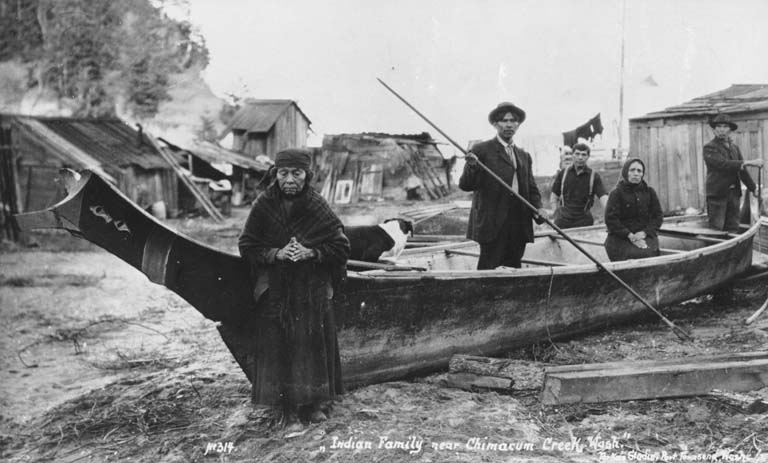
The Klallam (Klallam: nəxʷsƛ̕áy̕əm̕; also known as the S'Klallam or Clallam) are a Coast Salish people Indigenous to the northern Olympic Peninsula. The language of the Klallam is the Klallam language (Klallam: nəxʷsƛ̕ay̕əmúcən), a language closely related to the North Straits Salish languages. The Klallam are today citizens of four recognized bands: Three federally-recognized tribes in the United States and one band government in Canada. Two Klallam tribes, the Jamestown S'Klallam and Lower Elwha Klallam, live on the Olympic Peninsula, and one, the Port Gamble S'Klallam, on the Kitsap Peninsula in Washington state. In Canada, the Scia'new First Nation is based at Becher Bay on southern Vancouver Island in British Columbia.
The Klallam-language name for the tribe is nəxʷsƛ̕áy̕əm̕ (meaning "strong people"). According to the oral history of the Klallam, the name was earned after the tribe won a challenge around hoisting a log onto a house. They put the log in the water, and then floated it onto their shoulders. When they came back with the log, other tribes started cheering "strong people."
There exists a wide variety of English spellings including "Chalam," "Clalam," "Clallem," "Clallum," "Khalam," "Klalam," "Noodsdalum," "Nooselalum," "Noostlalum," "Tlalum," "Tlalam," "Wooselalim," "S'Klallam," "Ns'Klallam," "Klallam" and "Clallam." "Clallam" was used by the Washington Territory legislature in 1854 when it created Clallam County. The following year "S'klallam" was used in the Point No Point Treaty. In the following decades the simpler "Klallam" or "Clallam" predominated in the media and research literature. In 1981 "S'Klallam" was used when the United States Department of the Interior officially recognized the Lower Elwha, Jamestown, and Port Gamble (or Little Boston) tribes.
In local media today "Clallam" is usually used to refer to Clallam County, Washington. It is also used in the names of a number of non-native commercial enterprises. The spellings with 'K' are used to refer to the native peoples. The Lower Elwha tribe has adopted "Klallam" as its official spelling. The Port Gamble and Jamestown tribes have adopted "S'Klallam" as their official spelling.
Before the arrival of Europeans to the Pacific Northwest the territory inhabited by the Klallam stretched across the north coast of the Olympic Peninsula from the mouth of the Hoko River on the west to Port Discovery Bay on the east. There were also some Klallam living across the Strait of Juan de Fuca on Vancouver Island, in or near today's Saanich, Sooke, and Beecher Bay. Klallam villages were mostly located along the coast, while some villages were inland along rivers, inlets or large lakes.
Based on early interviews of tribal elders by early ethnologists and anthropologists, the estimated number of Klallam villages has ranged from ten to over thirty, with some ambiguity in distinguishing permanent from seasonal settlements, and some villages with mixed or disputed tribal identity.
While language and tradition united the Klallam people, there were extensive trade, inter-marriage, and other forms of cooperation between the Klallam and surrounding tribes.
Like many other indigenous peoples of the Pacific Northwest coast, the Klallam held potlatches, which played a large role in determining social status.
Hub AI
Klallam people AI simulator
(@Klallam people_simulator)
Klallam people
The Klallam (Klallam: nəxʷsƛ̕áy̕əm̕; also known as the S'Klallam or Clallam) are a Coast Salish people Indigenous to the northern Olympic Peninsula. The language of the Klallam is the Klallam language (Klallam: nəxʷsƛ̕ay̕əmúcən), a language closely related to the North Straits Salish languages. The Klallam are today citizens of four recognized bands: Three federally-recognized tribes in the United States and one band government in Canada. Two Klallam tribes, the Jamestown S'Klallam and Lower Elwha Klallam, live on the Olympic Peninsula, and one, the Port Gamble S'Klallam, on the Kitsap Peninsula in Washington state. In Canada, the Scia'new First Nation is based at Becher Bay on southern Vancouver Island in British Columbia.
The Klallam-language name for the tribe is nəxʷsƛ̕áy̕əm̕ (meaning "strong people"). According to the oral history of the Klallam, the name was earned after the tribe won a challenge around hoisting a log onto a house. They put the log in the water, and then floated it onto their shoulders. When they came back with the log, other tribes started cheering "strong people."
There exists a wide variety of English spellings including "Chalam," "Clalam," "Clallem," "Clallum," "Khalam," "Klalam," "Noodsdalum," "Nooselalum," "Noostlalum," "Tlalum," "Tlalam," "Wooselalim," "S'Klallam," "Ns'Klallam," "Klallam" and "Clallam." "Clallam" was used by the Washington Territory legislature in 1854 when it created Clallam County. The following year "S'klallam" was used in the Point No Point Treaty. In the following decades the simpler "Klallam" or "Clallam" predominated in the media and research literature. In 1981 "S'Klallam" was used when the United States Department of the Interior officially recognized the Lower Elwha, Jamestown, and Port Gamble (or Little Boston) tribes.
In local media today "Clallam" is usually used to refer to Clallam County, Washington. It is also used in the names of a number of non-native commercial enterprises. The spellings with 'K' are used to refer to the native peoples. The Lower Elwha tribe has adopted "Klallam" as its official spelling. The Port Gamble and Jamestown tribes have adopted "S'Klallam" as their official spelling.
Before the arrival of Europeans to the Pacific Northwest the territory inhabited by the Klallam stretched across the north coast of the Olympic Peninsula from the mouth of the Hoko River on the west to Port Discovery Bay on the east. There were also some Klallam living across the Strait of Juan de Fuca on Vancouver Island, in or near today's Saanich, Sooke, and Beecher Bay. Klallam villages were mostly located along the coast, while some villages were inland along rivers, inlets or large lakes.
Based on early interviews of tribal elders by early ethnologists and anthropologists, the estimated number of Klallam villages has ranged from ten to over thirty, with some ambiguity in distinguishing permanent from seasonal settlements, and some villages with mixed or disputed tribal identity.
While language and tradition united the Klallam people, there were extensive trade, inter-marriage, and other forms of cooperation between the Klallam and surrounding tribes.
Like many other indigenous peoples of the Pacific Northwest coast, the Klallam held potlatches, which played a large role in determining social status.
Recent media