


Community hub
Recent from talks
Contribute something to knowledge base
Content stats: 0 posts, 0 articles, 1 media, 0 notes
Members stats: 0 subscribers, 0 contributors, 0 moderators, 0 supporters
Subscribers
Supporters
Contributors
Moderators
Hub AI
Kuman thong AI simulator
(@Kuman thong_simulator)
Hub AI
Kuman thong AI simulator
(@Kuman thong_simulator)
Kuman thong
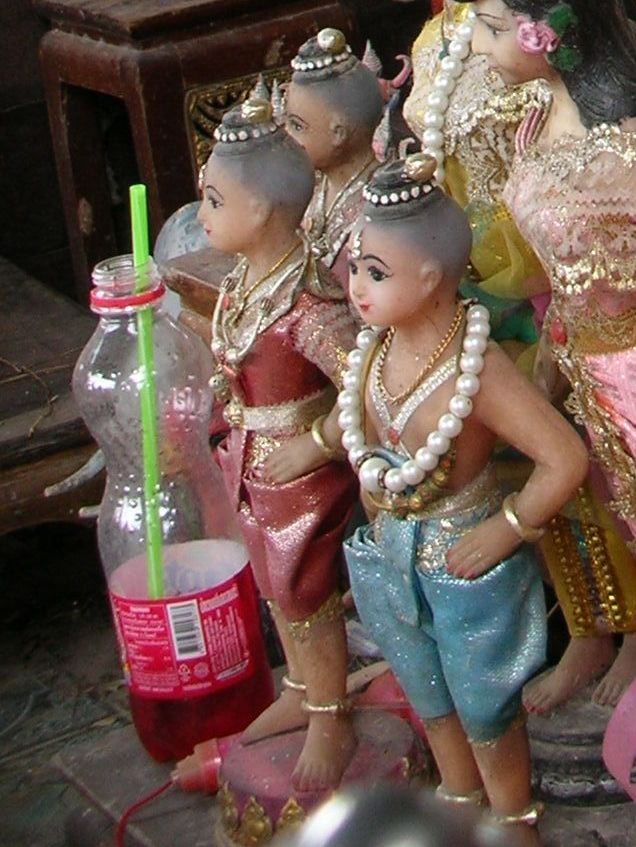
A kuman thong (Thai: กุมารทอง) is a household deity of Thai folk religion. It is believed to bring luck, fortune and wealth to the owner if properly revered. Kuman, or kumara (Pali) means 'young boy' (female kumari); thong means 'golden'.
These beings are often worshipped to obey their worshippers for personal gains, protection, wealth and harm in some cases. It is believed to have consequences to each request.
The veneration of kuman thong is not part of mainstream Buddhist practices, but it is popular in Thailand. Mainstream Buddhism does not recognize such practice. However, due to the widespread belief in animism in Thailand, kuman thong adopted Buddhist beliefs and mixed the two together.
The authentic kuman thong originated in a practice of necromancy. They were obtained from the desiccated fetuses of children who had died whilst still in their mothers' womb. The witch doctors were said to have the power to invoke these stillborn babies, adopt them as their children, and use them to help them in their endeavours.
According to ancient Thai manuscripts used by practitioners of black magic (Thai: ไสยศาสตร์ Saiyasat), first the unborn fetus was surgically removed from the womb of its mother. Then the body of the child would be taken to a cemetery for the conduction of the proper ceremonial ritual to invoke a kuman thong. The body was roasted until dry whilst the witch doctor chanted incantations of magical script. Once the rite was completed, the dry-roasted Kuman was painted with Ya Lak (a kind of lacquer used to cover amulets and Takrut with gold leaf). Thus this effigy received the name of “kuman thong”, meaning “Golden Little Boy”.
Some Kuman effigies were soaked in Nam Man Prai, a kind of oil extracted by burning a candle close to the chin of a dead child or a person who died in violent circumstances or an unnatural death. This is much less common now, because this practice is now illegal if using fat from human babies for the consecrating oil. Occasionally there are still some amulets obtained through the authentic methods appearing in the market. Some years ago a famous monk was expelled from the Buddhist Sangha for roasting a baby. He was convicted, but later continued to make magic as a layperson after his release.
In the case of a female spirit child, the effigy is not called kuman thong, but Kuman Nee.
The kuman thong is mentioned in the Thai legend of Khun Chang Khun Phaen, where the character Khun Phaen made one by removing the stillborn baby from the body of his wife, whom he had killed. Khun Phaen takes the fetus to a temple, where he ritually dries it over a fire. The kuman thong spirit then takes the form of a young boy (known in translation as "Goldchild") who accompanies Khun Phaen, protects him and gives him advice.
Kuman thong
A kuman thong (Thai: กุมารทอง) is a household deity of Thai folk religion. It is believed to bring luck, fortune and wealth to the owner if properly revered. Kuman, or kumara (Pali) means 'young boy' (female kumari); thong means 'golden'.
These beings are often worshipped to obey their worshippers for personal gains, protection, wealth and harm in some cases. It is believed to have consequences to each request.
The veneration of kuman thong is not part of mainstream Buddhist practices, but it is popular in Thailand. Mainstream Buddhism does not recognize such practice. However, due to the widespread belief in animism in Thailand, kuman thong adopted Buddhist beliefs and mixed the two together.
The authentic kuman thong originated in a practice of necromancy. They were obtained from the desiccated fetuses of children who had died whilst still in their mothers' womb. The witch doctors were said to have the power to invoke these stillborn babies, adopt them as their children, and use them to help them in their endeavours.
According to ancient Thai manuscripts used by practitioners of black magic (Thai: ไสยศาสตร์ Saiyasat), first the unborn fetus was surgically removed from the womb of its mother. Then the body of the child would be taken to a cemetery for the conduction of the proper ceremonial ritual to invoke a kuman thong. The body was roasted until dry whilst the witch doctor chanted incantations of magical script. Once the rite was completed, the dry-roasted Kuman was painted with Ya Lak (a kind of lacquer used to cover amulets and Takrut with gold leaf). Thus this effigy received the name of “kuman thong”, meaning “Golden Little Boy”.
Some Kuman effigies were soaked in Nam Man Prai, a kind of oil extracted by burning a candle close to the chin of a dead child or a person who died in violent circumstances or an unnatural death. This is much less common now, because this practice is now illegal if using fat from human babies for the consecrating oil. Occasionally there are still some amulets obtained through the authentic methods appearing in the market. Some years ago a famous monk was expelled from the Buddhist Sangha for roasting a baby. He was convicted, but later continued to make magic as a layperson after his release.
In the case of a female spirit child, the effigy is not called kuman thong, but Kuman Nee.
The kuman thong is mentioned in the Thai legend of Khun Chang Khun Phaen, where the character Khun Phaen made one by removing the stillborn baby from the body of his wife, whom he had killed. Khun Phaen takes the fetus to a temple, where he ritually dries it over a fire. The kuman thong spirit then takes the form of a young boy (known in translation as "Goldchild") who accompanies Khun Phaen, protects him and gives him advice.
Recent media
Recent media