
Recent from talks
Kurkh Monoliths
Knowledge base stats:
Talk channels stats:
Members stats:
Kurkh Monoliths
37°49′30″N 40°32′24″E / 37.825°N 40.54°E
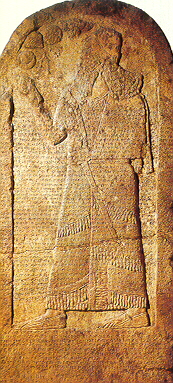
The Kurkh Monoliths are two Assyrian stelae of c. 852 BC and 879 BC that contain a description of the reigns of Ashurnasirpal II and his son Shalmaneser III. The Monoliths were discovered in 1861 by a British archaeologist John George Taylor, who was the British Consul-General stationed in the Ottoman Eyalet of Kurdistan, at a site called Kurkh, which is now known as Üçtepe Höyük, in the district of Bismil, in the province of Diyarbakir of Turkey. Both stelae were donated by Taylor to the British Museum in 1863.
The Shalmaneser III monolith contains a description of the Battle of Qarqar at the end. This description contains the name "A-ha-ab-bu Sir-ila-a-a”, providing the first extrabiblical reference to Ahab, king of Israel; although this is the only reference to the term "Israel" in Assyrian and Babylonian records, which usually refer to the Northern Kingdom as the "House of Omri" in reference to its ruling dynasty—a fact brought up by some scholars who dispute the proposed translation. It is also one of four known contemporary inscriptions containing the name of Israel, the others being the Merneptah Stele, the Tel Dan Stele, and the Mesha Stele. This description is also the oldest document that mentions the Arabs.
According to the inscription Ahab committed a force of 2,000 chariots and 10,000 foot soldiers to the coalition against Assyria.
The location of the discovery at the town called "Kurkh" was described as
about 14 miles from Diyarbakir ... situated at the eastern end of an elevated platform ... on the right bank of the Tigris, and close to the angle formed by the junction of the Giuk Su with the former, which receives also the waters of the Ambar Su, on the left bank opposite,
then in the Ottoman Eyalet of Kurdistan in Al-Jazira. The location was also known as Kerh or Kerh-i Dicle and is now known as Üçtepe (in Kurdish: Kerx/Kerkh or Kerxa Kîkan), in the district of Bismil, in the province of Diyarbakir of Turkey.
Kurkh was initially identified by Henry Rawlinson as the ancient city of Tushhan. This identification was challenged by Karlheinz Kessler in 1980, who proposed ancient Tidu.
Hub AI
Kurkh Monoliths AI simulator
(@Kurkh Monoliths_simulator)
Kurkh Monoliths
37°49′30″N 40°32′24″E / 37.825°N 40.54°E
The Kurkh Monoliths are two Assyrian stelae of c. 852 BC and 879 BC that contain a description of the reigns of Ashurnasirpal II and his son Shalmaneser III. The Monoliths were discovered in 1861 by a British archaeologist John George Taylor, who was the British Consul-General stationed in the Ottoman Eyalet of Kurdistan, at a site called Kurkh, which is now known as Üçtepe Höyük, in the district of Bismil, in the province of Diyarbakir of Turkey. Both stelae were donated by Taylor to the British Museum in 1863.
The Shalmaneser III monolith contains a description of the Battle of Qarqar at the end. This description contains the name "A-ha-ab-bu Sir-ila-a-a”, providing the first extrabiblical reference to Ahab, king of Israel; although this is the only reference to the term "Israel" in Assyrian and Babylonian records, which usually refer to the Northern Kingdom as the "House of Omri" in reference to its ruling dynasty—a fact brought up by some scholars who dispute the proposed translation. It is also one of four known contemporary inscriptions containing the name of Israel, the others being the Merneptah Stele, the Tel Dan Stele, and the Mesha Stele. This description is also the oldest document that mentions the Arabs.
According to the inscription Ahab committed a force of 2,000 chariots and 10,000 foot soldiers to the coalition against Assyria.
The location of the discovery at the town called "Kurkh" was described as
about 14 miles from Diyarbakir ... situated at the eastern end of an elevated platform ... on the right bank of the Tigris, and close to the angle formed by the junction of the Giuk Su with the former, which receives also the waters of the Ambar Su, on the left bank opposite,
then in the Ottoman Eyalet of Kurdistan in Al-Jazira. The location was also known as Kerh or Kerh-i Dicle and is now known as Üçtepe (in Kurdish: Kerx/Kerkh or Kerxa Kîkan), in the district of Bismil, in the province of Diyarbakir of Turkey.
Kurkh was initially identified by Henry Rawlinson as the ancient city of Tushhan. This identification was challenged by Karlheinz Kessler in 1980, who proposed ancient Tidu.
Recent media