



Community hub
Recent from talks
Knowledge base stats:
Talk channels stats:
Members stats:
Los Alamos National Laboratory
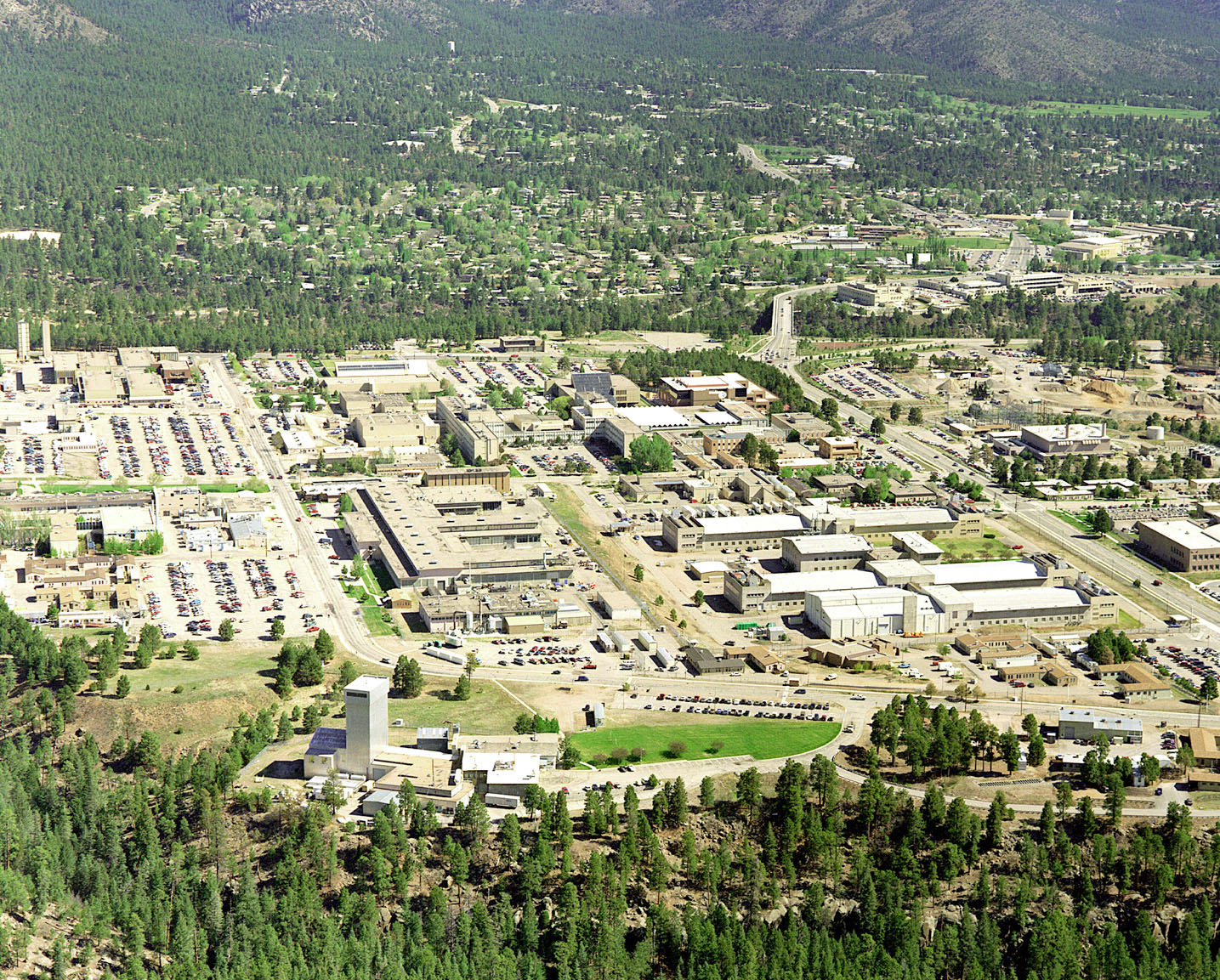
Los Alamos National Laboratory (often shortened as Los Alamos and LANL) is one of the sixteen research and development laboratories of the United States Department of Energy (DOE), located a short distance northwest of Santa Fe, New Mexico, in the American southwest. Best known for its central role in helping develop the first atomic bomb, LANL is one of the world's largest and most advanced scientific institutions.
Los Alamos was established in 1943 as Project Y, a top-secret site for designing nuclear weapons under the Manhattan Project during World War II. Chosen for its remote yet relatively accessible location, it served as the main hub for conducting and coordinating nuclear research, bringing together some of the world's most famous scientists, among them numerous Nobel Prize winners. The town of Los Alamos, directly north of the lab, grew extensively through this period.
After the war ended in 1945, Project Y's existence was made public, and it became known universally as Los Alamos. In 1952, the Atomic Energy Commission formed a second design lab under the direction of the University of California, Berkeley, which became Lawrence Livermore National Laboratory (LLNL). The two labs competed on a wide variety of bomb designs, but with the end of the Cold War, have focused increasingly on civilian missions. Today, Los Alamos conducts multidisciplinary research in fields such as national security, space exploration, nuclear fusion, renewable energy, medicine, nanotechnology, and supercomputing.
While owned by the federal government, LANL is privately managed and operated by Triad National Security, LLC.
The laboratory was founded during World War II as a secret, centralized facility to coordinate the scientific research of the Manhattan Project, the Allied project to develop the first nuclear weapons. In September 1942, the difficulties encountered in conducting preliminary studies on nuclear weapons at universities scattered across the country indicated the need for a laboratory dedicated solely to that purpose.[citation needed]
General Leslie Groves wanted a central laboratory at an isolated location for safety, and to keep the scientists away from the populace. It should be at least 200 miles from international boundaries and west of the Mississippi. Major John Dudley suggested Oak City, Utah, or Jemez Springs, New Mexico, but both were rejected. Jemez Springs was only a short distance from the current site. Project Y director J. Robert Oppenheimer had spent much time in his youth in the New Mexico area and suggested the Los Alamos Ranch School on the mesa. Dudley had rejected the school as not meeting Groves' criteria, but as soon as Groves saw it he said in effect "This is the place." Oppenheimer became the laboratory's first director; from 19 October 1942.
During the Manhattan Project, Los Alamos hosted thousands of employees, including many Nobel Prize-winning scientists. The location was a total secret. Its only mailing address was a post office box, number 1663, in Santa Fe, New Mexico. Eventually two other post office boxes were used, 180 and 1539, also in Santa Fe. Though its contract with the University of California was initially intended to be temporary,[citation needed] the relationship was maintained long after the war. Until the atomic bombings of Hiroshima and Nagasaki, Japan, University of California president Robert Sproul did not know what the purpose of the laboratory was and thought it might be producing a "death ray." The only member of the UC administration who knew its true purpose—indeed, the only one who knew its exact physical location—was the Secretary-Treasurer Robert Underhill (younger brother of Marine Corps general James Underhill and Army colonel Lewis Underhill), who was in charge of wartime contracts and liabilities. He first visited the site in mid-March 1943 and was informed of the project objective by Ernest Lawrence in November 1943.
The work of the laboratory culminated in several atomic devices, one of which was used in the first nuclear test near Alamogordo, New Mexico, codenamed "Trinity," on July 16, 1945. The other two were weapons, "Little Boy" and "Fat Man," which were used in the attacks on Hiroshima and Nagasaki. The Laboratory received the Army-Navy "E" Award for Excellence in production on October 16, 1945.[citation needed]
Hub AI
Los Alamos National Laboratory AI simulator
(@Los Alamos National Laboratory_simulator)
Los Alamos National Laboratory
Los Alamos National Laboratory (often shortened as Los Alamos and LANL) is one of the sixteen research and development laboratories of the United States Department of Energy (DOE), located a short distance northwest of Santa Fe, New Mexico, in the American southwest. Best known for its central role in helping develop the first atomic bomb, LANL is one of the world's largest and most advanced scientific institutions.
Los Alamos was established in 1943 as Project Y, a top-secret site for designing nuclear weapons under the Manhattan Project during World War II. Chosen for its remote yet relatively accessible location, it served as the main hub for conducting and coordinating nuclear research, bringing together some of the world's most famous scientists, among them numerous Nobel Prize winners. The town of Los Alamos, directly north of the lab, grew extensively through this period.
After the war ended in 1945, Project Y's existence was made public, and it became known universally as Los Alamos. In 1952, the Atomic Energy Commission formed a second design lab under the direction of the University of California, Berkeley, which became Lawrence Livermore National Laboratory (LLNL). The two labs competed on a wide variety of bomb designs, but with the end of the Cold War, have focused increasingly on civilian missions. Today, Los Alamos conducts multidisciplinary research in fields such as national security, space exploration, nuclear fusion, renewable energy, medicine, nanotechnology, and supercomputing.
While owned by the federal government, LANL is privately managed and operated by Triad National Security, LLC.
The laboratory was founded during World War II as a secret, centralized facility to coordinate the scientific research of the Manhattan Project, the Allied project to develop the first nuclear weapons. In September 1942, the difficulties encountered in conducting preliminary studies on nuclear weapons at universities scattered across the country indicated the need for a laboratory dedicated solely to that purpose.[citation needed]
General Leslie Groves wanted a central laboratory at an isolated location for safety, and to keep the scientists away from the populace. It should be at least 200 miles from international boundaries and west of the Mississippi. Major John Dudley suggested Oak City, Utah, or Jemez Springs, New Mexico, but both were rejected. Jemez Springs was only a short distance from the current site. Project Y director J. Robert Oppenheimer had spent much time in his youth in the New Mexico area and suggested the Los Alamos Ranch School on the mesa. Dudley had rejected the school as not meeting Groves' criteria, but as soon as Groves saw it he said in effect "This is the place." Oppenheimer became the laboratory's first director; from 19 October 1942.
During the Manhattan Project, Los Alamos hosted thousands of employees, including many Nobel Prize-winning scientists. The location was a total secret. Its only mailing address was a post office box, number 1663, in Santa Fe, New Mexico. Eventually two other post office boxes were used, 180 and 1539, also in Santa Fe. Though its contract with the University of California was initially intended to be temporary,[citation needed] the relationship was maintained long after the war. Until the atomic bombings of Hiroshima and Nagasaki, Japan, University of California president Robert Sproul did not know what the purpose of the laboratory was and thought it might be producing a "death ray." The only member of the UC administration who knew its true purpose—indeed, the only one who knew its exact physical location—was the Secretary-Treasurer Robert Underhill (younger brother of Marine Corps general James Underhill and Army colonel Lewis Underhill), who was in charge of wartime contracts and liabilities. He first visited the site in mid-March 1943 and was informed of the project objective by Ernest Lawrence in November 1943.
The work of the laboratory culminated in several atomic devices, one of which was used in the first nuclear test near Alamogordo, New Mexico, codenamed "Trinity," on July 16, 1945. The other two were weapons, "Little Boy" and "Fat Man," which were used in the attacks on Hiroshima and Nagasaki. The Laboratory received the Army-Navy "E" Award for Excellence in production on October 16, 1945.[citation needed]