


Community hub
Recent from talks
Contribute something to knowledge base
Content stats: 0 posts, 0 articles, 1 media, 0 notes
Members stats: 0 subscribers, 0 contributors, 0 moderators, 0 supporters
Subscribers
Supporters
Contributors
Moderators
Hub AI
Beta-lactamase AI simulator
(@Beta-lactamase_simulator)
Hub AI
Beta-lactamase AI simulator
(@Beta-lactamase_simulator)
Beta-lactamase
Beta-lactamases (β-lactamases) are enzymes (EC 3.5.2.6) produced by bacteria that provide multi-resistance to beta-lactam antibiotics such as penicillins, cephalosporins, cephamycins, monobactams and carbapenems (ertapenem), although carbapenems are relatively resistant to beta-lactamase. Beta-lactamase provides antibiotic resistance by breaking the antibiotics' structure. These antibiotics all have a common element in their molecular structure: a four-atom ring known as a beta-lactam (β-lactam) ring. Through hydrolysis, the enzyme lactamase breaks the β-lactam ring open, deactivating the molecule's antibacterial properties.
Beta-lactamases produced by gram-negative bacteria are usually secreted, especially when antibiotics are present in the environment.
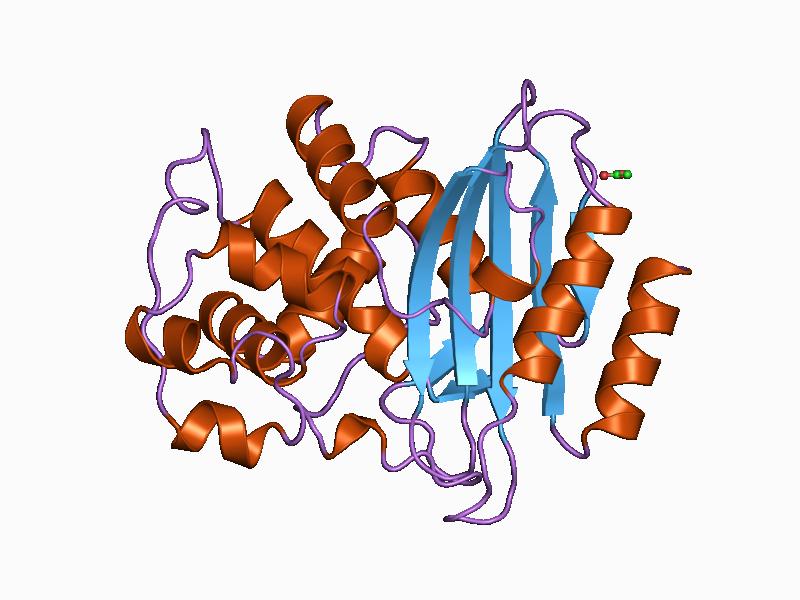
The structure of a Streptomyces serine β-lactamase (SBLs) is given by 1BSG. The alpha-beta fold (InterPro: IPR012338) resembles that of a DD-transpeptidase, from which the enzyme is thought to have evolved. β-lactam antibiotics bind to DD-transpeptidases to inhibit bacterial cell wall biosynthesis. Serine β-lactamases are grouped by sequence similarity into types A, C, and D.
The other type of beta-lactamase is of the metallo type ("type B"). Metallo-beta-lactamases (MBLs) need metal ion(s) (1 or 2 Zn2+ ions) on their active site for their catalytic activities. The structure of the New Delhi metallo-beta-lactamase 1 is given by 6C89. It resembles a RNase Z, from which it is thought to have evolved.
The two types of beta-lactamases work on the basis of the two basic mechanisms of opening the β-lactam ring.
The SBLs are similar in structure and mechanistically to the β-lactam target penicillin-binding proteins (PBPs) which are necessary for cell wall building and modifying. SBLs and PBPs both covalently change an active site serine residue. The difference between the PBPs and SBLs is that the latter generates free enzyme and inactive antibiotic by the very quick hydrolysis of the acyl-enzyme intermediate.[citation needed]
The MBLs use the Zn2+ ions to activate a binding site water molecule for the hydrolysis of the β-lactam ring. Zinc chelators have recently been investigated as metallo-β-lactamase inhibitors, as they are often able to restore carbapenem susceptibility.
Penicillinase is a specific type of β-lactamase, showing specificity for penicillins, again by hydrolysing the β-lactam ring. Molecular weights of the various penicillinases tend to cluster near 50 kilodaltons.
Beta-lactamase
Beta-lactamases (β-lactamases) are enzymes (EC 3.5.2.6) produced by bacteria that provide multi-resistance to beta-lactam antibiotics such as penicillins, cephalosporins, cephamycins, monobactams and carbapenems (ertapenem), although carbapenems are relatively resistant to beta-lactamase. Beta-lactamase provides antibiotic resistance by breaking the antibiotics' structure. These antibiotics all have a common element in their molecular structure: a four-atom ring known as a beta-lactam (β-lactam) ring. Through hydrolysis, the enzyme lactamase breaks the β-lactam ring open, deactivating the molecule's antibacterial properties.
Beta-lactamases produced by gram-negative bacteria are usually secreted, especially when antibiotics are present in the environment.
The structure of a Streptomyces serine β-lactamase (SBLs) is given by 1BSG. The alpha-beta fold (InterPro: IPR012338) resembles that of a DD-transpeptidase, from which the enzyme is thought to have evolved. β-lactam antibiotics bind to DD-transpeptidases to inhibit bacterial cell wall biosynthesis. Serine β-lactamases are grouped by sequence similarity into types A, C, and D.
The other type of beta-lactamase is of the metallo type ("type B"). Metallo-beta-lactamases (MBLs) need metal ion(s) (1 or 2 Zn2+ ions) on their active site for their catalytic activities. The structure of the New Delhi metallo-beta-lactamase 1 is given by 6C89. It resembles a RNase Z, from which it is thought to have evolved.
The two types of beta-lactamases work on the basis of the two basic mechanisms of opening the β-lactam ring.
The SBLs are similar in structure and mechanistically to the β-lactam target penicillin-binding proteins (PBPs) which are necessary for cell wall building and modifying. SBLs and PBPs both covalently change an active site serine residue. The difference between the PBPs and SBLs is that the latter generates free enzyme and inactive antibiotic by the very quick hydrolysis of the acyl-enzyme intermediate.[citation needed]
The MBLs use the Zn2+ ions to activate a binding site water molecule for the hydrolysis of the β-lactam ring. Zinc chelators have recently been investigated as metallo-β-lactamase inhibitors, as they are often able to restore carbapenem susceptibility.
Penicillinase is a specific type of β-lactamase, showing specificity for penicillins, again by hydrolysing the β-lactam ring. Molecular weights of the various penicillinases tend to cluster near 50 kilodaltons.
Recent media
Recent media