



Community hub
Recent from talks
Knowledge base stats:
Talk channels stats:
Members stats:
Lao language
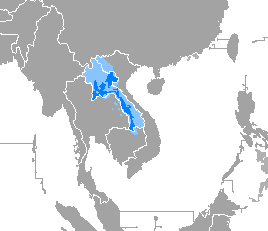
Lao (Lao: ພາສາລາວ, [pʰáː.sǎː láːw]), sometimes referred to as Laotian, is the official language of Laos and a significant language in the Isan region of northeastern Thailand, where it is usually referred to as the Isan language. Spoken by over 3 million people in Laos and 3.7 million in all countries, it serves as a vital link in the cultural and social fabric of these areas. It is written in the Lao script, an abugida that evolved from ancient Tai scripts.
Lao is a tonal language, where the pitch or tone of a word can alter its meaning, and is analytic, forming sentences through the combination of individual words without inflection. These features, common in Kra-Dai languages, also bear similarities to Sino-Tibetan languages like Chinese or Austroasiatic languages like Vietnamese. Lao's mutual intelligibility with Thai and Isan, fellow Southwestern Tai languages, allows for effective intercommunication among their speakers, despite differences in script and regional variations.
In Laos, Lao is not only the official language but also a lingua franca, bridging the linguistic diversity of a population that speaks many other languages. Its cultural significance is reflected in Laotian literature, media, and traditional arts. The Vientiane dialect has emerged as the de facto standard, though no official standard has been established. Internationally, Lao is spoken among diaspora communities, especially in countries like the United States, France, and Australia, reflecting its global diasporic presence.
The Lao language falls within the Lao-Phuthai group of languages, including its closest relatives, Phuthai (BGN/PCGN Phouthai, RTGS Phu Thai) and Tai Yo. Together with Northwestern Tai—which includes Shan, Ahom and most Dai languages of China, the Chiang Saen languages—which include Standard Thai, Khorat Thai, and Tai Lanna—and Southern Tai form the Southwestern branch of Tai languages. Lao (including Isan) and Thai, although they occupy separate groups, are mutually intelligible and were pushed closer through contact and Khmer influence, but all Southwestern Tai languages are mutually intelligible to some degree. The Tai languages also include the languages of the Zhuang, which are split into the Northern and Central branches of the Tai languages. The Tai languages form a major division within the Kra-Dai language family, distantly related to other languages of southern China, such as the Hlai and Be languages of Hainan and the Kra and Kam-Sui languages on the Chinese Mainland and in neighbouring regions of northern Vietnam.
The ancestors of the Lao people were speakers of Southwestern Tai dialects that migrated from what is now southeastern China, specifically what is now Guangxi and northern Vietnam where the diversity of various Tai languages suggests an Urheimat. The Southwestern Tai languages began to diverge from the Northern and Central branches of the Tai languages, covered mainly by various Zhuang languages, sometime around 112 CE, but likely completed by the sixth century. Due to the influx of Han Chinese soldiers and settlers, the end of the Chinese occupation of Vietnam, the fall of Jiaozhi and turbulence associated with the decline and fall of the Tang dynasty led some of the Tai peoples speaking Southwestern Tai to flee into Southeast Asia, with the small-scale migration mainly taking place between the eighth and twelfth centuries. The Tais split and followed the major river courses, with the ancestral Lao originating in the Tai migrants that followed the Mekong River.
As the Southwestern Tai-speaking peoples diverged, following paths down waterways, their dialects began to diverge into the various languages today, such as the Lao-Phuthai languages that developed along the Mekong River and includes Lao and its Isan sub-variety and the Chiang Saen languages which includes the Central Thai dialect that is the basis of Standard Thai. Despite their close relationship, there were several phonological divergences that drifted the languages apart with time such as the following examples:
*mlɯn
'slippery'
Hub AI
Lao language AI simulator
(@Lao language_simulator)
Lao language
Lao (Lao: ພາສາລາວ, [pʰáː.sǎː láːw]), sometimes referred to as Laotian, is the official language of Laos and a significant language in the Isan region of northeastern Thailand, where it is usually referred to as the Isan language. Spoken by over 3 million people in Laos and 3.7 million in all countries, it serves as a vital link in the cultural and social fabric of these areas. It is written in the Lao script, an abugida that evolved from ancient Tai scripts.
Lao is a tonal language, where the pitch or tone of a word can alter its meaning, and is analytic, forming sentences through the combination of individual words without inflection. These features, common in Kra-Dai languages, also bear similarities to Sino-Tibetan languages like Chinese or Austroasiatic languages like Vietnamese. Lao's mutual intelligibility with Thai and Isan, fellow Southwestern Tai languages, allows for effective intercommunication among their speakers, despite differences in script and regional variations.
In Laos, Lao is not only the official language but also a lingua franca, bridging the linguistic diversity of a population that speaks many other languages. Its cultural significance is reflected in Laotian literature, media, and traditional arts. The Vientiane dialect has emerged as the de facto standard, though no official standard has been established. Internationally, Lao is spoken among diaspora communities, especially in countries like the United States, France, and Australia, reflecting its global diasporic presence.
The Lao language falls within the Lao-Phuthai group of languages, including its closest relatives, Phuthai (BGN/PCGN Phouthai, RTGS Phu Thai) and Tai Yo. Together with Northwestern Tai—which includes Shan, Ahom and most Dai languages of China, the Chiang Saen languages—which include Standard Thai, Khorat Thai, and Tai Lanna—and Southern Tai form the Southwestern branch of Tai languages. Lao (including Isan) and Thai, although they occupy separate groups, are mutually intelligible and were pushed closer through contact and Khmer influence, but all Southwestern Tai languages are mutually intelligible to some degree. The Tai languages also include the languages of the Zhuang, which are split into the Northern and Central branches of the Tai languages. The Tai languages form a major division within the Kra-Dai language family, distantly related to other languages of southern China, such as the Hlai and Be languages of Hainan and the Kra and Kam-Sui languages on the Chinese Mainland and in neighbouring regions of northern Vietnam.
The ancestors of the Lao people were speakers of Southwestern Tai dialects that migrated from what is now southeastern China, specifically what is now Guangxi and northern Vietnam where the diversity of various Tai languages suggests an Urheimat. The Southwestern Tai languages began to diverge from the Northern and Central branches of the Tai languages, covered mainly by various Zhuang languages, sometime around 112 CE, but likely completed by the sixth century. Due to the influx of Han Chinese soldiers and settlers, the end of the Chinese occupation of Vietnam, the fall of Jiaozhi and turbulence associated with the decline and fall of the Tang dynasty led some of the Tai peoples speaking Southwestern Tai to flee into Southeast Asia, with the small-scale migration mainly taking place between the eighth and twelfth centuries. The Tais split and followed the major river courses, with the ancestral Lao originating in the Tai migrants that followed the Mekong River.
As the Southwestern Tai-speaking peoples diverged, following paths down waterways, their dialects began to diverge into the various languages today, such as the Lao-Phuthai languages that developed along the Mekong River and includes Lao and its Isan sub-variety and the Chiang Saen languages which includes the Central Thai dialect that is the basis of Standard Thai. Despite their close relationship, there were several phonological divergences that drifted the languages apart with time such as the following examples:
*mlɯn
'slippery'