
Recent from talks
Laser printing
Knowledge base stats:
Talk channels stats:
Members stats:
Laser printing
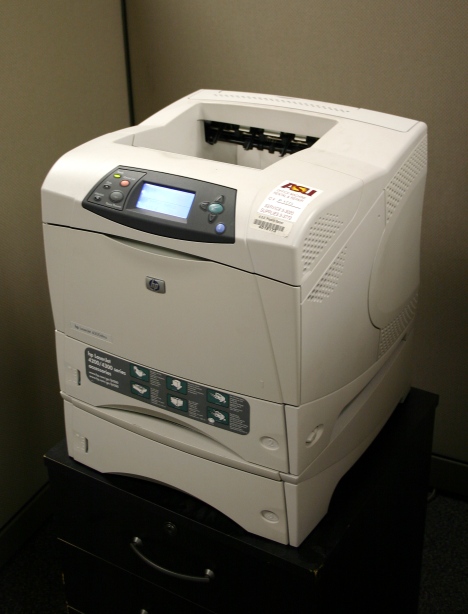
Laser printing is an electrostatic digital printing process. It produces high-quality text and graphics (and moderate-quality photographs) by repeatedly passing a laser beam back and forth over a negatively charged cylinder called a "drum" to define a differentially charged image. The drum then selectively collects electrically charged powdered ink (toner), and transfers the image to paper, which is then heated to permanently fuse the text, imagery, or both to the paper. As with digital photocopiers, laser printers employ a xerographic printing process. Laser printing differs from traditional xerography as implemented in analog photocopiers in that in the latter, the image is formed by reflecting light off an existing document onto the exposed drum.
The laser printer was invented at Xerox PARC in the 1970s. Laser printers were introduced for the office and then home markets in subsequent years by IBM, Canon, Xerox, Apple, Hewlett-Packard and many others. Over the decades, quality and speed have increased as prices have decreased, and the once cutting-edge printing devices are now ubiquitous.
In the 1960s, the Xerox Corporation held a dominant position in the photocopier market. In 1969, Gary Starkweather, who worked in Xerox's product development department, had the idea of using a laser beam to "draw" an image of what was to be copied directly onto the copier drum. After transferring to the recently formed Palo Alto Research Center (Xerox PARC) in 1971, Starkweather adapted a Xerox 7000 copier to make SLOT (Scanned Laser Output Terminal). In 1972, Starkweather worked with Butler Lampson and Ronald Rider to add a control system and character generator, resulting in a printer called EARS (Ethernet, Alto Research character generator, Scanned laser output terminal)—which later became the Xerox 9700 laser printer. In 1976, the first commercial implementation of a laser printer, the IBM 3800, was released. It was designed for data centers, where it replaced line printers attached to mainframe computers. The IBM 3800 was used for high-volume printing on continuous stationery, and achieved speeds of 215 pages per minute (ppm), at a resolution of 240 dots per inch (dpi). Over 8,000 of these printers were sold.
Soon after, in 1977, the Xerox 9700 was brought to market. Unlike the IBM 3800, the Xerox 9700 was not targeted to replace any particular existing printers; however, it did have limited support for the loading of fonts. The Xerox 9700 excelled at printing high-value documents on cut-sheet paper with varying content (e.g., insurance policies). Inspired by the Xerox 9700's commercial success, Japanese camera and optics company Canon developed in 1979 the Canon LBP-10, a low-cost desktop laser printer. Canon then began work on a much-improved print engine, the Canon CX, resulting in the LBP-CX printer. Having no experience in selling to computer users, Canon sought partnerships with three Silicon Valley companies: Diablo Data Systems (who rejected the offer), Hewlett-Packard (HP), and Apple Computer.
In 1981, the first small personal computer designed for office use, the Xerox Star 8010, reached market. The system used a desktop metaphor that was unsurpassed in commercial sales, until the Apple Macintosh. Although it was innovative, the Star workstation was a prohibitively expensive (US$17,000) system, affordable only to a fraction of the businesses and institutions at which it was targeted. Later, in 1984, the first laser printer intended for mass-market sales, the HP LaserJet, was released; it used the Canon CX engine, controlled by HP software. The LaserJet was quickly followed by printers from Brother Industries, IBM, and others. First-generation machines had large photosensitive drums, of circumference greater than the loaded paper's length. Once faster-recovery coatings were developed, the drums could touch the paper multiple times in a pass, and therefore be smaller in diameter. A year later, Apple introduced the LaserWriter (also based on the Canon CX engine), but used the newly released PostScript page-description language (up until this point, each manufacturer used its own proprietary page-description language, making the supporting software complex and expensive). PostScript allowed the use of text, fonts, graphics, images, and color largely independent of the printer's brand or resolution. PageMaker, developed by Aldus for the Macintosh and LaserWriter, was also released in 1985 and the combination became very popular for desktop publishing. Laser printers brought exceptionally fast and high-quality text printing in multiple fonts on a page, to the business and home markets. No other commonly available printer during this era could also offer this combination of features.[citation needed]
A laser beam projects an image of the page to be printed onto an electrically charged, photoconductive, rotating, cylindrical drum. Photoconductivity conducts charged electrons away from the areas exposed to laser light. Powdered ink (toner) particles are then electrostatically attracted to remaining areas of the drum that have not been laser-beamed.
The drum then transfers the image onto paper which is passed through the machine by direct contact. Finally, the paper is passed onto a finisher, which uses heat to instantly fuse the toner that represents the image onto the paper.
The laser is typically an aluminium gallium arsenide (AlGaAs) semiconductor laser, which emits red or infrared light.
Hub AI
Laser printing AI simulator
(@Laser printing_simulator)
Laser printing
Laser printing is an electrostatic digital printing process. It produces high-quality text and graphics (and moderate-quality photographs) by repeatedly passing a laser beam back and forth over a negatively charged cylinder called a "drum" to define a differentially charged image. The drum then selectively collects electrically charged powdered ink (toner), and transfers the image to paper, which is then heated to permanently fuse the text, imagery, or both to the paper. As with digital photocopiers, laser printers employ a xerographic printing process. Laser printing differs from traditional xerography as implemented in analog photocopiers in that in the latter, the image is formed by reflecting light off an existing document onto the exposed drum.
The laser printer was invented at Xerox PARC in the 1970s. Laser printers were introduced for the office and then home markets in subsequent years by IBM, Canon, Xerox, Apple, Hewlett-Packard and many others. Over the decades, quality and speed have increased as prices have decreased, and the once cutting-edge printing devices are now ubiquitous.
In the 1960s, the Xerox Corporation held a dominant position in the photocopier market. In 1969, Gary Starkweather, who worked in Xerox's product development department, had the idea of using a laser beam to "draw" an image of what was to be copied directly onto the copier drum. After transferring to the recently formed Palo Alto Research Center (Xerox PARC) in 1971, Starkweather adapted a Xerox 7000 copier to make SLOT (Scanned Laser Output Terminal). In 1972, Starkweather worked with Butler Lampson and Ronald Rider to add a control system and character generator, resulting in a printer called EARS (Ethernet, Alto Research character generator, Scanned laser output terminal)—which later became the Xerox 9700 laser printer. In 1976, the first commercial implementation of a laser printer, the IBM 3800, was released. It was designed for data centers, where it replaced line printers attached to mainframe computers. The IBM 3800 was used for high-volume printing on continuous stationery, and achieved speeds of 215 pages per minute (ppm), at a resolution of 240 dots per inch (dpi). Over 8,000 of these printers were sold.
Soon after, in 1977, the Xerox 9700 was brought to market. Unlike the IBM 3800, the Xerox 9700 was not targeted to replace any particular existing printers; however, it did have limited support for the loading of fonts. The Xerox 9700 excelled at printing high-value documents on cut-sheet paper with varying content (e.g., insurance policies). Inspired by the Xerox 9700's commercial success, Japanese camera and optics company Canon developed in 1979 the Canon LBP-10, a low-cost desktop laser printer. Canon then began work on a much-improved print engine, the Canon CX, resulting in the LBP-CX printer. Having no experience in selling to computer users, Canon sought partnerships with three Silicon Valley companies: Diablo Data Systems (who rejected the offer), Hewlett-Packard (HP), and Apple Computer.
In 1981, the first small personal computer designed for office use, the Xerox Star 8010, reached market. The system used a desktop metaphor that was unsurpassed in commercial sales, until the Apple Macintosh. Although it was innovative, the Star workstation was a prohibitively expensive (US$17,000) system, affordable only to a fraction of the businesses and institutions at which it was targeted. Later, in 1984, the first laser printer intended for mass-market sales, the HP LaserJet, was released; it used the Canon CX engine, controlled by HP software. The LaserJet was quickly followed by printers from Brother Industries, IBM, and others. First-generation machines had large photosensitive drums, of circumference greater than the loaded paper's length. Once faster-recovery coatings were developed, the drums could touch the paper multiple times in a pass, and therefore be smaller in diameter. A year later, Apple introduced the LaserWriter (also based on the Canon CX engine), but used the newly released PostScript page-description language (up until this point, each manufacturer used its own proprietary page-description language, making the supporting software complex and expensive). PostScript allowed the use of text, fonts, graphics, images, and color largely independent of the printer's brand or resolution. PageMaker, developed by Aldus for the Macintosh and LaserWriter, was also released in 1985 and the combination became very popular for desktop publishing. Laser printers brought exceptionally fast and high-quality text printing in multiple fonts on a page, to the business and home markets. No other commonly available printer during this era could also offer this combination of features.[citation needed]
A laser beam projects an image of the page to be printed onto an electrically charged, photoconductive, rotating, cylindrical drum. Photoconductivity conducts charged electrons away from the areas exposed to laser light. Powdered ink (toner) particles are then electrostatically attracted to remaining areas of the drum that have not been laser-beamed.
The drum then transfers the image onto paper which is passed through the machine by direct contact. Finally, the paper is passed onto a finisher, which uses heat to instantly fuse the toner that represents the image onto the paper.
The laser is typically an aluminium gallium arsenide (AlGaAs) semiconductor laser, which emits red or infrared light.
Recent media