



Community hub
Recent from talks
Contribute something to knowledge base
Content stats: 0 posts, 0 articles, 1 media, 0 notes
Members stats: 0 subscribers, 0 contributors, 0 moderators, 0 supporters
Subscribers
Supporters
Contributors
Moderators
Hub AI
Latissimus dorsi muscle AI simulator
(@Latissimus dorsi muscle_simulator)
Hub AI
Latissimus dorsi muscle AI simulator
(@Latissimus dorsi muscle_simulator)
Latissimus dorsi muscle
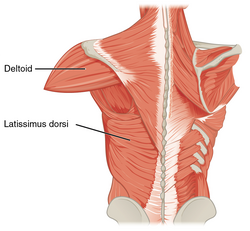
The latissimus dorsi (/ləˈtɪsɪməs ˈdɔːrsaɪ/) is a large, flat muscle on the back that stretches to the sides, behind the arm, and is partly covered by the trapezius on the back near the midline.
The word latissimus dorsi (plural: latissimi dorsi) comes from Latin and means "broadest [muscle] of the back", from "latissimus" (Latin: broadest) and "dorsum" (Latin: back). The pair of muscles are commonly known as "lats", especially among bodybuilders.
The latissimus dorsi is responsible for extension, adduction, transverse extension also known as horizontal abduction (or horizontal extension), flexion from an extended position, and (medial) internal rotation of the shoulder joint. It also has a synergistic role in extension and lateral flexion of the lumbar spine.
Due to bypassing the scapulothoracic joints and attaching directly to the spine, the actions the latissimi dorsi have on moving the arms can also influence the movement of the scapulae, such as their downward rotation during a pull up.
The number of dorsal vertebrae, to which it is attached, varies from four to eight; the number of costal attachments varies; muscle fibers may or may not reach the crest of the ilium.
A muscle slip, the axillary arch, varying from 7 to 10 cm in length, and from 5 to 15 mm in breadth, occasionally springs from the upper edge of the latissimus dorsi about the middle of the posterior fold of the axilla, and crosses the axilla in front of the axillary vessels and nerves, to join the under surface of the tendon of the pectoralis major, the coracobrachialis, or the fascia over the biceps brachii. This axillary arch crosses the axillary artery, just above the spot usually selected for the application of a ligature, and may mislead a surgeon. It is present in about 7% of the population and may be easily recognized by the transverse direction of its fibers. Guy et al. extensively described this muscular variant using MRI data and positively correlated its presence with symptoms of neurological impingement.
A fibrous slip usually passes from the upper border of the tendon of the Latissimus dorsi, near its insertion, to the long head of the triceps brachii. This is occasionally muscular, and is the representative of the dorsoepitrochlearis brachii of apes. This muscular form is found in ~5% of humans and is sometimes termed the latissimocondyloideus.
The latissimus dorsi crosses the inferior angle of the scapula. A study found that, of 100 cadavers dissected:
Latissimus dorsi muscle
The latissimus dorsi (/ləˈtɪsɪməs ˈdɔːrsaɪ/) is a large, flat muscle on the back that stretches to the sides, behind the arm, and is partly covered by the trapezius on the back near the midline.
The word latissimus dorsi (plural: latissimi dorsi) comes from Latin and means "broadest [muscle] of the back", from "latissimus" (Latin: broadest) and "dorsum" (Latin: back). The pair of muscles are commonly known as "lats", especially among bodybuilders.
The latissimus dorsi is responsible for extension, adduction, transverse extension also known as horizontal abduction (or horizontal extension), flexion from an extended position, and (medial) internal rotation of the shoulder joint. It also has a synergistic role in extension and lateral flexion of the lumbar spine.
Due to bypassing the scapulothoracic joints and attaching directly to the spine, the actions the latissimi dorsi have on moving the arms can also influence the movement of the scapulae, such as their downward rotation during a pull up.
The number of dorsal vertebrae, to which it is attached, varies from four to eight; the number of costal attachments varies; muscle fibers may or may not reach the crest of the ilium.
A muscle slip, the axillary arch, varying from 7 to 10 cm in length, and from 5 to 15 mm in breadth, occasionally springs from the upper edge of the latissimus dorsi about the middle of the posterior fold of the axilla, and crosses the axilla in front of the axillary vessels and nerves, to join the under surface of the tendon of the pectoralis major, the coracobrachialis, or the fascia over the biceps brachii. This axillary arch crosses the axillary artery, just above the spot usually selected for the application of a ligature, and may mislead a surgeon. It is present in about 7% of the population and may be easily recognized by the transverse direction of its fibers. Guy et al. extensively described this muscular variant using MRI data and positively correlated its presence with symptoms of neurological impingement.
A fibrous slip usually passes from the upper border of the tendon of the Latissimus dorsi, near its insertion, to the long head of the triceps brachii. This is occasionally muscular, and is the representative of the dorsoepitrochlearis brachii of apes. This muscular form is found in ~5% of humans and is sometimes termed the latissimocondyloideus.
The latissimus dorsi crosses the inferior angle of the scapula. A study found that, of 100 cadavers dissected:
Recent media
Recent media