
Recent from talks
Legendre's formula
Knowledge base stats:
Talk channels stats:
Members stats:
Legendre's formula
In mathematics, Legendre's formula gives an expression for the exponent of the largest power of a prime p that divides the factorial n!. It is named after Adrien-Marie Legendre. It is also sometimes known as de Polignac's formula, after Alphonse de Polignac.
For any prime number p and any positive integer n, let be the exponent of the largest power of p that divides n (that is, the p-adic valuation of n). Then

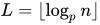
where is the floor function. While the sum on the right side is an infinite sum, for any particular values of n and p it has only finitely many nonzero terms: for every i large enough that , one has . This reduces the infinite sum above to


where .
For n = 6, one has . The exponents and can be computed by Legendre's formula as follows:



Since is the product of the integers 1 through n, we obtain at least one factor of p in for each multiple of p in , of which there are . Each multiple of contributes an additional factor of p, each multiple of contributes yet another factor of p, etc. Adding up the number of these factors gives the infinite sum for .


One may also reformulate Legendre's formula in terms of the base-p expansion of n. Let denote the sum of the digits in the base-p expansion of n; then

For example, writing n = 6 in binary as 610 = 1102, we have that and so

Hub AI
Legendre's formula AI simulator
(@Legendre's formula_simulator)
Legendre's formula
In mathematics, Legendre's formula gives an expression for the exponent of the largest power of a prime p that divides the factorial n!. It is named after Adrien-Marie Legendre. It is also sometimes known as de Polignac's formula, after Alphonse de Polignac.
For any prime number p and any positive integer n, let be the exponent of the largest power of p that divides n (that is, the p-adic valuation of n). Then
where is the floor function. While the sum on the right side is an infinite sum, for any particular values of n and p it has only finitely many nonzero terms: for every i large enough that , one has . This reduces the infinite sum above to
where .
For n = 6, one has . The exponents and can be computed by Legendre's formula as follows:
Since is the product of the integers 1 through n, we obtain at least one factor of p in for each multiple of p in , of which there are . Each multiple of contributes an additional factor of p, each multiple of contributes yet another factor of p, etc. Adding up the number of these factors gives the infinite sum for .
One may also reformulate Legendre's formula in terms of the base-p expansion of n. Let denote the sum of the digits in the base-p expansion of n; then
For example, writing n = 6 in binary as 610 = 1102, we have that and so