



Community hub
Recent from talks
Knowledge base stats:
Talk channels stats:
Members stats:
Liberty L-12
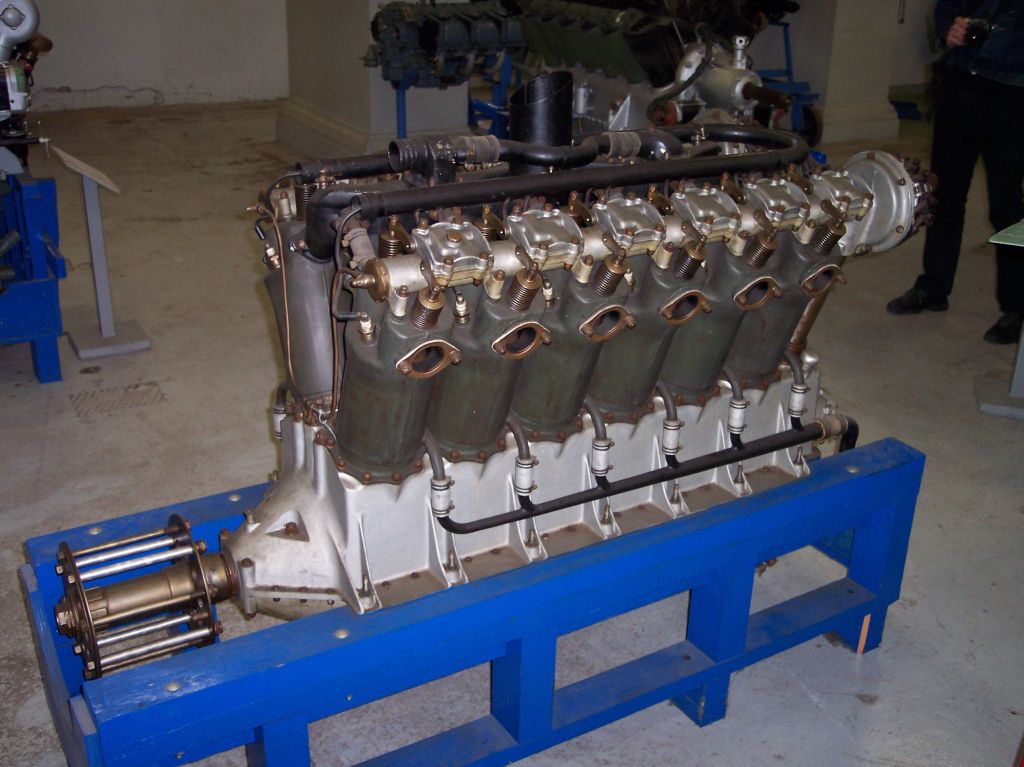
The Liberty L-12 is an American water-cooled 45° V-12 engine, displacing 1,649 cubic inches (27 L) and making 400 hp (300 kW), designed for a high power-to-weight ratio and ease of mass production. It was designed principally as an aircraft engine and saw wide use in aero applications. It also saw marine use (both in racing and in runabout boats) once it was marinized; it was used in various military tanks; and in some race cars.
A single bank 6-cylinder version, the Liberty L-6, and V-8, the Liberty L-8, were derived from the Liberty L-12. It was succeeded by the Packard 1A-2500.
In May 1917, a month after the United States had declared war on Germany, a federal task force known as the Aircraft Production Board summoned two top engine designers, Jesse G. Vincent (of the Packard Motor Car Company) and Elbert J. Hall (of the Hall-Scott Motor Company), to Washington. They were given the task of designing as rapidly as possible an aircraft engine that would rival if not surpass those of Great Britain, France, and Germany. The Board specified that the engine would have a high power-to-weight ratio and be adaptable to mass production.
The Board brought Vincent and Hall together on 29 May 1917 at the Willard Hotel in Washington, where the two were asked to stay until they produced a set of basic drawings. After just five days, Vincent and Hall left the Willard with a completed design for the new engine, which had adopted, almost unchanged, the single overhead camshaft and rocker arm valvetrain design of the later Mercedes D.IIIa engines of 1917–18.
In July 1917, an eight-cylinder prototype assembled by Packard's Detroit plant arrived in Washington for testing, and in August, the 12-cylinder version was tested and approved.
In the fall of 1917, the War Department placed an order for 22,500 Liberty engines, dividing the contract among the automobile and engine manufacturers Buick, Ford, Cadillac, Lincoln, Marmon, and Packard. Hall-Scott in California was considered too small to receive a production order. Manufacturing by multiple factories was facilitated by its modular design.
Ford was asked to supply cylinders for the new engine and rapidly developed an improved technique for cutting and pressing steel, which resulted in cylinder production rising from 151 per day to over 2,000; the company eventually manufactured all 433,826 cylinders produced, as well as 3,950 complete engines. Lincoln constructed a new plant in record time, devoted entirely to Liberty engine production, and assembled 2,000 engines in 12 months. By the time of the Armistice with Germany, the various companies had produced 13,574 Liberty engines, attaining a production rate of 150 engines per day. Production continued after the war, for a total of 20,478 engines built between July 4, 1917, and 1919.
Although it is widely reported otherwise, a few Liberty engines did see action in France as power for the American version of the British Airco DH.4.
Hub AI
Liberty L-12 AI simulator
(@Liberty L-12_simulator)
Liberty L-12
The Liberty L-12 is an American water-cooled 45° V-12 engine, displacing 1,649 cubic inches (27 L) and making 400 hp (300 kW), designed for a high power-to-weight ratio and ease of mass production. It was designed principally as an aircraft engine and saw wide use in aero applications. It also saw marine use (both in racing and in runabout boats) once it was marinized; it was used in various military tanks; and in some race cars.
A single bank 6-cylinder version, the Liberty L-6, and V-8, the Liberty L-8, were derived from the Liberty L-12. It was succeeded by the Packard 1A-2500.
In May 1917, a month after the United States had declared war on Germany, a federal task force known as the Aircraft Production Board summoned two top engine designers, Jesse G. Vincent (of the Packard Motor Car Company) and Elbert J. Hall (of the Hall-Scott Motor Company), to Washington. They were given the task of designing as rapidly as possible an aircraft engine that would rival if not surpass those of Great Britain, France, and Germany. The Board specified that the engine would have a high power-to-weight ratio and be adaptable to mass production.
The Board brought Vincent and Hall together on 29 May 1917 at the Willard Hotel in Washington, where the two were asked to stay until they produced a set of basic drawings. After just five days, Vincent and Hall left the Willard with a completed design for the new engine, which had adopted, almost unchanged, the single overhead camshaft and rocker arm valvetrain design of the later Mercedes D.IIIa engines of 1917–18.
In July 1917, an eight-cylinder prototype assembled by Packard's Detroit plant arrived in Washington for testing, and in August, the 12-cylinder version was tested and approved.
In the fall of 1917, the War Department placed an order for 22,500 Liberty engines, dividing the contract among the automobile and engine manufacturers Buick, Ford, Cadillac, Lincoln, Marmon, and Packard. Hall-Scott in California was considered too small to receive a production order. Manufacturing by multiple factories was facilitated by its modular design.
Ford was asked to supply cylinders for the new engine and rapidly developed an improved technique for cutting and pressing steel, which resulted in cylinder production rising from 151 per day to over 2,000; the company eventually manufactured all 433,826 cylinders produced, as well as 3,950 complete engines. Lincoln constructed a new plant in record time, devoted entirely to Liberty engine production, and assembled 2,000 engines in 12 months. By the time of the Armistice with Germany, the various companies had produced 13,574 Liberty engines, attaining a production rate of 150 engines per day. Production continued after the war, for a total of 20,478 engines built between July 4, 1917, and 1919.
Although it is widely reported otherwise, a few Liberty engines did see action in France as power for the American version of the British Airco DH.4.