



Community hub
Recent from talks
Contribute something to knowledge base
Content stats: 0 posts, 0 articles, 1 media, 0 notes
Members stats: 0 subscribers, 0 contributors, 0 moderators, 0 supporters
Subscribers
Supporters
Contributors
Moderators
Hub AI
Limbourg brothers AI simulator
(@Limbourg brothers_simulator)
Hub AI
Limbourg brothers AI simulator
(@Limbourg brothers_simulator)
Limbourg brothers
The Limbourg brothers (Dutch: Gebroeders van Limburg or Gebroeders Van Lymborch; fl. 1385–1416) were Dutch miniature painters (Herman, Paul, and Jean) from the city of Nijmegen. They were active in the early 15th century in France and Burgundy, working in the International Gothic style.
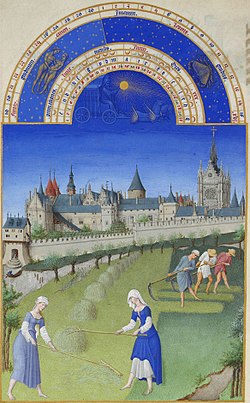
They painted the miniatures and decorated page margins for the best-known late medieval illuminated manuscripts, the Très Riches Heures du Duc de Berry, the Belles Heures of Jean de France, Duc de Berry, in both of which their work survives largely complete although, like many grand manuscript projects, the Très Riches Heures was not finished.
A Johannes de Lymborgh appears in mid-14th century archives. He may have come from Limbourg on the Meuse to Nijmegen, then the capital of the duchy of Guelders, and appears to be the father of Arnold de Limbourch, a wood carver and sculptor whose name also appears in medieval archives. In 1385 Arnold married Mechteld Maelwael or Maloeul. She came from a family of craftsmen and painters. Her father and uncle were painters in the employ of the Duke of Guelders, as gilders and as painters of heraldic devices. It was as a heraldic painter that Mechteld's brother Jean Malouel received a commission in Paris by Isabeau of Bavaria in 1396, regent to her husband Charles VI of France. Within the year Maloul accepted the position as valet de chambre and court painter to Charles's uncle Philip the Bold, the Duke of Burgundy.
Arnold and Mechteld had six children over the next decade: the three boys, Herman, Paul, and Jean were born between c. 1385 and c. 1388; two more boys in the early 1390s and a daughter in the mid-1390s. In the late 1390s (probably around 1398) Herman and Jean were sent to Paris, where records from 1399 document them as apprentices to a Parisian goldsmith, a position possibly organized by their uncle. That year the goldsmith sent the boys home to Guelders during an outbreak of disease in Paris. They were captured and imprisoned in Brussels, probably because of a conflict between Brabant and Guelders, with their ransom set at 55 écus plus prison expenses. The boys' father had died that year leaving their mother destitute, unable to secure their release. Local guild members in Brussels tried to raise the funds, but six months passed, the boys were still in captivity, when Philip the Bold paid the ransom in May of 1400.
In February 1402 Paul and Jean were contracted by Philip to work for four years exclusively on illuminating a bible (a très belle et notable Bible). It is their first documented commission and the work seems to have been executed in Paris. Art historians are divided as to whether the Bible Moralisée (Ms. fr. 166 in the Bibliothèque nationale de France in Paris) is the same manuscript as Philip's commission; although there is consensus that Jean and Paul Limbourg executed the manuscript.
A bible moralisée is a type of condensed and heavily illustrated bible that emerged in the 13th century. It followed a specific format in which bible passages were paired with commentary or moralizations and an image, with each page containing four pairs of images meant to dominate the page. Typically such a bible contained more than 5000 painted miniatures; the cost and labor involved in such a production was so great that only royalty commissioned them. Manuscript 166 in Paris is an almost verbatim copy of the bible moralisée commissioned by Philip's father John II of France, known as Ms. fr. 167, which contains 5122 miniatures.
The contract Philip executed with the brothers was quite specific: they were to provide miniatures (ystoires) as quickly as possible irrespective of holidays, to be paid a daily rate of 6 sous. Philip's physician, Jean Durant, was to supervise the effort, for which he received 600 francs and periodic repayments for lapis lazuli used to produce Illuminated manuscripts. In 1404 the brothers are referred to as peintres et historieurs, whereas they were earlier referred to as painters (peintres) and illuminators (enlumineurs). They almost certainly painted the miniatures as well as the borders. They completed folios 1-24 and the underdrawings to folio 32.
The recorded documentation regarding specific commissions ends with Philip's death in April 1404.
Limbourg brothers
The Limbourg brothers (Dutch: Gebroeders van Limburg or Gebroeders Van Lymborch; fl. 1385–1416) were Dutch miniature painters (Herman, Paul, and Jean) from the city of Nijmegen. They were active in the early 15th century in France and Burgundy, working in the International Gothic style.
They painted the miniatures and decorated page margins for the best-known late medieval illuminated manuscripts, the Très Riches Heures du Duc de Berry, the Belles Heures of Jean de France, Duc de Berry, in both of which their work survives largely complete although, like many grand manuscript projects, the Très Riches Heures was not finished.
A Johannes de Lymborgh appears in mid-14th century archives. He may have come from Limbourg on the Meuse to Nijmegen, then the capital of the duchy of Guelders, and appears to be the father of Arnold de Limbourch, a wood carver and sculptor whose name also appears in medieval archives. In 1385 Arnold married Mechteld Maelwael or Maloeul. She came from a family of craftsmen and painters. Her father and uncle were painters in the employ of the Duke of Guelders, as gilders and as painters of heraldic devices. It was as a heraldic painter that Mechteld's brother Jean Malouel received a commission in Paris by Isabeau of Bavaria in 1396, regent to her husband Charles VI of France. Within the year Maloul accepted the position as valet de chambre and court painter to Charles's uncle Philip the Bold, the Duke of Burgundy.
Arnold and Mechteld had six children over the next decade: the three boys, Herman, Paul, and Jean were born between c. 1385 and c. 1388; two more boys in the early 1390s and a daughter in the mid-1390s. In the late 1390s (probably around 1398) Herman and Jean were sent to Paris, where records from 1399 document them as apprentices to a Parisian goldsmith, a position possibly organized by their uncle. That year the goldsmith sent the boys home to Guelders during an outbreak of disease in Paris. They were captured and imprisoned in Brussels, probably because of a conflict between Brabant and Guelders, with their ransom set at 55 écus plus prison expenses. The boys' father had died that year leaving their mother destitute, unable to secure their release. Local guild members in Brussels tried to raise the funds, but six months passed, the boys were still in captivity, when Philip the Bold paid the ransom in May of 1400.
In February 1402 Paul and Jean were contracted by Philip to work for four years exclusively on illuminating a bible (a très belle et notable Bible). It is their first documented commission and the work seems to have been executed in Paris. Art historians are divided as to whether the Bible Moralisée (Ms. fr. 166 in the Bibliothèque nationale de France in Paris) is the same manuscript as Philip's commission; although there is consensus that Jean and Paul Limbourg executed the manuscript.
A bible moralisée is a type of condensed and heavily illustrated bible that emerged in the 13th century. It followed a specific format in which bible passages were paired with commentary or moralizations and an image, with each page containing four pairs of images meant to dominate the page. Typically such a bible contained more than 5000 painted miniatures; the cost and labor involved in such a production was so great that only royalty commissioned them. Manuscript 166 in Paris is an almost verbatim copy of the bible moralisée commissioned by Philip's father John II of France, known as Ms. fr. 167, which contains 5122 miniatures.
The contract Philip executed with the brothers was quite specific: they were to provide miniatures (ystoires) as quickly as possible irrespective of holidays, to be paid a daily rate of 6 sous. Philip's physician, Jean Durant, was to supervise the effort, for which he received 600 francs and periodic repayments for lapis lazuli used to produce Illuminated manuscripts. In 1404 the brothers are referred to as peintres et historieurs, whereas they were earlier referred to as painters (peintres) and illuminators (enlumineurs). They almost certainly painted the miniatures as well as the borders. They completed folios 1-24 and the underdrawings to folio 32.
The recorded documentation regarding specific commissions ends with Philip's death in April 1404.
Recent media
Recent media